
 Need help?
Do you have a question about the Panasonic TC-21FG20R and is the answer not in the manual?
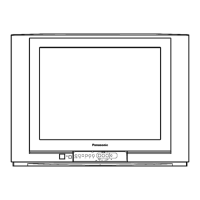
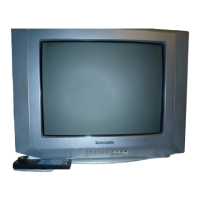
This document outlines the service and maintenance procedures for the Panasonic TC-21FG20R Colour Television, which operates on the GP31 Chassis. It is intended for experienced repair technicians and emphasizes safety precautions due to the high voltage present within the device.
The TC-21FG20R is a colour television designed for home entertainment, capable of receiving various broadcast systems including PAL B, PAL/SECAM D, NTSC M, PAL/SECAM B, G, PAL G, and NTSC M. It supports a wide range of channels across VHF, UHF, and CATV bands, making it adaptable to different regional broadcasting standards. The television features multiple video and audio input/output terminals, including AV1 and AV2, allowing for connection to external devices such as DVD players, VCRs, or gaming consoles. A monitor out function is also available for connecting to other display or recording equipment. The device is designed to operate on an AC AUTO 110-240V, 50/60 Hz power supply, ensuring broad compatibility across different electrical grids.
Key usage features include its ability to display colour television broadcasts with a 90° deflection picture tube, providing a standard viewing experience. The television's design incorporates a user-friendly interface for basic operations, although specific details on user controls are not extensively covered in this service manual, which focuses on technical adjustments. The presence of multiple receiving systems and channels indicates its versatility in different broadcast environments.
Maintenance features are a significant focus of this manual, providing detailed instructions for technicians. The document begins with crucial safety precautions, highlighting the presence of high voltage (up to 29.0kV) and the necessity of using an isolation transformer during servicing. It outlines procedures for leakage current checks, both cold and hot, to ensure the device remains safe after repair. These checks involve measuring resistance and current between the AC plug and exposed metallic parts of the cabinet, with specified limits to prevent shock hazards.
X-Radiation precautions are also detailed, emphasizing the importance of using an accurate, calibrated high voltage meter and ensuring that any test jigs can handle the specified voltage without causing X-Radiation. Technicians are instructed to measure the EHT (Extra High Tension) and adjust brightness to minimum during this process. The manual stresses the use of specified picture tubes for replacement to prevent X-Radiation.
The service hints section provides practical guidance for technicians, including how to position the E-Board for service and how to access the "Factory Mode" for adjustments. The Factory Mode is a critical maintenance feature, allowing technicians to perform precise adjustments that are not available to the end-user. This mode is accessed through a specific sequence of remote control and TV button presses, leading to various "CHK" modes (CHK1, CHK2, CHK3, CHK4) for different adjustment categories.
Detailed adjustment procedures are provided for various aspects of the television's performance. White balance adjustment involves receiving a white balance pattern, setting the picture menu to "DYNAMIC NORMAL," degaussing the CRT face, and using a CRT colour analyzer. Both low light and high light adjustments are covered, requiring precise manipulation of "Sub Bright," "R-CUT OFF," "G-CUT OFF," "R-Drive," and "B-Drive" settings to achieve specified nit values and colour coordinates.
CRT CUT OFF adjustment is another critical maintenance procedure, involving connecting an oscilloscope to a test point (TPL5), setting the screen VR to minimum, and adjusting "Sub Bright" and "Bright" in factory mode to display a vertical line. The "Screen VR" is then adjusted until a 1-H Line appears, ensuring proper cut-off levels.
Further adjustments include +B Voltage, RF AGC (Automatic Gain Control), and High Voltage. The +B Voltage adjustment involves confirming DC voltages at specific test points (TPA 10, TPA 8, TPA 9, TPA 21). RF AGC adjustment requires receiving a colour bar signal at a specified RF level, connecting a digital multimeter to the RF AGC at the Tuner, and adjusting the "RF AGC" setting in CHK2 mode until a specific voltage is reached. High Voltage adjustment involves receiving a crosshatch pattern, setting to 0 Beam, and confirming voltage readings at the heater and +B voltage test points.
NTSC TINT COLOUR adjustment is also covered, requiring an oscilloscope connected to TPL1 (R OUT) and setting the system to AV-NTSC. Technicians adjust "Sub-Tint" to achieve a level waveform and confirm phase changes and maximum colour level.
For PAL Colour, the manual describes adjusting local frequency, confirming contrast and colour settings, and setting specific voltage levels using BRT (Brightness) in CHK2 mode. Contrast and "Sub Colour" adjustments are also detailed to achieve desired waveform characteristics.
Colour Purity and Convergence adjustments are extensive, requiring the TV to be operated for 60 minutes, degaussing the picture tube, and applying a crosshatch pattern. Technicians adjust static convergence magnets, purity magnetic rings, and the deflection yoke to achieve uniform green fields and good overall convergence. Specific instructions are given for sliding magnetic tabs, rotating rings, and inserting wedges to optimize the picture.
Finally, the adjustment of CRT VRS (Vertical Rate System) involves setting the DY (Deflection Yoke) and CY (Convergence Yoke) to specific positions and adjusting magnets to center the crosshatch pattern on the CRT.
The manual also includes block diagrams, schematic diagrams, parts locations, and a comprehensive replacement parts list, all crucial for effective troubleshooting and repair. Components identified with a "!" mark are highlighted as having special safety characteristics, requiring the use of manufacturer-specified parts for replacement. This detailed approach ensures that technicians can safely and effectively maintain and repair the Panasonic TC-21FG20R television.
 General
| Screen Size | 21 inches |
|---|---|
| Display Type | CRT |
| Aspect Ratio | 4:3 |
| Tuner | NTSC |
| Inputs | Composite |


 To Next Page