Refrigerating Specialties Division
5
Maintenance and Service (continued)
Electrical
The Refrigerating Specialties Division molded water resistance Class “B”
solenoid coil is designed for long life and powerful opening force. The
standard coil housing meets NEMA 3R and 4 requirements. This sealed
construction can withstand direct contact with moisture and ice. The coil
housing far exceeds the requirements of NEMA Standard ICS, 1-110.57 salt
spray test for rust resistance.
By definition, Class “B” coil construction will permit coil temperatures
as measured by resistance method, as high as 130°C (266°F). Final coil
temperatures are a function of both fluid and ambient temperatures. The
higher fluid temperatures require lower ambient temperatures so the
maximum coil temperature is not exceeded. Conversely, low fluid tem-
peratures permit higher ambient temperatures.
The molded Class “B” coil is available from stock with most standard
voltages. However, coils are available for other voltages and frequencies,
as well as for direct current. Coils are also available as transformer type
with a 6 volt secondary winding for use with the Refrigerating Specialties
Division Pilot Light Assembly (see current copy of Bulletin 60-10, “Pilot
Light Assembly and Solenoid Transformer Coil”). The solenoid coil must
be connected to electrical lines with volts and Hertz same as stamped on
coil. The supply circuits must be properly sized to give adequate voltage
at the coil leads even when other electrical equipment is operating. The
coil is designed to operate with line voltage from 85% to 110% of rated
coil voltage. Operating with a line voltage above or below these limits may
result in coil burnout. Also, operating with line voltage below the limit will
definitely result in lowering the valve opening pressure differential. Power
consumption during normal operation will be 33 Watts or less.
Inrush and running current is listed below:
Inrush Running Fuse
Standard Coil Current Current Size
Volts/Hertz (Amps) (Amps) (Amps)
120/60 (Blue leads) 1.86 0.46 1
208/60 (Blue & Red leads) 0.63 0.26 1
240/60 (Red leads) 0.60 0.23 1
440/60 (Yellow & Red leads) 0.39 0.13 1
115/50 (Yellow & Blue leads) 1.22 0.21 1
230/50 (Yellow leads) 0.65 0.26 1
Other (Contact Factory)
On transformer coil the 6 volt leads are always black.
SERVICE POINTERS (Check General Procedure)
SYMPTOM PROBABLE REASON CORRECTION
Regulator does not
shut off flow. Diaphragm or seat dirty, damaged or frozen. Clean or replace. Clean strainer.
Diaphragm follower stuck or damaged. Clean or replace. Install follower carefully.
Piston jammed with excess dirt. Remove and polish piston and bore with crocus cloth. Clean valve and strainer.
Modulating plug leaking due to excess dirt Clean or replace. If used on liquid, check for erosion due to excessive
or damage. flash gas. Reduce flash gas by subcooling or by reducing pressure
drop across valve by providing restriction at valve outlet.
Diaphragm ruptured or badly deformed. Replace. If Range “D” make sure has 2 diaphragms.
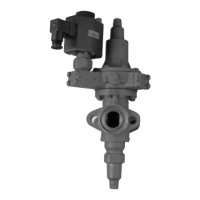
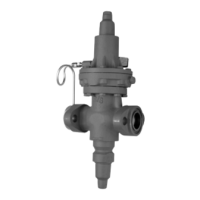
A4AOS/A4AOSE Modular Solenoid Pilot
Seat leaking. Check seat and needle. Replace as needed.
Diaphragm and seat eroded due to flash gas. Replace. Reduce flash gas by subcooling or by reducing pressure
drop across regulator by providing restriction at valve outlet.
Modular Solenoid Pilot not closing. Check power at leads, make sure coil is de-energized.
Regulator does not Pressure Regulator Diaphragm Replace. If Range D make sure has 2
open. ruptured or badly deformed. diaphragms.
Diaphragm follower stuck, damaged Clean or replace.
or frozen. Install follower carefully.
A4AOS/A4AOSE Modular Solenoid Pressure drop across valve too high; over 21 bar (300 psig). Lower
Pilot not opening. pressure drop. Improper power supply. Correct. Replace solenoid coil.
Piston worn, too much clearance. Replace piston. Check for reason. If used on liquid, check for flash gas.
Piston jammed with excess dirt. Remove and polish piston and bore with crocus cloth.
Clean valve and strainer.
Regulator Operation Diaphragm or seat dirty
erratic. or damaged. Clean or replace. Clean strainer.
Diaphragm follower has dirt on the outside
diameter or outside diameter is damaged. Clean or replace.
Other system components, line controllers,
thermostats, etc., erratic. Adjust, repair or replace.
Regulator too far oversized. Check load. Replace with smaller regulator or investigate use of
reduced capacity plug.
Pressure drop across Inlet or outlet restricted. Check for restriction.
regulator too high. Clean strainer.
Regulator too small. Open manually to be sure valve is full open.
Replace with proper size regulator.
Large amount of flash gas in liquid line. Reduce flash gas by subcooling. Reduce line restriction by increasing line
size, particularly at the regulator outlet. Replace with larger regulator.
High pressure drop causes high rate of
expansion gas at regulator outlet. Increase pipe size at the outlet of the regulator.
Regulator does not open all the way. Check piston for wear. Replace, if needed.




 To Next Page