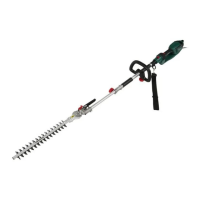
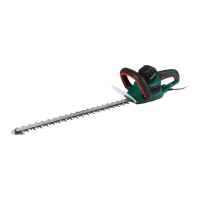
GB MT
35
3. The safety lock (14) must engage
again before you can use the appli-
ance safely.
Cutting Techniques
• Cut thick branches beforehand using a
branch clippers.
• The double-sided cutter bar enables cut-
ting in both directions or, with a swing-
ing action, from one side to the other.
• In case of vertical cutting, move the
hedge trimmer uniformly forward or up
and down in an arc movement.
• In case of horizontal cutting, move
the hedge trimmer in a sickle-shaped
movement to the edge of the hedge, so
that cut branches fall to the ground.
• In order to achieve long straight lines,
the placing of tensioned guiding cords
is recommended.
Application examples:
Please observe the illustrations on
the back fold-out page for applicati-
on examples.
vertical cutting
vertical cutting with pivoted safety
cutter bar
horizontal cutting overhead
horizontal cutting at ground level
horizontal cutting at waist level
Cutting Shaped Hedges:
It is recommended that hedges be cut in
a trapezoidal shape, in order to prevent
stripping off of the lower branches. This cor-
responds to the natural plant growth and
allows the hedge to thrive optimally. During
cutting, only the new annual growths are
reduced and thus a dense branching and a
good screen will develop.
1. Cut the sides of a hedge rst. To do
this, move the hedge trimmer in the
direction of growth from bottom to top.
If you cut down from the top, the thin-
ner branches will move out, which may
result in some areas having sparse
growth or holes.
2. Cut the top edge, according to taste, in a
at shape, roof shape or rounded shape
3. Trim young plants to the required
shape. The main growth should re-
main undamaged until the hedge has
reached the planned height. All other
shoots are lopped off to half size.
Care of Free-Growing Hedges:
Free-growing hedges are not shaped
when cut, although they must be regularly
maintained so the hedge does not become
too high.
Working Safely
• Before using the hedge trimmer, ensure
that the locking mechanisms (e.g. safety
slides of the extension arm) of all mov-
ing parts are in the locking position.
• Do not use the high pruning saw when
standing on a ladder or in an unsafe
position.
• Do not be tempted to make unconsid-
ered cuts. Doing so may endanger
both yourself and others.
• Children must be supervised to ensure
that they do not play with the equipment.
• Long use of the equipment can result in
vibration-related circulatory disorders
in the hands. However, the length of
use can be extended by using suitable
gloves or taking regular breaks. Note


 To Next Page
 Loading...