English – 7
SAFETY INSTRUCTIONS
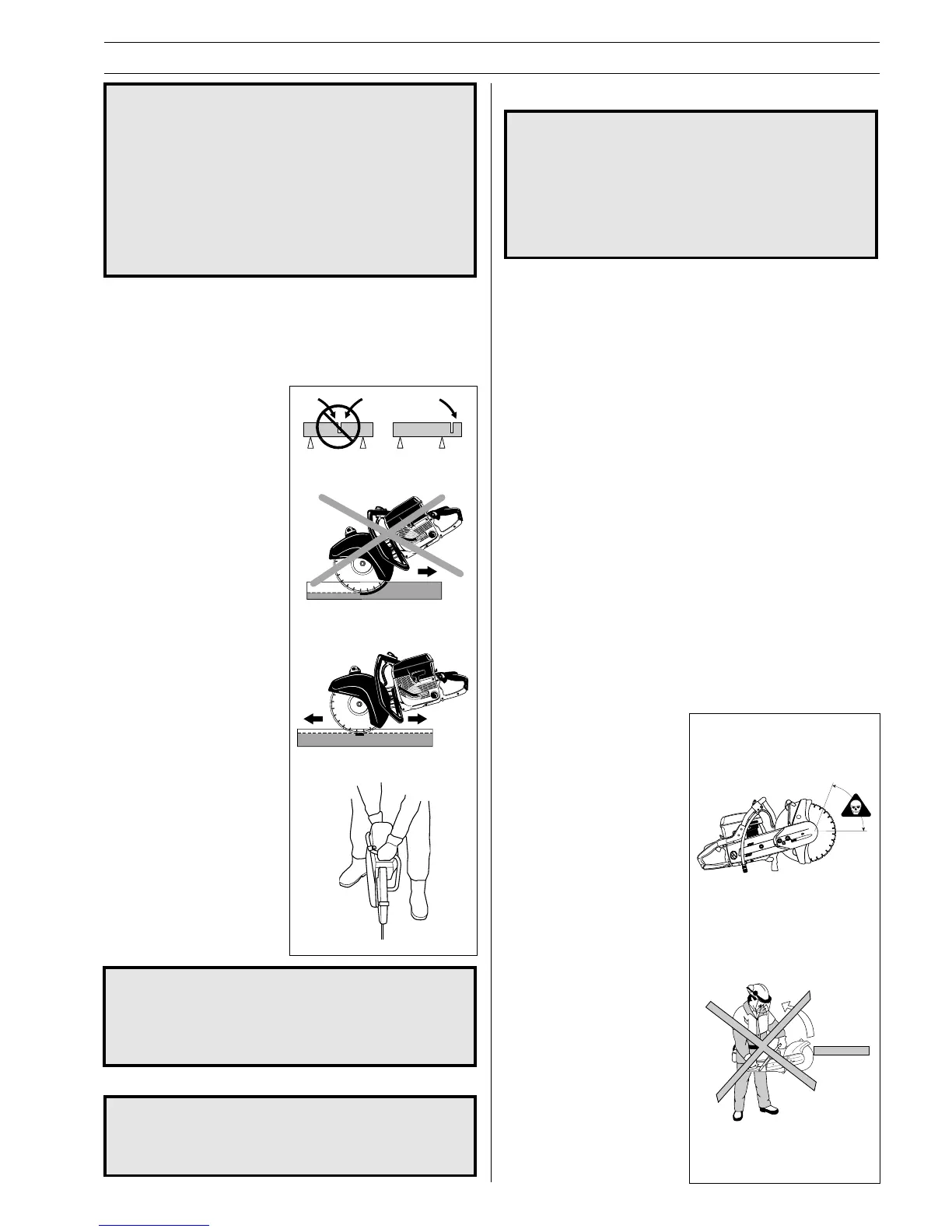
Cutting technique
The technique described below is of a general character. Check
information for each blade regarding individual cutting characte-
ristics (for example, a diamond blade requires less feeding
pressure than an abrasive disc).
1.Support the work piece in
such away that you can
predict what will happen
and so it will not pinch.
2.Always cut at full throttle.
3.Start cutting gently, do
not force or squeeze the
blade in.
4.Use a high blade speed.
5.Move the blade slowly
backwards and forwards.
6.Use a small part of the
blade’s cutting edge.
7.Only use the blade’s
cutting edge when
cutting.
8.Cut with the blade fully
vertical – at right angles
to the work piece.
!
Over exposure to vibrations can result in
blood-vessel or nerve injury to persons
suffering with blood circulation problems.
Seek medical attention if you experience
physical symptoms that can be related to over
exposure to vibrations. Examples of such
symptoms are numbness, lack of feeling,
“tickling“, “pricking“, pain lack of or a
reduction in normal strength, changes in the
colour of the skin or its surfaces. These
symptoms normally appear in the fingers,
hands or wrists.
!
WARNING!
Under all circumstances avoid cutting using
the side of the blade; it will almost certainly
be damaged, break and can cause immense
damage. Only use the cutting section.
!
WARNING!
Do not pull the power cutter to one side, this
can cause the blade to jam or break resulting
in injury to people.
Sharpening diamond blades
Diamond blades can become dull when the wrong feeding
pressure is used or when cutting certain materials such as
heavily reinforced concrete. Working with a dull blade causes
overheating and finally the loss of a segment (part of a cutting
blade).
Sharpen against a soft material such as sandstone or brick.
Blade vibration
The blade can become out of shape (not round) and vibrate if a
too high feeding pressure is used or if the blade is pressed into
the work piece.
A lower feeding pressure ought to stop the vibration. Otherwise
replace the cutting blade.
Kickback
Kickback can occur very suddenly and with great force. If the
following directives are not followed, it can result in serious or
even fatal injury.
If the sector of the blade illustrated below is used for cutting the
blade can start to climb causing the power cutter to kickback
upwards and backwards towards the user with immense force.
How to avoid kickback
1.Never cut with the
segment illustrated in the
diagram.
2.Keep a good balance and
a firm foothold.
3.Use both hands and take
a firm grip with the thumb
and fingers around the
handle.
4.Stand at a comfortable
distance from the work
piece.
5. Run the power cutter at
full throttle.
6.Take care when inserting
the blade in an existing
cut.
7. Never cut above shoulder
height.
8.Be alert to movement of
the work piece or anything
else that can occur, which
could cause the cut to
close and pinch the blade.
Water cooling
!
WARNING!
Water cooling, which is only used on petrol
driven power cutters and when cutting
concrete, cools the blade and increases its
service life as well as reducing dust (see the
section Abrasive discs). Among the disadv-
antages are difficulties at very low temperatu-
res, the risk of damaging the floor and other
sections of the building and risk for slippage.



 To Next Page