www.parweld.com
5
WELDING can cause re or explosion.
Remove all ammables within 10m of the welding arc. If this is not
possible, tightly cover them with approved covers.
Do not weld where ying sparks can strike ammable material.
Protect yourself and others from ying sparks and hot metal.
Be alert that welding sparks and hot materials from welding can
easily go through small cracks and openings to adjacent areas.
Watch for re, and keep a re extinguisher nearby. Be aware that
welding on a ceiling, oor, bulkhead, or partition can cause re on
the hidden side.
Do not weld on closed containers such as tanks, drums, or pipes,
unless they are properly prepared according to local regulations
Connect work cable to the work as close to the welding area as
practical to prevent welding current from travelling along, possibly
unknown paths and causing electric shock, sparks, and re hazards.
Cut o welding wire at contact tip when not in use.
Wear oil-free protective garments such as leather gloves, heavy
shirt, cuess trousers, high shoes, and a cap. Remove any
combustibles, such as a butane lighter or matches, from your person
before doing any welding.
FLYING METAL can injure eyes.
Welding, chipping, wire brushing, and grinding cause sparks and
ying metal. As welds cool they can throw o slag. Wear approved
safety glasses with side shields even under your welding helmet.
BUILDUP OF GAS can injure or kill.
Shut o shielding gas supply when not in use. Always ventilate
conned spaces or use approved air-supplied respirator.
HOT PARTS can cause severe burns.
Do not touch hot parts with bare handed.
Allow cooling period before working on gun or torch.
To handle hot parts, use proper tools and/or wear heavy, insulated
welding gloves and clothing to prevent burns.
MAGNETIC FIELDS can aect pacemakers.
Pacemaker wearers keep away.
Wearers should consult their doctor before going near arc welding,
gouging, or spot welding operations.
NOISE can damage hearing.
Noise from some processes or equipment can damage hearing.
Wear approved ear protection if noise level is high.
Shielding gas cylinders contain gas under high pressure.
CYLINDERS can explode if damaged.
Protect compressed gas cylinders from excessive heat, mechanical
shocks, physical damage, slag, open ames, sparks, and arcs. Install
cylinders in an upright position by securing to a stationary support or
cylinder rack to prevent falling or tipping. Keep cylinders away from
any welding or other electrical circuits. Never drape a welding torch
over a gas cylinder. Never allow a welding electrode to touch any
cylinder. Never weld on a pressurized cylinder - explosion will result.
Use only correct shielding gas cylinders, regulators, hoses, and ttings
designed for the specic application; maintain them and associated
parts in good condition.
Turn face away from valve outlet when opening cylinder valve.
Use the right equipment, correct procedures, and sucient number of
persons to lift and move cylinders.
Read and follow instructions on compressed gas cylinders, associated
equipment, and Compressed Gas Association (CGA)
2.0 Product Description
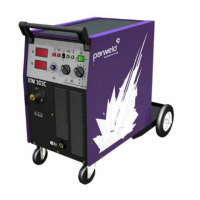
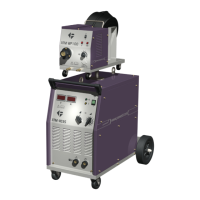
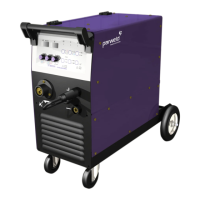
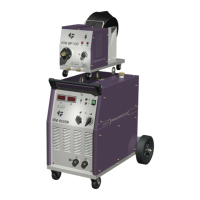
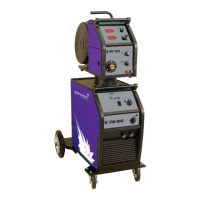
The XTM 404S is complete semiautomatic constant voltage DC arc
welding machines built to meet CE specications. They combine a
constant voltage power source and a constant speed wire feeder with
a microcomputer-based controller to form a reliable high-performance
welding system. A simple control scheme, consisting of a range
voltage and wire feed speed controls, provides versatility with ease of
use and accuracy. Other features include separate wire feed unit for
remote operation, an integral gas cylinder mounting undercarriage,
an adjustable Argon ow regulator with cylinder pressure gauge and
inlet hose, a Parweld MIG torch, and a 3.0m work cable with clamp.
Digital meters display the actual welding voltage and amperage and
the machine has additional controls for adjustment of burn back and
soft starting.


 To Next Page