EasyManua.ls Logo

Payne PG9MXA - User Manual

Payne PG9MXA
62 pages
Print Icon
To Next Page IconTo Next Page
Loading...
1
PG9MXA
Installation, Start--up and
Operating Instructions
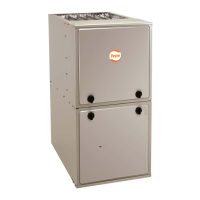
D E L U X E 4 --- W A Y M U LT I P O I S E 2 --- S T A G E
CONDENSING GAS FURNACE
SIZES 060---120, SERIES A
NOTE: Read the entire instruction manual before starting
the installation.
NOTE: This furnace can be installed as a
(2-pipe) direct vent
or (1-pipe) non-direct vent
condensing gas furnace.
Special Venting Requirements for Installations in Canada
Installation in Canada must conform to the requirements of CSA
B149 code. Vent systems must be composed of pipe, fittings,
cements, and primers listed to ULC S636. The special vent
fittings and accessory concentric vent termination kits and
accessory external drain trap have been certified to ULC S636 for
use with those IPEX PVC vent components which have been
certified to this standard. In Canada, the primer and cement must
be of the same manufacturer as the vent system -- IPEX System
636, PVC/CPVC Primer, Purple Violet for Flue Gas Venting and
IPEX System 636, PVC Cement for Flue Gas Venting, rated
Class IIA, 65 deg C. must be used with this venting system -- do
not mix primers and cements from one manufacturer with a vent
system from a different manufacturer. Follow the manufacturers
instructions in the use of primer and cement and never use primer
or cement beyond its expiration date.
The safe operation, as defined by ULC S636, of the vent system
is based on following these installation instructions, the vent
system manufacturers installation instructions, and proper use of
primer and cement. All fire stop and roof flashing used with this
system must be UL listed material. Acceptability under Canadian
standard CSA B149 is dependent upon full compliance with all
installation instructions. Under this standard, it is recommended
that the vent system be checked once a year by qualified service
personnel.
The authority having jurisdiction (gas inspection authority,
municipal building department, fire department, etc) should b e
consulted before installation to determine the need to obtain a
permit.
Consignes spéciales pour l’installation d e ventillation au Canada
L’installation faite au Canada doit se conformer aux exigences du
code CSA B149. Ce systême d e ventillation doit se composer de
tuyaux, raccords, ciments et apprêts conformes au ULC S636. La
tuyauterie de ventillation des gaz, ses accessoires, le terminal
concentrique mural ainsi que l’ensemble du drain de condensat
extérieur ont été certifiés ULCS 636 pour l’application des
composantes IPEX PVC qui sont certifiées à ce standard. Au
Canada l’apprêt et le ciment doivent être du même manufacturier
que le systême de ventillation -- IPEX Système 636, Apprêt
PVC/CPVC. Mauve Violette pour conduit en évacuation des gaz
et IPEX Système 636, ciment pour PVC pour conduit en
évacuation des gaz, évalué CLASSEIIA,65deg.C.doitre
utilisé avec ce systèeme d’évacuation -- ne pas mélanger l’apprêt
et le ciment d’un manufacturier avec le systême de ventillation
d’un autre manufacturier. Bien suivre les indications du
manufacturier lors de l’utilisation de l’apprêt et du ciment et ne
pas utiliser ceux--ci si la date d ’expiration est atteinte.
L’opération sécuritaire, tel que définit par ULC S636, du système
de ventilation est basé sur les instructions d’installation suivantes,
ainsi que l’usage approprié de l’apprêt et ciment. Tout arrët feu et
solin de toit utilisés avec ce système doivent être des matériaux
listés UL. L’acceptation du standard Canadien CSA B419 est
directement relié à l’installation conforme aux instructions ci--
haut mentionnées. Le standard Canadien recommande l’
inspection par un personel qualifié et ce, une fois par année.
Some Provinces may require the combustion air system to be
ULC-- S636 certified.
Question and Answer IconNeed help?

Do you have a question about the Payne PG9MXA and is the answer not in the manual?

Summary

Installation, Start-up and Operating Instructions

Special Venting Requirements for Installations in Canada

Details Canadian venting standards, pipe materials, and installation compliance.

Massachusetts Installation Requirements

Carbon Monoxide Detector Installation Mandates

Specifies CO detector installation on each dwelling level with battery backup.

Safety Considerations and Hazards

General Safety Warnings and Cautions

Alerts to fire, explosion, electrical shock, and carbon monoxide poisoning hazards.

Furnace Installation Orientations and Requirements

Furnace Installation Guidelines

Covers installation on combustible floors, in garages, and for construction heat.

Installation Procedures and Clearances

Minimum Clearances to Combustibles

Specifies minimum distances required from the furnace to combustible materials.

Condensate Trap Configuration and Warnings

Carbon Monoxide Hazard - Casing Holes

Warns about CO hazard if furnace casing holes are not properly sealed.

Downflow Condensate Trap Configurations

Carbon Monoxide Hazard - Casing Hole Filler

Emphasizes sealing casing holes to prevent CO release.

Furnace Location and Application Specifics

Hazardous Locations and Direct Vent Application

Covers installation in garages and direct vent application requirements.

Non-Direct Vent Applications and Air Supply

Non-Direct Vent (1-Pipe) Application Hazards

Warns against corrosive atmospheres and details air supply needs.

Air for Combustion and Ventilation Methods

Explains requirements for combustion air, ventilation, and dilution air.

Combustion Air Requirements and Methods

Combustion Air Opening Size Calculations

Provides tables and methods for calculating required combustion air opening sizes.

Furnace Installation Procedures

Upflow and Downflow Application Installation

Details installation steps for upflow and downflow furnace applications.

Bottom Closure Panel and Gas Piping

Gas Piping Installation and Warnings

Outlines gas piping requirements, safety, and fire/explosion hazards.

Electrical Connections and J-Box Relocation

Electrical Connections and Wiring

Covers 115-V wiring, grounding, and field wiring requirements.

Combustion Air and Vent Pipe Systems

Combustion Air Pipe Assembly

Details procedures for assembling combustion air pipes for direct and non-direct vent systems.

Combustion Air Pipe Assembly and Warnings

Combustion Air Pipe Assembly Details

Provides specific instructions for assembling combustion air pipes.

Approved Materials and Venting Hazards

Venting System Hazards and Pipe Sizing

Alerts to venting hazards and discusses pipe sizing considerations.

Control Center and Combustion Air Pipe Assembly

Combustion Air Pipe Assembly Procedures

Continues instructions for assembling combustion air pipes.

Direct Vent Termination Clearances

Direct Vent Termination Clearance Table

Provides clearance requirements for direct vent terminations.

Non-Direct Vent Termination Clearances

Non-Direct Vent Termination Clearance Table

Lists clearance requirements for non-direct vent terminations.

Vent Pipe Length and Combustion Air Pipe Attachment

Combustion Air Pipe Attachment and Guidelines

Covers attachment of combustion air pipe and installation guidelines.

Vent Extension Pipe and Pipe Installation Guidelines

Combustion Air and Vent Pipe Installation Guidelines

Provides guidelines for cutting, preparing, and cementing pipes.

Vent Termination Kits and Condensate Drain

Condensate Drain Protection and Start-Up

Start-Up and Safety Checks

Outlines initial start-up procedures and safety control checks.

Condensate Trap Priming and Gas Line Purge

Two-Stage Heating Modes

Adaptive Mode Heating with Single-Stage Thermostat

Explains furnace operation with adaptive heating for single-stage thermostats.

Cooling Modes and Thermidistat Operation

Blower Modes and Component Testing

Gas Input Rate Adjustments

Setting Gas Input Rate

Guides on determining and adjusting natural gas input rates.

Orifice Size Verification and Adjustment

Emphasizes checking orifice size and adjusting manifold pressure.

Verifying Natural Gas Input Rate

Clocking the Gas Meter for Input Rate

Explains how to measure gas input rate by clocking the meter.

Altitude Derate and Orifice Verification

Covers altitude derating and verifying orifice size for accurate input.

Temperature Rise and Speed Selection

Setting and Adjusting Temperature Rise

Details how to set and adjust the furnace's temperature rise.

Safety Controls Check and Installation Checklist

Checking Primary Limit and Pressure Switch

Guides on verifying the operation of safety controls.

Direct Vent Installation Checklist

Non-Direct Vent Installation Checklist

Payne PG9MXA Specifications

General IconGeneral
Fuel TypeNatural Gas
Blower MotorVariable Speed
Heating Capacity40, 000-120, 000 BTU/h
Ignition TypeHot Surface Ignition
Heat Exchanger MaterialAluminized Steel
Warranty10-Year Limited Parts Warranty

Related product manuals