6
OPERATION
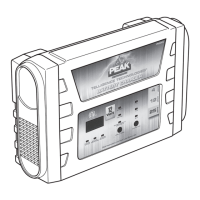
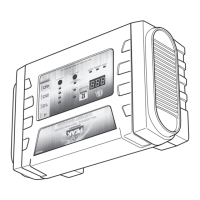
LED Indicators
Charging Indicator Light – The yellow LED will light when the battery is charging. This LED will only
light when the AC power cord is connected to an AC power source and the Battery Charger cables
are connected to a battery with a minimum of 4.5 volts residual charge.
Charging Mode Light (Full/Float Maintenance) – The green LED will light to indicate the Battery
Charger detects one of the following:
Battery is fully charged•
Battery Charger is in float/maintenance mode (maintenance charge at constant voltage, keeping •
batteries at 100% charge)
There is no load in the circuit•
AC power is off with Battery Charger cables connected to battery•
Reverse Polarity Light – The red LED will light when the Battery Charger is not properly connected
to the battery. When lit, the Battery Charger will not operate.
EXPLOSION HAZARD
If the red LED reverse polarity light turns on, immediately disconnect the Battery Charger
cables from the battery terminals.
Automatic Protection Features
Overheat Protection• (no indicator lit) - The automatic overheat protection will stop battery
charging if the operating temperature of the Battery Charger rises above 248°F (120°C). Charging
will automatically resume when the operating temperature returns to the normal operating
range. For optimum charging performance, only operate this Battery Charger within an ambient
temperature range of 32° to 104°F (0° to 40°C). The automatic cooling fan turns on during normal
charging and turns off during a no load condition and during float/maintenance charge mode.
Short-Circuit Protection• (no indicator lit) - The automatic short-circuit protection will stop battery
charging if the Battery Charger cables or the battery short. Charging will automatically resume
when the electrical short condition is corrected.
Reverse Polarity Protection• (red and green indicator LED lights on) - The automatic reverse
polarity protection feature will stop battery charging if the Battery Charger cables are improperly
connected (reversed) to a battery. Charging will resume when the Battery Charger cables are
properly connected (positive (+) to positive (+) and negative (–) to negative (–)).
Before Charging
Make sure the Battery Charger is disconnected from the power supply.•
Make sure that the voltage of the battery matches the rated output of the Battery Charger by •
referring to the vehicle owner’s manual.
Check the polarities of the battery terminals: positive for the (+) symbol and negative for the (–) •
symbol.
Refer to CHARGING TIMES on page 8 before charging battery.•
Pre-Charge Activation
When starting to charge a battery, the current will depend on the battery’s percent of charge. As the
battery charge level increases, the current reduces. To measure the battery charge level as charging
proceeds, a hydrometer or a voltmeter should be used. Typically 12.6 VDC is considered full charge
for a 12-volt battery if the voltage is measured one hour after the Battery Charger is disconnected.
During charging, a nominal 12-volt battery can measure 13.6 volts or higher. If so, it needs to rest
after charging to measure actual state of charge.
EXPLOSION HAZARD
Be aware that a fully charged battery will also cause a low current reading. Attempting pre-
charge activation of a fully charged battery may cause explosion - make sure that battery is
discharged before using this procedure.
Pre-charge activation is the term for the time it takes before a battery begins to
accept a measurable rate of charge - it can be as long as 4-8 hours from the time the charging
process begins. Pre-charge activation is indicated if the ammeter reading is zero and a
hydrometer or voltmeter reading shows that the battery is fully discharged.
The newer, high-calcium-type 12-volt DC batteries may need pre-charge activation if
their charge has been allowed to drop to a very low level. When deeply discharged, this type
of battery will provide only a very low voltage output and will draw less than 1 amp during the
recharging process, until activated.
6
6
OPERACIÓN
Indicadores LED
Luz Indicadora de Carga – La luz LED amarilla se encenderá cuando la batería esta cargando.
Esta luz LED sólo se excederá cuando el cordón CA este conectado a una fuente de energía CA
y cuando los cables del Cargador de Baterías estén conectadas a la batería con un mínimo de 4.5
voltios de carga residual.
Luz de Modo de Carga (Mantenimiento Total/Flote) – La luz LED verde se encenderá para indicar
que el Cargador de Baterías detecta uno de los siguientes:
La batería está completamente cargada•
El Cargador de Baterías está en el modo de flote/mantenimiento (carga de mantenimiento a •
voltaje constante, manteniendo las baterías al 100% de carga)
No hay carga en el circuito•
La energía CA esta apagada con los cables del Cargador de Baterías conectadas a la batería•
Luz de Polaridad Invertida – La luz LED roja se encenderá si el Cargador de Baterías no fue
conectado apropiadamente. Cuando está encendida, el Cargador de Baterías no operará.
PELIGRO DE EXPLOSIÓN
Si la luz LED roja de polaridad inversa se enciende, desconecte inmediatamente los cables del
Cargador de Baterías de los terminales de la batería.
Características de Protección Automática
Protección contra Recalentamiento• (ningún indicador prendido) - La protección automática de
recalentamiento detendrá la carga de la batería si la temperatura del Cargador de Baterías se
sube por encima de 248°F (120°C). La carga continuará automáticamente cuando la temperatura
de operación retorne a la temperatura normal. Para obtener el rendimiento de carga óptimo,
sólo opere el Cargador de Baterías a una temperatura ambiente de 32° a 104°F (0° a 40°C). Los
ventiladores de enfriamiento automáticos se encienden durante la carga normal y se apagan
durante una condición sin carga o durante el modo de carga de flote/mantenimiento.
Protección contra Cortocircuitos• (ningún indicador prendido) - La protección automática contra
cortocircuito detendrá la carga de la batería si los cables del Cargador de Baterías o la batería
hacen cortocircuito. La carga continuara cuando la condición de cortocircuito sea corregida.
Protección contra Polaridad Inversa• (luces LED roja y verde encendidas) - La característica
de protección automática de polaridad inversa detendrá la carga de la batería si los cables
del Cargador de Baterías son conectadas impropiamente (invertidas) en la batería. La carga
continuará cuando los cables del Cargador de Baterías sean conectadas apropiadamente (positivo
(+) a positivo (+) y negativo (–) al negativo (–)).
Antes de Cargar
• Asegúrese de que el Cargador de Baterías sea desconectado de la fuente de energía.
Asegúrese de el el voltaje de la batería sea igual a la potencia nominal del Cargador de Baterías •
refiriéndose al manual del propietario del vehículo.
Verifique las polaridades de los terminales de la batería: positivo para el símbolo (+) y negativo •
para el símbolo (–).
Consulte TIEMPOS DE CARGA en la página 8 antes de cargar la batería.•
Activación de Precarga
Cuando comience a cargar una batería, la corriente dependerá de porcentaje de carga de la batería.
A medida que el nivel de carga de la batería aumenta, se reduce la corriente. Para medir el nivel de
carga de la batería a medida que carga, se debe usar un hidrómetro o un voltímetro. Típicamente
12.6 VCC se consideran carga completa para una batería de 12 voltios si el voltaje es medido una
hora después de desconectar el Cargador de Baterías. Durante la carga, el voltaje nominal de una
batería de 12 voltios puede medir 13.6 voltios o más. Si es así, necesita reposar después de la
carga para medir el estado de carga real.
PELIGRO DE EXPLOSIÓN
Esté enterado de que una batería completamente cargada causara una lectura de corriente
baja. El intentar activación de precarga de una batería completamente cargada podrá causar
una explosión - asegúrese de que la batería sea descargada antes de usar este procedimiento.
Activación de precarga es un término para el tiempo que se toma antes de que una
batería comience a aceptar una tasa de carga cuantificable - puede ser tanto como de 4 a 8
horas desde el comienzo del proceso de carga. La activación de precarga es indicada si la
lectura del amperímetro es cero y la lectura del hidrómetro o del voltímetro muestra que la
batería está totalmente cargada.
Las baterías más nuevas de tipo de alto calcio de 12 voltios CC podrán necesitar
activación de precarga si se les ha permitido que su nivel de carga caiga a un nivel muy bajo.
Cuando están profundamente descargadas, este tipo de baterías proporcionaran sólo una
salida de voltaje muy bajo y consumirán menos de 1 amperio durante el proceso de recarga,
hasta que son activadas.



 To Next Page
 Loading...