7
7
Carga si la Batería está Instalada en un Vehículo
Revise la polaridad de los terminales de la batería: Para terminales de batería montados en la 1.
parte superior, usualmente el terminal de batería positivo (+) tiene un diámetro mayor que el del
terminal negativo (–). Para conexiones de batería montadas al lado, el terminal positivo es rojo y
el terminal negativo es negro.
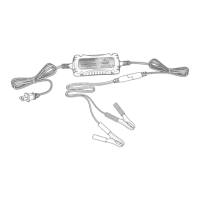
Hay tres juegos de cables diferentes que pueden ser usados para cargar. Usted puede usar 2.
el cable de batería con pinza, el cable con terminal de anillo o el cable de enchufe hembra del
encendedor de cigarrillos/accesorios de 12 voltios. Retire el conector de protección del cable
que esté usando y del cordón del conector del cable.
Cuando use el cable con terminal de anillo, asegúrese de usar los herrajes
correctos para conectar los cables a la batería. Los herrajes no son suministrados con el
Cargador de Baterías.
Cuando use el cable de enchufe hembra del encendedor de cigarrillos/accesorios
de 12 voltios, asegúrese de que sea enchufado a un enchufe hembra del encendedor de
cigarrillos/accesorios de 12 voltios no alambrado por medio de un interruptor. Consulte el
manual del operador de su vehículo para determinar cuál es este conector hembra.
Usando el cable apropiado, enchúfelo dentro del cordón del conector del cable del Cargador de 3.
Baterías. Si usa el cable del conector hembra del encendedor de cigarrillos/accesorios de 12
voltios, enchúfelo en el conector hembra de 12 voltios.
Si usa el cable de batería con pinza o el cable con terminal de anillo, sujete los cables del 4.
Cargador de Baterías a las conexiones de la batería de la forma siguiente. Si hay un error, la luz
indicadora de polaridad inversa se encenderá cuando el Cargador de Baterías es enchufado.
Vehículo con Tierra Negativa: Conecte el cable positivo (ROJO) del Cargador de Baterías al
terminal de la batería positivo (+) sin tierra. Luego, conecte el cable del Cargador de Baterías
negativo (NEGRO) al chasis del vehículo o al bloque del motor (lejos de la batería). No conecte
el cable al carburador, tubos de combustible o piezas de hojalata de la carrocería: conéctela a
una pieza metálica de grueso calibre del chasis o del bloque del motor.
Los sistemas de tipo de tierra negativa son los más comunes en los vehículos
actuales.
Vehículo con Tierra Positiva: Conecte el cable negativo (NEGRO) del Cargador de Baterías
al terminal de la batería negativo (–) sin tierra. Luego, conecte el cable positivo (ROJO) del
Cargador de Baterías al chasis del vehículo o al bloque del motor (lejos de la batería). No
conecte el cable al carburador, tubos de combustible o piezas de hojalata de la carrocería:
conéctela a una pieza metálica de grueso calibre del chasis o del bloque del motor.
Enchufe el cordón del Cargador de Baterías en una toma de corriente de 110/120 voltios CA.5.
Si el Cargador de Baterías fue conectado correctamente, el indicador de polaridad inversa no se 6.
encenderá. Si los cables fueron conectados incorrectamente, la luz LED de polaridad inversa se
encenderá en rojo. Desconecte el Cargador de Baterías y revise sus conexiones.
Durante la carga, la luz LED amarilla de carga estará encendida.7.
Cuando la carga termine, la luz LED verde de mantenimiento total/flote se encenderá.8.
Después de que la carga esté completa, desconecte el enchufe del Cargador de Baterías de la 9.
toma de corriente de 110/120 voltios CA.
Desconecte los cables en orden inverso al que fueron conectadas. Desc10. onecte su primer cable
tan lejos de la batería como le sea posible.
Carga si la Batería está Fuera del Vehículo
Revise la polaridad de los terminales de la batería - Para conectores de batería montados 1.
encima, el terminal positivo (+) tiene usualmente un diámetro mayor que el del terminal negativo
(–) de la batería. Para conexiones de batería montadas al lado, el terminal positivo es rojo y el
terminal negativo es negro.
Hay dos juegos de cables diferentes que pueden ser usados para cargar. Usted puede usar el 2.
cable de batería con pinzas o el cable de terminal de anillo. Retire el conector de protección del
cable que esté usando y del cordón del conector del cable.
Cuando use el cable con terminal de anillo, asegúrese de usar los herrajes
correctos para conectar los cables a la batería. Los herrajes no son suministrados con el
Cargador de Baterías.
Sujete un cable de batería aislado de 24 pulgadas (longitud mínima) de calibre 6 AWG al 3.
terminal negativo (–) de la batería.
Conecte el cable positivo (ROJO) 4. del Cargador de Baterías al terminal positivo (+) de la batería.
Párese tan lejos de la batería como le sea posible y no le de la cara a la batería al efectuar las 5.
conexiones finales.
Párese con el extremo libre de los cables tan lejos de la batería como le sea posible. Conecte 6.
cuidadosamente el cable negativo (NEGRO) del Cargador de Baterías al extremo libre del cable
de la batería conectado al terminal negativo.
Conecte el cordón del Cargador de Baterías en una toma de corriente de 110/120 voltios CA.7.
Si el Cargador de Baterías fue conectado correctamente, el indicador de polaridad inversa no se 8.
encenderá. Si los cables fueron conectados incorrectamente, la luz LED de polaridad inversa se
encenderá en rojo. Desconecte el Cargador de Baterías y revise sus conexiones.
7
Charging if Battery is Installed in a Vehicle
Check polarity of battery terminals: For top-mounted battery connectors, the positive (+) terminal 1.
usually has a larger diameter than the negative (–) battery terminal. For side-mounted battery
connections, the positive terminal is red, the negative terminal is black.
There are three different sets of cables that can be used for charging. You can use the battery 2.
clip cable, the ring terminal cable or the 12-volt cigarette lighter/accessory socket cable. Remove
the protective connector from the cable you are using and from the cable connector cord.
When using the ring terminal cable, make sure to use the correct hardware to
connect the cables to the battery. Hardware is not supplied with the Battery Charger.
When using the 12-volt cigarette lighter/accessory socket cable, make sure it is
plugged into an unswitched 12-volt cigarette lighter/accessory socket. See your vehicle
operator manual to determine which socket this is.
Using the appropriate cable, plug it into the cable connector cord from the Battery Charger. If 3.
using the 12-volt cigarette lighter/accessory socket cable, plug it into the 12-volt socket.
If using the battery clip cable or the ring terminal cable, attach Battery Charger cables to battery 4.
connections as follows. If there is a mistake, the reverse polarity indicator will light when Battery
Charger is plugged in:
Negative-Grounded Vehicle: Connect the positive (RED) Battery Charger cable to the positive
(+) ungrounded battery terminal. Then, connect the negative (BLACK) Battery Charger cable to
the vehicle chassis, or the engine block (away from the battery). Do not connect the cable to the
carburetor, fuel lines or sheet metal body parts: connect only to a heavy gauge metal part of the
frame or engine block.
Negative-grounded type systems are the most common in today’s vehicles.
Positive-Grounded Vehicle: Connect the negative (BLACK) Battery Charger cable to the
negative (–) ungrounded battery terminal. Then, connect the positive (RED) Battery Charger
cable to the vehicle chassis or engine part (away from the battery). Do not connect the cable to
the carburetor, fuel lines or sheet metal body parts: connect only to a heavy gauge, stable metal
part of the frame or engine block.
Plug Battery Charger power cord into a 110/120-volt AC power outlet.5.
If the Battery Charger is connected correctly the reverse polarity indicator will not be lit. If the 6.
cables are connected incorrectly the reverse polarity LED will be red. Disconnect the Battery
Charger and check your connections.
During charging, the yellow charging LED will be lit.7.
When charging is complete, the green full/float maintenance LED will be lit.8.
After charging is complete, disconnect the Battery Charger plug from the 110/120-volt AC power 9.
outlet.
Disconnect the cables in the reverse order in which they were connected. Disconnect your first 10.
cable as far away from the battery as possible.
Charging if Battery is Outside of Vehicle
Check polarity of battery terminals - For top-mounted battery connectors, the positive (1. +) terminal
usually has a larger diameter than the negative (–) battery terminal. For side-mounted battery
connections the positive terminal is red, the negative terminal is black.
There are two different sets of cables that can be used for charging. You can use the battery clip 2.
cable or the ring terminal cable. Remove the protective connector from the cable you are using
and from the cable connector cord.
When using the ring terminal cable, make sure to use the correct hardware to
connect the cables to the battery. Hardware is not supplied with the Battery Charger.
Attach a 24-inch (minimum length) 6 AWG insulated battery cable to the negative (–) battery 3.
terminal.
Connect the positive (RED) 4. Battery Charger cable to the positive (+) battery terminal.
Stand as far back from battery as possible, and do not face battery when making final 5.
connection.
Position yourself and free end of cables as far away from battery as possible. Carefully connect 6.
the negative (BLACK) Battery Charger cable to the free end of the battery cable connected to the
negative terminal.
Connect the Battery Charger’s power cord to a 110/120-volt AC power outlet.7.
If the Battery Charger is connected correctly the reverse polarity indicator will not be lit. If the 8.
cables are connected incorrectly the reverse polarity LED will be red. Disconnect the Battery
Charger and check your connections.
During charging, the yellow charging LED will be lit.9.
When charging is complete, the green full/float maintenance LED will be lit.10.



 To Next Page
 Loading...