This document is the owner's manual for a 1 1/2 Ton Scissor Jack, Item Number W1600, manufactured by Performance Tool. It provides essential information regarding the jack's function, specifications, usage, safety guidelines, and maintenance.
Function Description
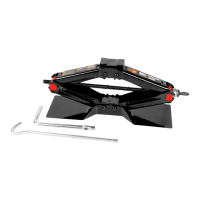
The 1 1/2 Ton Scissor Jack is a lifting device primarily designed for emergency tire changing or tire chain mounting on vehicles. It is intended for temporary use to lift a load, allowing for necessary work underneath, and should always be used in conjunction with jack stands for sustained support. The jack operates by rotating a handle, which in turn extends or retracts a screw mechanism to raise or lower the saddle.
Important Technical Specifications
The manual provides detailed capacity specifications based on the extended height of the jack:
- Capacity:
- 3000 lb. when extended 14 inches or more
- 1800 lb. when extended 10 inches or more
- 1200 lb. when extended 8 inches or more
- 900 lb. when extended 6 inches or more
- Minimum Lift Height: 4 inches
- Maximum Lift Height: 15 inches
- Base Length: 15 inches
- Base Width: 4 7/8 inches
- Item Number: W1600
It is crucial to note that these specifications are subject to change without prior notice.
Usage Features
The manual outlines a clear procedure for both raising and lowering a vehicle using the scissor jack, emphasizing safety at every step.
To Raise:
- Vehicle Placement: Park the vehicle on a hard, level surface, safely away from oncoming traffic.
- Vehicle Preparation: Turn off the engine, place the transmission in PARK (automatic) or its lowest gear (manual), and set the emergency brake. Block any wheels not being lifted.
- Jacking Points: Consult the vehicle owner's manual for recommended lift locations. Lift only on these specified areas.
- Load Centering: Ensure the load is centered on the jack's saddle.
- Handle Assembly: Insert the curved end of the hook handle into the screw socket (Figure 1) and the straight side of the hook handle into the long side of the "L" handle (Figure 2).
- Lifting: Use one hand to hold the front part of the handle and the other to slowly rotate the end of the handle clockwise to achieve the desired height.
- Support with Jack Stands: ALWAYS support the load with appropriately sized jack stands (Figure 3) placed at the vehicle manufacturer's recommended locations. The jack is not designed for prolonged heavy loads. Do not get under the vehicle without jack stands. Avoid placing jack stands simultaneously under both ends or one side of the vehicle. If using two jack stands, they must be at the same height.
- Lowering onto Stands: Slowly turn the release valve counter-clockwise to lower the vehicle onto the jack stands and then remove the jack.
To Lower:
- Clearance: Remove all tools and parts from under the vehicle.
- Positioning: Position the saddle under the lifting point.
- Slight Raise: Turn the handle firmly clockwise to raise the vehicle slightly above the jack stand(s). Collapse and remove the jack stand(s).
- Controlled Descent: Slowly turn the handle counter-clockwise just enough to allow a controlled descent of the vehicle onto the ground (never more than two full turns).
- Storage: Lower the jack completely and store it in a safe, dry location out of reach of children.
Safety Guidelines:
The manual stresses the importance of reading and understanding all instructions and warnings to prevent personal injury or property damage and to avoid voiding the warranty. Key safety points include:
- Capacity Limits: Do not exceed the rated capacities at specified heights. Overloading can damage the jack.
- Minimum Extension: Do not use the jack if it cannot extend at least 6 inches before lifting the load.
- Surface Requirements: Use only on hard, level surfaces capable of sustaining the load to prevent instability.
- Temporary Use: This is an emergency lifting device only; do not lift loads for extended periods.
- Movement: Do not move or dolly the load while on the jack.
- Damaged Jack: Discard the jack if the load is pushed off it; do not reuse.
- Personal Protective Equipment: Wear ANSI approved safety goggles and heavy-duty work gloves.
- Clearance: Keep clear of the load during lifting and lowering.
- Slow Lowering: Lower the load slowly.
- Aircraft Use: Not for aircraft purposes.
- Vehicle Security: Apply the parking brake and chock tires before lifting.
- Lift Locations: Lift only at vehicle manufacturer-recommended points.
- Modifications: Do not alter the product.
- Pre-Use Inspection: Inspect before every use; do not use if parts are loose or damaged.
- Work Area: Keep the work area clean, well-lit, and free of distractions.
- Bystanders: Keep bystanders, children, and visitors away.
- Alertness: Stay alert and use common sense; do not operate while tired or under the influence of substances.
- Storage: Store idle jacks out of reach of children and untrained persons.
- Servicing: Jack service must be performed by qualified repair personnel using identical replacement parts.
- Labels: Maintain labels and nameplates.
- Vehicle Manual: Read the vehicle's instruction manual before use.
- Jack Stands: Never work under a vehicle without proper support from jack stands.
- Traffic: Avoid dangerous oncoming traffic; use the jack as far from the roadside as possible.
- Occupants: Do not allow anyone inside the vehicle while using the jack.
- Simultaneous Lifting: Do not support both ends of the vehicle at the same time.
- Tool Removal: Remove all tools and equipment from under the vehicle before lowering.
- Common Sense: The operator must supply common sense and caution.
Maintenance Features
Monthly maintenance is recommended to ensure the jack's longevity and proper function, as lubrication is critical for supporting heavy loads.
- Pre-Use Inspection: Before each use, inspect the jack for broken, cracked, bent, loose, or missing parts, or any condition affecting proper operation. Remove damaged jacks from service immediately.
- Part Replacement: Replace worn or damaged parts with Performance Tool replacement parts. Repairs should only be performed by qualified personnel.
- Operational Test: Thoroughly test the jack for proper operation before actual use.
- Storage Position: When not in use, store the jack in a fully down position to prevent corrosion of machined surfaces.
- Lubrication: Keep the jack clean and well lubricated at the points illustrated in Figure 4.
- Oil Quality: Use only high-quality lightweight oil for lubrication.
- Screw Rod Maintenance: Keep the Screw Rod (4) well oiled and free of rust to prevent binding during use.
Replacement Parts List:
The manual includes a diagram and a list of replacement parts:
- #1 Base (Qty: 1)
- #2 Saddle (Qty: 1)
- #3 Screw Socket (Qty: 1)
- #4 "L" Handle (Qty: 1)
- #5 Hook Handle (Qty: 1)
Performance Tool offers a 1-year limited warranty to original retail purchasers. Defective products can be returned for free replacement within 90 days of purchase. After 90 days and up to one year, Performance Tool will replace defective parts at no charge, provided a sales receipt is presented. The warranty excludes consumables and parts used for purposes other than their design, or those subjected to misuse, neglect, accident, or normal wear and tear. The warranty does not cover consequential, incidental, or special damages, and the sole remedy for a defective product is repair or replacement.

 Need help?
 General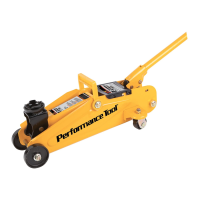



 To Next Page