Note: Some applications will require a fuel cooler to
be installed. The fuel cooler is a type of radiator that
uses air to cool the fuel and the fuel cooler will
require cleaning.
Note: Adjust the frequency of cleaning according to
the effects of the operating environment.
Inspect the radiator for these items: damaged fins,
corrosion, dirt, grease, insects, leaves, oil, and other
debris. Clean the radiator, if necessary.
Pressurized air is the preferred method for removing
loose debris. Direct the air in the opposite direction of
the air flow. Hold the nozzle approximately 6 mm
(0.25 inch) away from the fins. Slowly move the air
nozzle in a direction that is parallel with the tubes.
This movement will remove debris that is between
the tubes.
Pressurized water may also be used for cleaning.
The maximum water pressure for cleaning purposes
must be less than 275 kPa (40 psi). Use pressurized
water to soften mud. Clean the core from both sides.
Use a degreaser and steam for removal of oil and
grease. Clean both sides of the core. Wash the core
with detergent and hot water. Thoroughly rinse the
core with clean water.
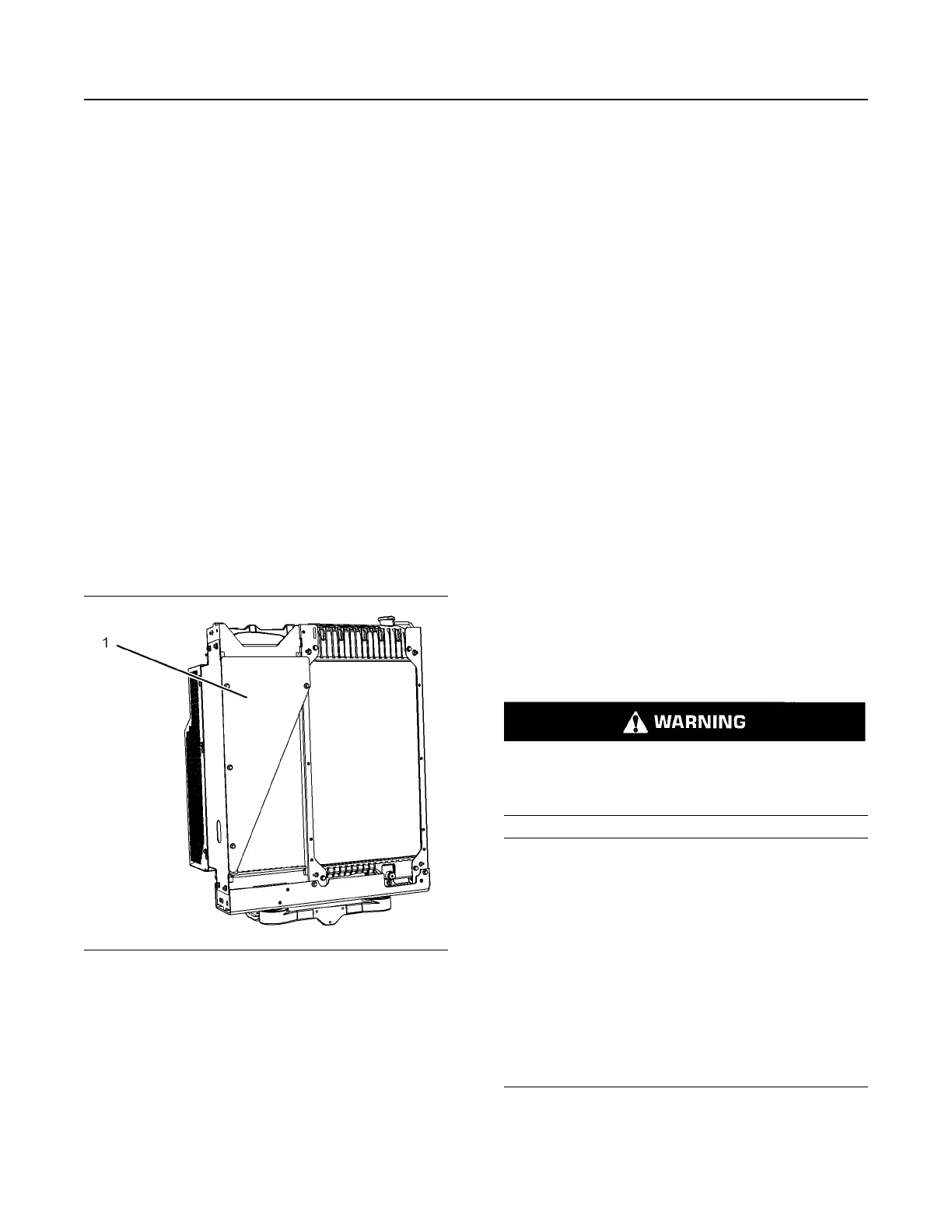
Illustration 87 g03674903
Typical example
If the baffle plate (1) has been removed, the baffle
plate must be installed again after cleaning and
ensure that the baffle is in the same orientation as
shown in illustration 87 . An engine operating without
the baffle plate installed would not be compliant with
emission regulations.
After cleaning, start the engine and accelerate the
engine to high idle rpm. This procedure will help in
the removal of debris and drying of the core. Stop the
engine. Use a light bulb behind the core to inspect
the core for cleanliness. Repeat the cleaning, if
necessary.
Inspect the fins for damage. Bent fins may be opened
with a “comb”. Inspect these items for good condition:
welds, mounting brackets, air lines, connections,
clamps, and seals. Make repairs, if necessary.
i07888480
Starting Motor - Inspect
Perkins recommends a scheduled inspection of the
starting motor. If the starting motor fails, the engine
may not start in an emergency situation.
Check the starting motor for correct operation. Check
the electrical connections and clean the electrical
connections. Refer to the Systems Operation, Testing
and Adjusting Manual, “Electric Starting System -
Test” for more information on the checking procedure
and for specifications consult your Perkins dealer or
your Perkins distributor for assistance.
i05805424
Turbocharger - Inspect
Hot engine components can cause injury from
burns. Before performing maintenance on the en-
gine, allow the engine and the components to
cool.
NOTICE
Turbocharger bearing failures can cause large quan-
tities of oil to enter the air intake and exhaust sys-
tems. Loss of engine lubricant can result in serious
engine damage.
Minor leakage of oil into a turbocharger under ex-
tended low idle operation should not cause problems
as long as a turbocharger bearing failure has not
occured.
When a turbocharger bearing failure is accompanied
by a significant engine performance loss (exhaust
smoke or engine rpm up at no load), do not continue
engine operation until the turbocharger is renewed.
132
SEBU9063-07
Maintenance Section
Starting Motor - Inspect





 To Next Page