17
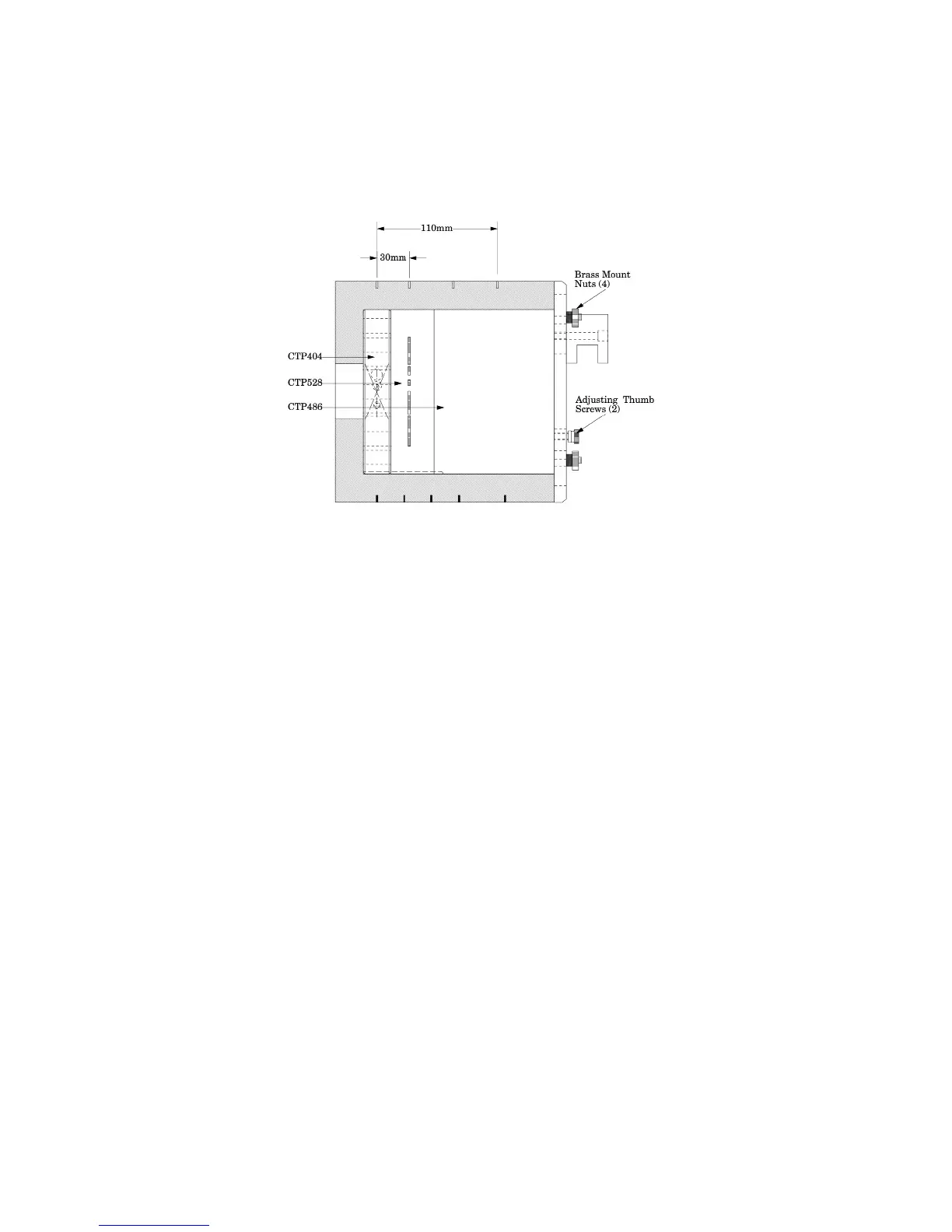
CTP528 High resolution module with 21 line pair per cm gauge and point
source
This section has a 1 through 21 line pair per centimeter high resolution test gauge
and two impulse sources (beads) which are cast into a uniform material. The beads are
positioned along the y axis 20mm above or below the phantom’s center and 2.5 and 10mm
past the center of the gauge in the z direction. On older CTP528 modules the bead is
aligned in the z axis with the gauge.
Bead Point Source for point spread function and MTF
Use the impulse source to estimate the point source response function of the CT
system. Print out a digitized image of the area surrounding the impulse source. Use the
numerical data to determine the two-dimensional array of the CT values arising from the
impulse source.
The FWHM of the point spread function is determined from the best-t curve of the point
spread function numerical data.
The average of several different arrays of impulse response functions is calculated to
obtain the average point spread function of the system. These numerical values are
used in conjunction with the Fourier Transform Program to provide an estimate of the
two-dimensional spatial frequency response characteristics of the CT system (MTF).
Illustration is on the next page.
The tungsten carbide bead has a diameter of 0.011” or 0.28mm. Because the bead is
subpixel sized it is not usually necessary to compensate for it. However, some MTF
programs are designed to compensate for its size.


 To Next Page