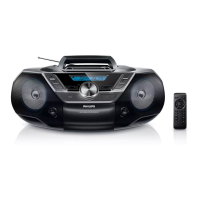
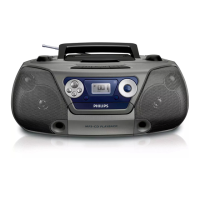
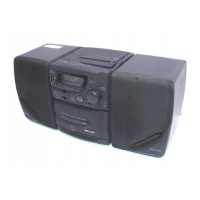
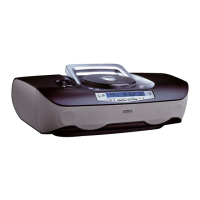
Need help?
Do you have a question about the Philips AZ4000 and is the answer not in the manual?
User must read and keep all safety instructions and heed all warnings before operating the equipment.
Do not use near water, block vents, or install near heat sources. Clean with dry cloth.
Do not defeat plug safety features. Protect power cord from pinching.
Only use specified attachments/accessories. Use caution with carts to prevent tip-over.
Unplug during lightning storms or long periods of disuse.
Refer all servicing to qualified personnel. Do not attempt self-repair to avoid invalidating warranty.
Install batteries correctly, do not mix types, and remove if unused long-term. Dispose properly.
Specifies what is covered by the warranty, including replacement of defective products within one year.
Outlines items and conditions not covered, such as misuse, accidental damage, labor, and commercial use.
Information on where and how to exchange the product in different geographical regions.
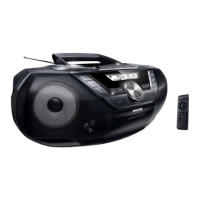
Details controls on the top and front panels, including BASS/TREBLE, VOLUME, ULTRABASS, and SOURCE.
Identifies connections and controls on the back and bottom, such as battery compartment and AC MAINS.
Explains the buttons and functions of the remote control for operating the set.
Instructions on connecting and using the AC power adapter for the unit.
Details how to switch the set on and off using the POWER button and remote control.
Guide on how to insert batteries into the unit and remote control for power.
Information on recognizing low battery power and switching to AC power.
How to adjust the volume level using the set's control or the remote control.
Adjusting bass and treble levels using the BASS/TREBLE button and VOLUME control.
How to activate or deactivate the ULTRABASS feature for enhanced bass response.
Using the MUTE button on the remote to interrupt and resume sound playback.
Instructions on tuning to FM/AM stations manually or via automatic search.
Tips for optimizing reception, including antenna adjustment and set orientation.
How to store up to 30 tuner stations manually or using the Autostore function.
Guidance on cleaning the CD player lens and handling condensation.
Proper methods for handling, cleaning, and storing CDs to prevent damage.
Instructions for cleaning the set and protecting it from environmental factors.
Supported formats, bit rates, directory nesting, and general MP3 information.
How to download or convert audio CDs to MP3 format for playback.
Tips for burning MP3-CDs, including file naming and disc finalization.
Guidelines on storing albums and titles, and understanding album 00.
Lists file formats and disc types that are not supported by the player.
Step-by-step instructions for inserting and playing MP3-CDs and standard CDs.
How to view text information such as album, track details, and playback time.
Methods for selecting previous/next tracks or albums on MP3-CDs and CDs.
How to search for specific passages within a track using the SEARCH function.
Explanation of play modes like SHUFFLE, REPEAT, and CD MODE.
How to store up to 30 tracks in a desired sequence for playback.
Description of the built-in sleep timer that automatically switches off the set.
How to activate, select time options, and cancel the sleep timer.
Solutions for issues related to no sound or the unit not powering on.
Troubleshooting steps for display errors or lack of response from controls.
Resolving issues related to inserting CDs or 'CHECK DISC' messages.
Solutions for problems like CD playback not working or skipping tracks.
Troubleshooting for sound skips, incorrect order, or inability to play MP3 titles.
Solutions for when the remote control does not function properly.
 General
| Brand | Philips |
|---|---|
| CD Player | Yes |
| Playable disc formats | CD, CD-R, CD-RW |
| Sound enhancement | Dynamic Bass Boost |
| Cassette Player | Yes |
| Model | AZ4000 |
| Radio Tuner | FM |
| Audio system | Stereo |
| Power Source | AC power or battery |
| Connectivity | 3.5 mm audio input |

 To Next Page