
 Need help?
Do you have a question about the Philips PICOPIX PPX3610 and is the answer not in the manual?
Introduction to the user manual, its structure, and a list of included projector components.
Overview of the projector's main features, connectivity options, and usage scenarios.
Guidelines for safe placement, ventilation, and environmental conditions for the projector.
Warnings against self-repair, handling with care, avoiding moisture, and using correct cleaning agents.
Precautions for using the power adapter, battery handling, and warnings related to the high power LED.
Information on potential interference from WLAN with medical devices and hearing aids.
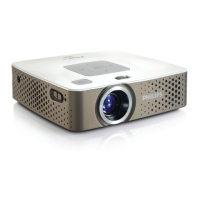
Identification of ports, buttons, status indicators, and features on the projector's exterior.
Detailed explanation of touchpad operation, gestures, input area, and the software keyboard.
Identification and function mapping of buttons on the remote control for navigation and playback.
Overview of the main menu structure and interpretation of status bar icons.
Steps to connect the power supply and charge the projector's internal battery.
Instructions for installing or replacing batteries in the remote control and battery care.
Guide to initial device setup, including projection adjustment and language selection.
Connecting computers, laptops, iPhones, iPads, iPods, and smartphones via HDMI and MHL.
Connecting computers via VGA and using CVBS adapter cables for audio/video input.
Connecting with Component-Video cables for higher image quality.
Connecting projector to computer via WLAN and connecting headphones.
Procedures for inserting SD/MMC memory cards and connecting USB storage media.
How to connect the projector to a computer for data transfer and file management.
Instructions to enable or disable the wireless networking function.
Guide to connecting to a wireless network using a wizard or scan.
Information on enabling DLNA for multimedia device interconnection and control.
Playing video files from various sources and adjusting playback settings.
Displaying photos, creating slideshows, and managing image viewing time.
Playing music files, adjusting volume, and managing playback with or without image display.
Displaying documents using the YOZO Office application.
Procedures for copying files between storage media and deleting files from the device.
Instructions for connecting an aerial to the projector or Pico Station.
Steps for initial TV playback setup, including channel scanning and area settings.
How to change channels and view channel information during playback.
How to launch, exit, and perform a factory reset on the Android system.
Instructions for installing applications and the Adobe Flash Player.
Changing browser modes to display websites with flash elements and resetting the mode.
Configuring wireless networks, DLNA sharing, and background images.
Adjusting audio, video, music playback parameters, and power saving modes.
Options for factory resets, language selection, and updating the device firmware.
Guidelines for battery maintenance, charging, and handling deep discharge scenarios.
Instructions for cleaning the device and lens, and understanding overheating behavior.
Step-by-step guide to updating the projector's firmware using a memory card.
Solutions for common issues like unresponsiveness, no sound, and connection problems.
Detailed technical specifications including dimensions, weight, and supported formats.
A list of optional accessories available for purchase for the projector.
 Optical Specifications
| Display technology | DLP |
|---|---|
| Light source | RGB LED |
| LED light source lifespan | 30, 000 hours |
| Native resolution | 854 x 480 pixels |
| Contrast ratio | 1000:1 |
| Screen size (diagonal) | 12" - 120" |
| Screen distance | 0.5m - 5.0m |
Memory and Storage| Internal memory | 2 GB |
|---|
Brightness| Brightness with AC | up to 100 lumens |
|---|---|
| Brightness with battery | up to 55 lumens |
 Power
Power| Power adapter | 110-240V AC, 50-60Hz, 12V@2A for EU and UK |
|---|---|
| Internal battery | 7.4V @ 2300mAh |
| Battery life in standard mode | 2 hours |
| Battery life in bright mode | 1.5 hours |
Operating Environment| Operating temperature range | 41 - 104°F |
|---|---|
| Storage temperature range packed | -13 - 140°F |
| Storage temperature range unpacked | 32 - 113°F |
| Operating relative humidity | 15 ~ 85% RH |
| Storage relative humidity packed | 5 ~ 93% RH |
| Storage relative humidity unpacked | 15 ~ 85% RH |
Dimensions| Packed dimensions (WxDxH) | 7.48 x 7.48 x 3.15 inch |
|---|---|
| Unpacked dimensions (WxDxH) | 4.13 x 4.13 x 1.24 inch |
Weight| Packed weight | 30.76 oz |
|---|---|
| Unpacked weight | 10.23 oz |


 To Next Page
