EasyManua.ls Logo

Philips PM2517X - 3.2.5. Power supply; 3.3.6. Power supply (Fig.26 and S4)

Philips PM2517X
104 pages
Print Icon
To Next Page IconTo Next Page
To Previous Page IconTo Previous Page
Loading...
40
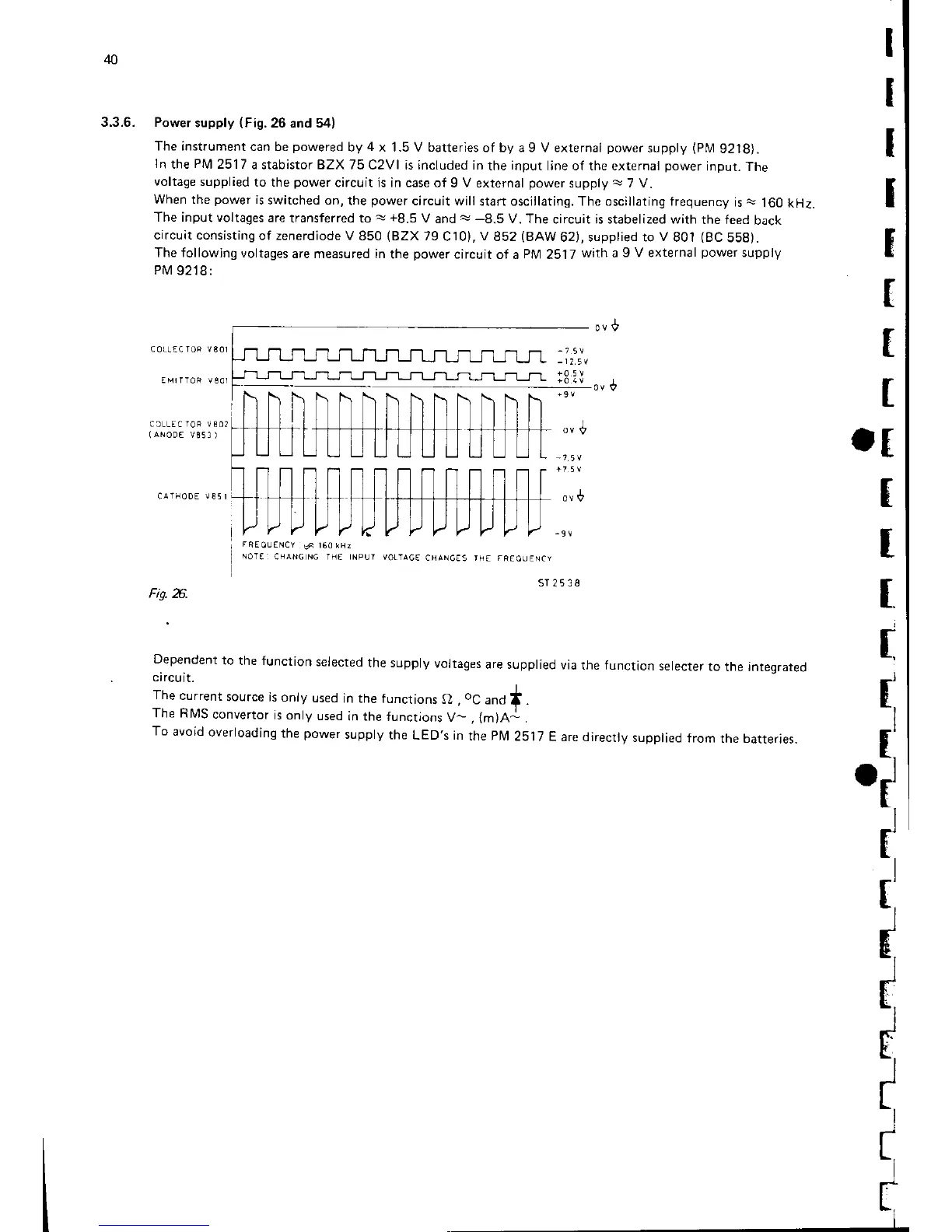
3.3.6. Power
supply
(Fig.26
and S)
The instrument
can be
powered
by
4
x 1.5 V batteries
of by a 9 V external
power
supply
(pM
92lg).
ln
the
PM
2517
a stabistor BZX 75
C2Vl is included in
the
input
line of the external
power
input.
The
voltage
supplied
to the
power
circuit is in case of
9
V
external
power
supply
-
7 V.
When the
power
is
switched on,
the
power
circuit will
start oscillating. The oscillating frequency
is:
160
kHz.
The input voltages
are
transferred to
!
+8.5
V
and
=
-8.5
V. The
circuit
js
stabelized with
the feed
back
circuit consisting
of zenerdiode V
850
{BZX
79
C10),
V
852
(BAW
62), supptied to
V
801
(BC
558).
The following
voltages
are measured in
the
power
circuit
oI a
PM
2511
with a
9 V external
power
supplV
P[/]
9218:
ov
ü
I
I
I
l
I
t
t
t
o, Ö
(aNo0E
v
85l
)
-7
5V
-r?
5v
+0
5v
0"0
_9V
ouü
sT25l8
CATNODE
!35I
.t
I
t
l
t
FREOUENCY
v^
160 kBz
NOT'
CHAN6 NG TH€
NPUI VOLTAGE
CIIANG€5 'IiE FREOUENCV
Fig.
.
Dependent
to the function
selected
the supply
voltages
are supplied
via
the function
selecter
to
the integrated
carcuit.
The
current
source
is only
used
in the
iunctions
e
.
oC
ana
*.
The
Rl/S
convertor
is
only
used in
the funcrions
V-
,
(m)Al
.
To
avoid
overloading
the
power
supply
the
LED's in
the PM
2517 E
are directly
supplied
from
the batteries.
q
q
rd
q
q
q
q
t

Table of Contents

Related product manuals