Philips Semiconductors
TDA1562Q application note
Koninklijke Philips Electronics N.V.
Application note Rev. 01.02 — 05 May 2006 13 of 62
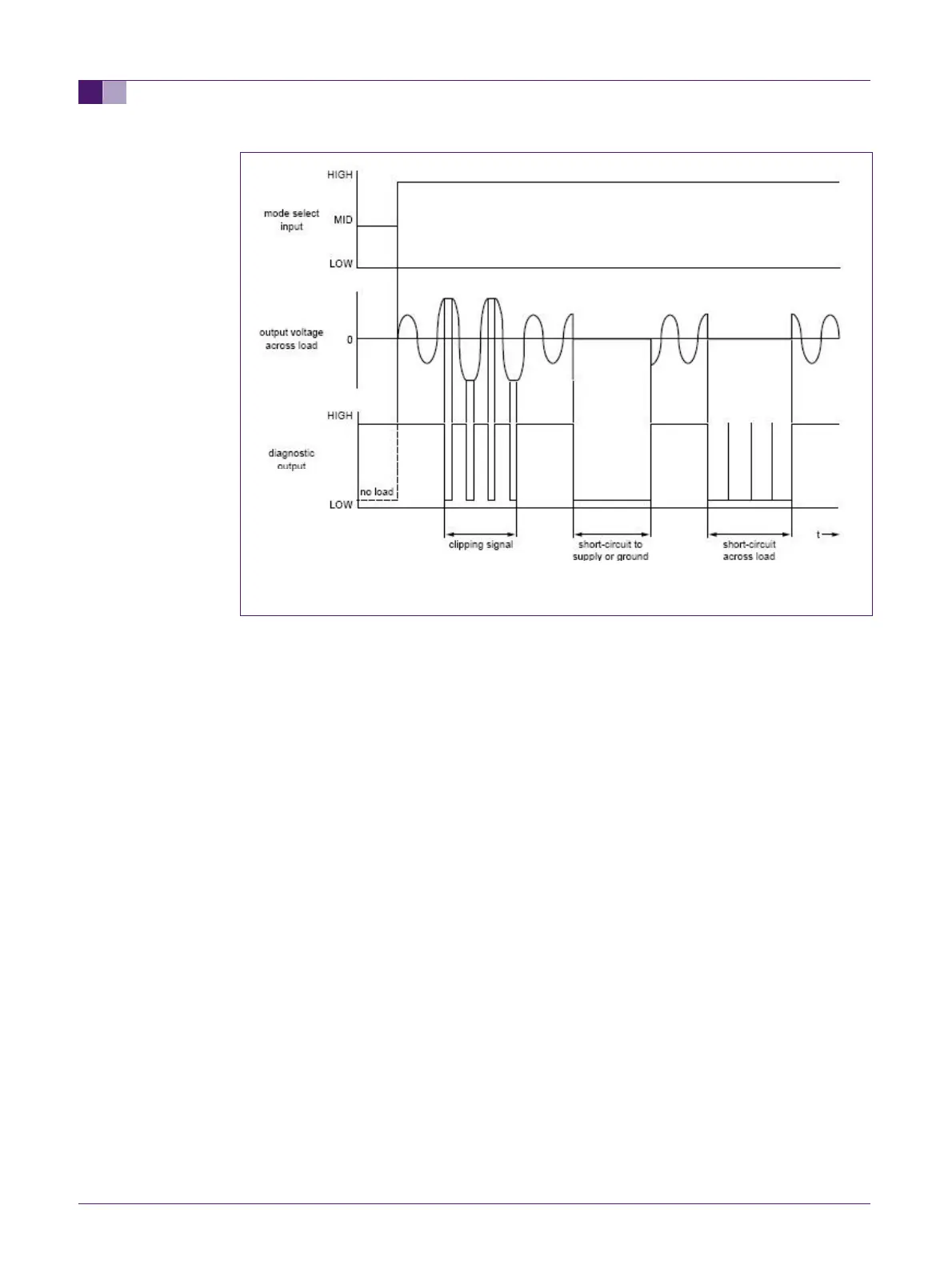
Fig 5. Diagnostic information
Finally, the diagnostic pin and the status I/O pin will give information, regarding the case
temperature and the die temperature.
Figure 6 shows the behavior of the output, the diagnostic pin and the status I/O pin, when
that pin is used as an output.
As long as the case temperature is below 120°C, the amplifier will be operating in full
class H mode, the lift circuits are enabled. When the case temperature reaches 120°C
the device will disable the class H circuits when the status I/O pin is open. When the
status I/O pin is forced high, the class H circuits will not be disabled and the amplifier will
continue working in class H mode. This type of operation is risky, since the class H
circuits will now be stressed more severely than they were meant to be.
When the status I/O pin is left floating or it is used as a diagnostic output, the voltage at
the status I/O pin will drop to between 2 and 3V.
When the case temperature continues rising after class H operation is disabled, the
overall temperature protection will be activated when the case temperature reaches
150°C. The thermal protection will reduce the output power until the case temperature
has sunk below 150°C again.
Just before the thermal protection becomes active, at a case temperature of 145°C, the
diagnostic pin will go low indicating a too high temperature.



 To Next Page