Philips Semiconductors
TDA1562Q application note
Koninklijke Philips Electronics N.V.
Application note Rev. 01.02 — 05 May 2006 22 of 62
• The lift capacitors Clift:
The lift capacitors are used to store the energy which is needed to lift the supply
voltage when the output power exceeds 10W.
The capacitance of the capacitors will determine the continuous output power at low
frequencies.
The larger the capacitance, the higher the continuous output power at low
frequencies.
Optimum performance can be achieved with 22000 µF lifter capacitors. Higher
values do not contribute noticeably to higher output powers at low frequencies.
Apart from the capacitance, the ESR (Equivalent Series Resistance) of the
capacitors is important.
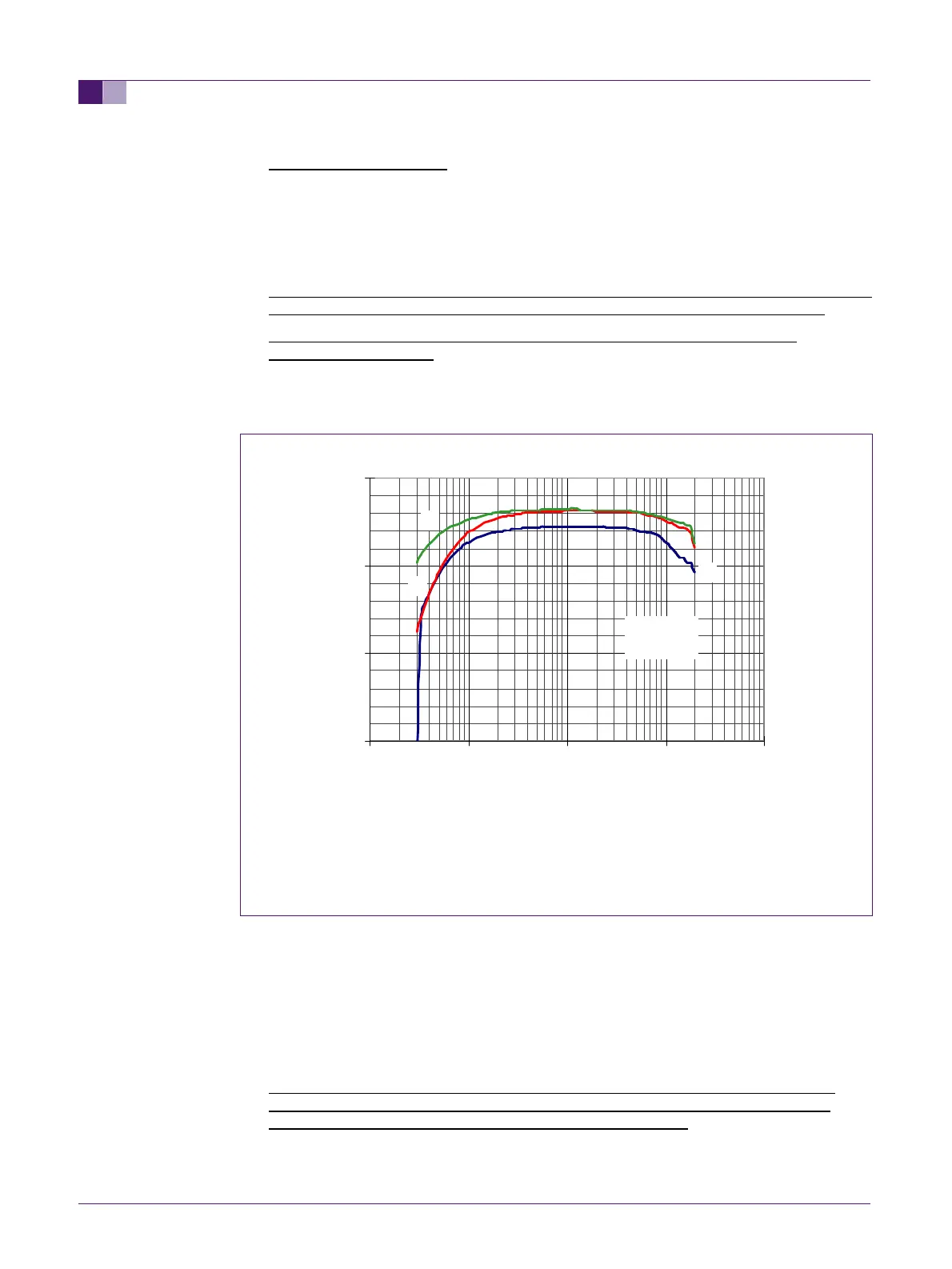
The influence of the capacitance and the ESR of the lift capacitors is illustrated in
fig.10.
A: Standard Multi purpose electrolytic capacitors 4700µF
B: Low ESR electrolytic capacitors 4700µF
C: Low ESR electrolytic capacitors 10000µF
Fig 10. The influence of ESR and capacitance of the lift capacitors on the output power
When the ESR is high, the power losses in the capacitors will be high too, resulting in
a reduction of output power. In fig. 10 it is visible that using Low ESR capacitors
instead of standard multi purpose electrolytics will result in a considerably higher
output power at frequencies above 100Hz. It is also visible that the standard
capacitors will run out of energy at 35Hz, causing the output power to drop very
sharply. Raising the capacitance of the lifter capacitors will result in a higher output
power at low frequencies
Especially when proper operation at extremely low temperatures is required, the
choice of the lift capacitors is very important. At low temperatures, the ESR of a
capacitor will increase, while the capacitance will decrease. It depends on what type
of capacitor is used, how much the ESR will increase and the capacitance will
decrease, but for applications where extremely low operating temperatures (below
30
40
50
60
0.01 0.1 1 10 100
F(kHz)
Po(W)
A
B
Rl=4ohm



 To Next Page