4
www.UsePhoenix.com • sales@UsePhoenix.comToll-Free 1-800-533-7533
4 Maintenance
4.1 Air Filter
The Phoenix R150 is equipped with a pleated media air lter
that must be checked regularly. The standard lter is a MERV-
8 high efciency lter. Operating the unit with a dirty lter will
reduce the dehumidier’s capacity and efciency and may
cause the compressor to cycle off and on unnecessarily. The
lter can generally be vacuumed clean several times before
needing replacement. Replacement lters can be ordered
from the manufacturer or purchased locally if available
IMPORTANT: DO NOT operate the unit without the filter or
with a less effective filter as the coils inside the unit could
become clogged and require disassembly to clean.
4.2 Storage
There are two issues to consider when the Phoenix
R150 is stored between uses and both pertain to the water
trapped in the unit: damage caused by freezing or biological
growth. The effect of the trapped water can be greatly
reduced if precautions are taken to remove as much as
possible before storage.
1. Use the pump PURGE button to reduce the water level in
the reservoir
2. Walk out the hose to drain it completely
In order to reduce biological growth ush the unit with a
biofungicide that is approved for use with copper, aluminum,
polyethylene and ABS. To ush:
1. Run the hose to a drain
2. Plug in the unit but do not turn it on
3. Remove the air lter. Slowly pour a pint of the chemical
through the top so that it drains into the heat exchanger
4. Use PURGE button to remove chemicals in reservoir. Run
PURGE until hose runs dry
5. Walk out hose to drain completely
6. Replace air lter
5 Service
WARNING: Servicing the Phoenix R150 with its high
pressure refrigerant system and high voltage circuitry
presents a health hazard which could result in death,
serious bodily injury, and/or property damage. Only
qualified service people should service this unit.
CAUTION: Do not operate unit without the front housing in
place.
5.1 Technical Description
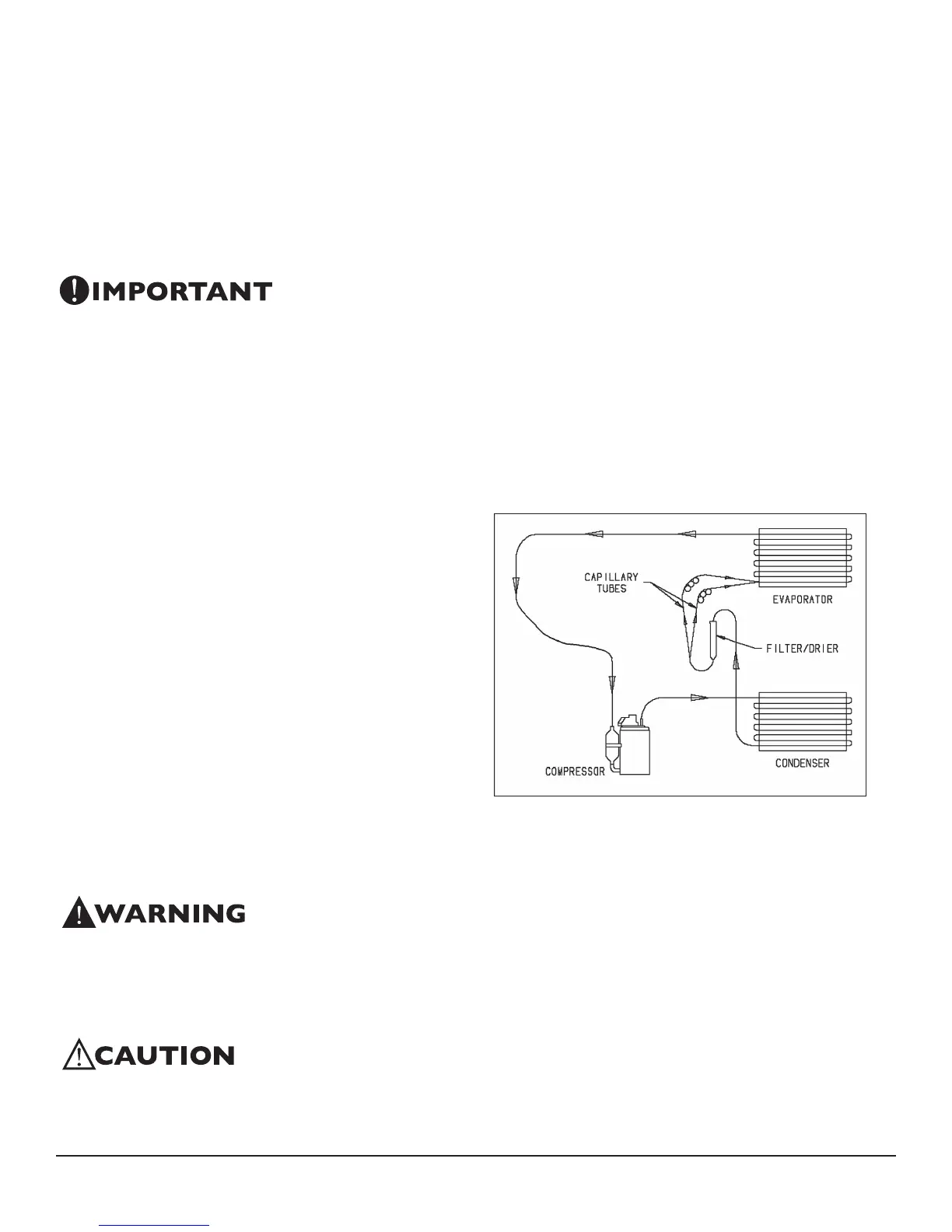
The Phoenix R150 uses a refrigeration system similar to an
air conditioner’s to remove heat and moisture from incoming
air and to add heat to the air that is discharged.
Hot, high pressure refrigerant gas is routed from the
compressor to the condenser coil. The refrigerant is cooled
and condensed by giving up its heat to the air that is about
to be discharged from the unit. The refrigerant liquid then
passes through a lter/drier and capillary tubing which cause
the refrigerant pressure and temperature to drop. It next
enters the evaporator coil where it absorbs heat from the
incoming air and evaporates.
The evaporator operates in a ooded condition, which means
that all the evaporator tubes contain liquid refrigerant during
normal operation. A ooded evaporator should maintain
constant pressure and temperature across the entire coil,
from inlet to outlet.
The mixture of gas and liquid refrigerant enter the
compressor after leaving the evaporator coil. The compressor
evacuates the cool refrigerant gas from the accumulator and
compresses it to a high pressure and temperature to repeat
the process.
Refrigeration system


 To Next Page