WHAT IS A CARDIOID MICROPHONE?
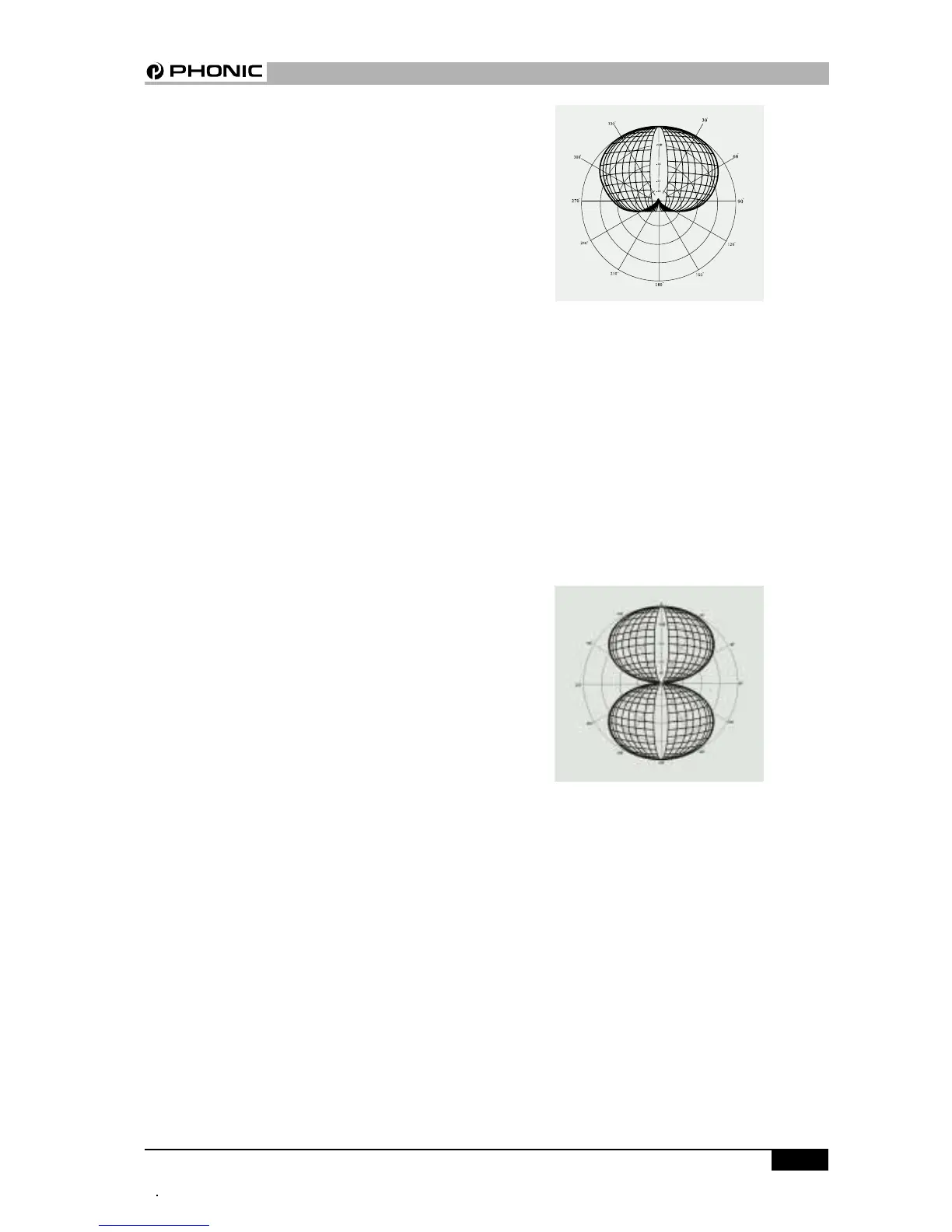
Cardioid means heart-shaped. Any microphone which
has a hearted-shaped Polar Pattern is called a car-
dioid microphone. The cardioid is most sensitive to
the sounds which arrive from the front. The sounds
which arrive from 90 degrees to the side are 6 Deci-
bels less sensitive than to the front, and theoretically,
it is completely insensitive to the sounds coming
from the rear. In practice, the 100% directional quali-
ties of a cardioid are impossible to achieve due to
reflected sounds from walls and ceiling, which are
entering the sensitive area of the microphone.
The most important attribute of the cardioid is that
the microphone can discriminate between direct
sounds and reverberant sounds, which come from
all other directions at random. One of the most im-
portant uses of the cardioid microphone is in sound
reinforcement, where the directivitive allows the sys-
tem gain to be higher without generating acoustic
feedback.
WHAT IS A FIGURE-8 MICROPHONE?
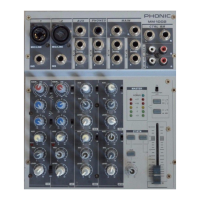
The derivation of the name for this pattern is obvious
from the following figure. Bi-directional elements are
most sensitive to sounds coming in from the front or
rear( left or right) of the microphone, and reject sounds
from the sides( front and rear).
CARDIOID POLAR PATTERN
FIGURE-8 POLAR PATTERN
PHONIC CORPORATION Page 11
CHANNEL STRIP DESCRIPTION
MM1002 / MM1202 USER’S MANUAL


 To Next Page