Need help?
Do you have a question about the Pioneer SX-1500TD and is the answer not in the manual?
Instructions for changing line voltage settings and replacing the fuse.
Guides for connecting loudspeakers and setting up FM/AM antennas for optimal reception.
Guides for tuning and receiving FM (mono/stereo) and AM radio broadcasts.
Instructions for playing records, tape, using a microphone, and recording.
Identifies common noises and conditions mistaken for faults, with remedies.
Step-by-step instructions for aligning the FM tuner section of the receiver.
Procedures for aligning the MPX and AM sections for optimal performance.
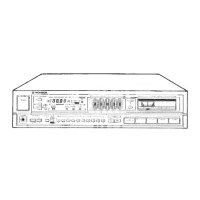
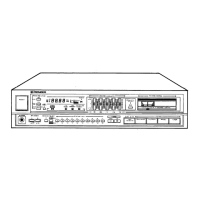
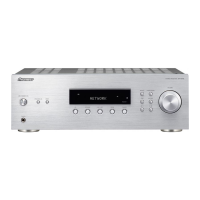
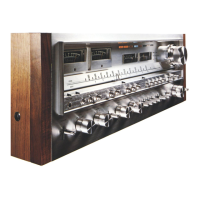
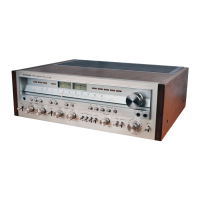
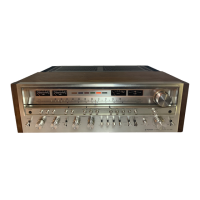
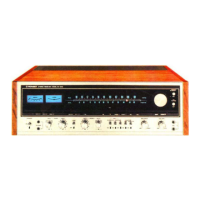
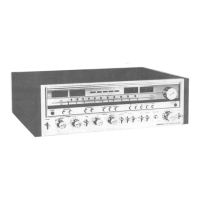
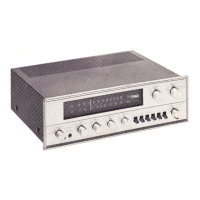
The Pioneer SX-1500TD is a solid-state AM/FM stereo receiver, designed to deliver high-fidelity audio performance and versatile connectivity for a comprehensive home stereo system. This receiver is engineered with a focus on both sound quality and user convenience, making it suitable for a wide range of audio enthusiasts.
At its core, the SX-1500TD functions as a central hub for various audio sources, integrating an AM/FM tuner, a preamplifier, and a power amplifier into a single unit. The FM tuner section is particularly advanced, utilizing a field-effect transistor (FET) in its radio-frequency amplifier to achieve high sensitivity and selectivity. This design minimizes interference and noise, ensuring clear reception of FM broadcasts. Furthermore, the intermediate-frequency amplifier incorporates four integrated circuits (ICs) to enhance signal processing and reduce unwanted artifacts. For FM stereo reception, a built-in MPX (multiplex) circuit with excellent separation and frequency response is included, designed to reproduce music with a sense of realism and depth. The AM tuner section is equally capable, featuring a highly-sensitive ferrite antenna that provides strong reception for AM programs.
The audio section of the SX-1500TD is designed for versatility and high performance. It boasts a powerful output, achieved through carefully selected transistors, allowing it to drive multiple loudspeaker systems simultaneously. The receiver supports the connection of up to three loudspeaker systems, two record players, and a tape recorder, making it a flexible component for various audio setups. Dedicated terminals are provided for tape recording output, a center channel output, preamplifier output, and power amplifier input, offering extensive options for system expansion and customization.
A unique feature of this receiver is its microphone input, complete with an independent microphone amplifier and level control. This allows users to mix microphone audio with other program sources, such as record play, providing creative possibilities for home entertainment or announcements.
The SX-1500TD is designed for intuitive and enjoyable use, featuring a well-organized front panel with a range of controls and indicators. The newly designed knobs are uniquely arranged on a silver-tone panel, contributing to its elegant aesthetic.
Key controls include the SPEAKERS switch, which doubles as the power on/off switch and a loudspeaker system selector. This allows users to choose between different speaker configurations (A, B, C, A+B, A+C) or to turn off the speakers when using headphones. The TUNING meters, vertically arranged, facilitate precise selection of FM broadcast programs, with one meter indicating signal strength and the other for fine-tuning. An FM STEREO indicator lamp illuminates when a stereo FM program is received, providing visual confirmation.
The SELECTOR switch allows users to choose their desired program source from AM, FM MONO, FM AUTO, PHONO 1, PHONO 2, and AUX. Each selection is accompanied by the illumination of a corresponding PROGRAM INDICATOR LAMP.
Audio adjustments are comprehensive, with separate BASS and TREBLE controls for each channel, allowing for precise tone shaping. These controls are friction-coupled, enabling simultaneous adjustment of both channels or independent adjustment of left and right channels. A VOLUME control adjusts the overall sound level, while a BALANCE control fine-tunes the stereo image.
Additional features enhance the listening experience. The LOUDNESS switch, when activated at low volume levels, compensates for perceived insufficiencies in bass and treble frequencies, providing a fuller sound. The MUTING switch helps eliminate noise generated during FM station tuning, particularly useful in areas with weak signals. A TAPE MONITOR switch allows for monitoring signals from a tape deck, which is essential for three-head tape recorders or for simply listening to a connected tape source. The MODE switch offers various listening modes, including REV (reversed stereo channels), STEREO (normal stereo), L (left channel only to both speakers), R (right channel only to both speakers), and L+R (mixed mono to both speakers), providing flexibility for different audio content and preferences.
Connectivity on the rear panel is extensive, including PHONO 1 and PHONO 2 terminals for record players (supporting moving magnet and ceramic cartridges), AUX input for other audio equipment, TAPE MON and TAPE REC terminals for tape decks, and a DIN-type TAPE REC/PB connector for simplified tape deck integration. AM and FM antenna input terminals are provided, along with a built-in AM ferrite loopstick antenna for convenience. PRE AMP OUTPUT and MAIN AMP INPUT terminals allow for the use of external preamplifiers or power amplifiers, or for integrating the SX-1500TD into a multi-amplifier system. A CENTER CHANNEL OUTPUT terminal facilitates the creation of a 3-D stereo system or connection to a dedicated center channel amplifier. Multiple AC outlets (switched and unswitched) are available for powering other audio components.
The SX-1500TD incorporates several features that simplify maintenance and ensure long-term reliability. A crucial aspect is the LINE VOLTAGE SELECTION AND FUSE system. The receiver is shipped configured for 240V operation, but it can be easily adapted to different line voltages (110V, 117V, 130V, 220V, 240V) by adjusting a selector switch and installing the appropriate fuse. Instructions are provided for removing the fuse cap and plug, selecting the correct voltage, and ensuring the proper fuse rating (1.5-ampere for 220V/240V, 3-ampere for 110V/117V/130V). This user-adjustable voltage selection makes the unit adaptable to various regions and power grids.
Fuse replacement is straightforward: if a fuse blows, the user can easily remove the fuse cap and install a new one, ensuring continued operation.
The manual also includes a "CONDITIONS FREQUENTLY MISTAKEN FOR TROUBLES" section, which serves as a valuable troubleshooting guide. This section helps users diagnose common audio issues, such as continuous noise, hum, hiss, or poor tone quality, by identifying potential external sources of interference (e.g., fluorescent lamps, motors, TV sets, worn styluses, poor connections) rather than immediately assuming a device fault. It provides practical remedies, such as improving antenna setup, ensuring proper grounding, checking connections, or adjusting listening levels, empowering users to resolve minor issues without professional assistance. This proactive approach to troubleshooting enhances the user's ability to maintain optimal performance of the receiver.
 General
| Type | Stereo Receiver |
|---|---|
| Tuning range | FM, MW |
| Total Harmonic Distortion | 0.5% |
| Speaker Impedance | 4Ω to 16Ω |
| Input Sensitivity | 2.5mV (MM), 200mV (line) |
| Signal-to-Noise Ratio | 70dB (MM), 80dB (line) |
| Speaker load impedance | 4 ohms to 16 ohms |
| Output Impedance | 8 Ohms |

 To Next Page