SECTION 9
PA-28-181, ARCHER III SUPPLEMENT 22
ISSUED: JULY 12, 1995 REPORT: VB-1611
REVISED: SEPTEMBER 12, 2005 5 of 10, 9-147
SECTION 9
PA-28-181, ARCHER III SUPPLEMENT 22
ISSUED: JULY 12, 1995 REPORT: VB-1611
REVISED: SEPTEMBER 12, 2005 5 of 10, 9-147
SECTION 7 - DESCRIPTION AND OPERATION
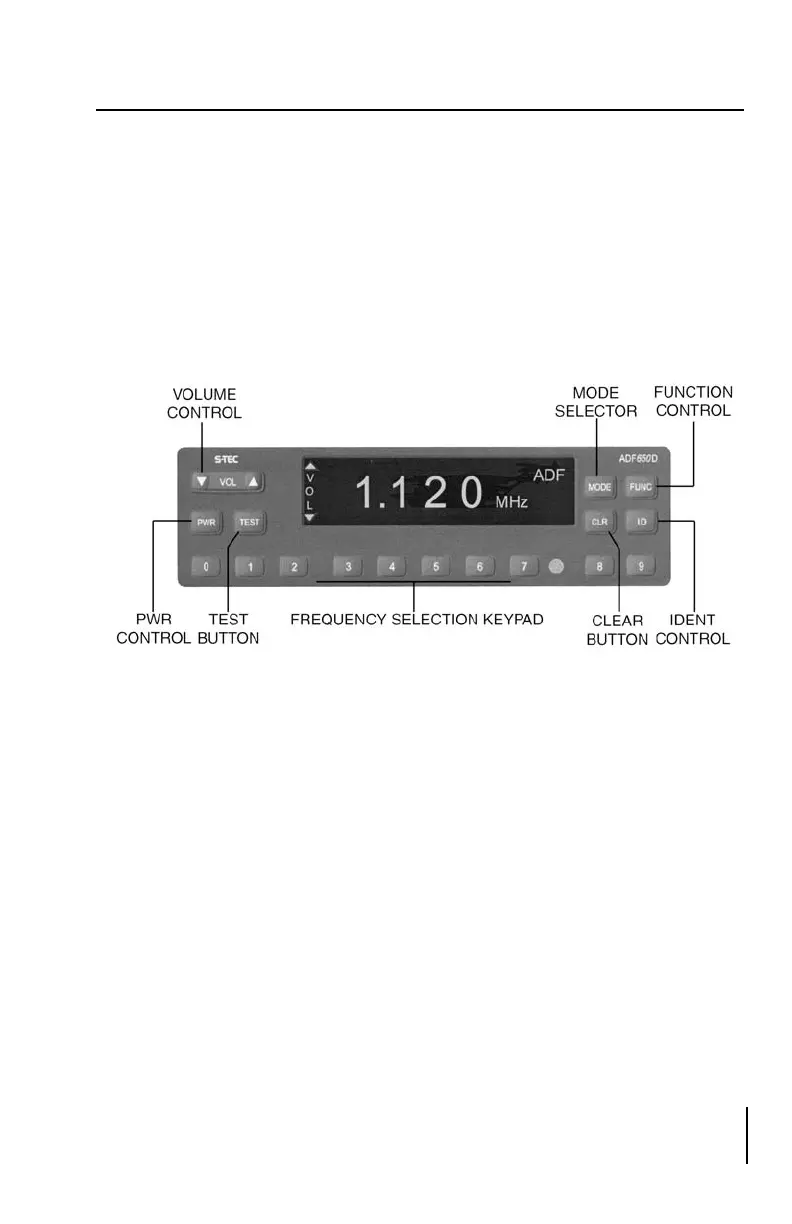
The S-TEC ADF-650D System operates over a frequency range of 200 through
1799 kHz in 1-kHz increments. Three operating modes are included as part of
the ADF-650D System.
• BFO
• ADF
• ANT
RCR-650D Receiver Controls
Beat Frequency Oscillator (BFO) Mode
The BFO (beat frequency oscillator) mode is used to aurally identify stations
that employ keyed CW (Carrier Wave) rather than amplitude modulation
techniques. This mode activates the bearing pointer. The bearing pointer will
point in the direction of the station relative to the aircraft heading.
NOTE
CW signals (Morse Code) are unmodulated and no audio
will be heard without use of BFO. This type of signal is
not used in the United States air navigation. It is used in
some foreign countries and marine beacons.
SECTION 7 - DESCRIPTION AND OPERATION
The S-TEC ADF-650D System operates over a frequency range of 200 through
1799 kHz in 1-kHz increments. Three operating modes are included as part of
the ADF-650D System.
• BFO
• ADF
• ANT
RCR-650D Receiver Controls
Beat Frequency Oscillator (BFO) Mode
The BFO (beat frequency oscillator) mode is used to aurally identify stations
that employ keyed CW (Carrier Wave) rather than amplitude modulation
techniques. This mode activates the bearing pointer. The bearing pointer will
point in the direction of the station relative to the aircraft heading.
NOTE
CW signals (Morse Code) are unmodulated and no audio
will be heard without use of BFO. This type of signal is
not used in the United States air navigation. It is used in
some foreign countries and marine beacons.




 To Next Page