Need help?
Do you have a question about the Planet VIP-200 and is the answer not in the manual?
Details the key features and capabilities of the PLANET Internet Telephony Gateway series.
Explains industry-standard networking protocols supported by the VIP series for voice communication.
Lists the items included in the product package, such as the gateway, cables, and manuals.
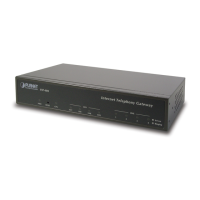
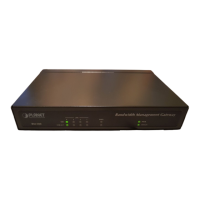
Describes the front panel layout, including LEDs, ports, and the reset button.
Details the components and ports located on the rear panel of the VIP gateway.
Specifies the essential network requirements for the successful operation of the VIP gateway.
Provides step-by-step instructions for installing the VIP gateway and its telephony interface modules.
Guides on connecting the VIP gateway to the network and providing AC power.
Explains the process of obtaining and assigning a static IP address, subnet mask, and default gateway.
Describes the fundamental operational flow of the VIP gateway in digitizing and transmitting voice over IP.
Explains the role of ATPM in mapping telephony numbers to IP addresses via the dial plan database.
Details how calls are terminated (Destination) and how multiple destinations are grouped (Hunt Group).
Outlines the components of the dial plan: Address Table, Hunt Group Table, and Destination Table.
Covers DTMF relay techniques and supported voice codecs for efficient voice transmission.
Guides on preparing the PC and accessing the VIP gateway's web interface for configuration.
Covers phone numbers, hunt groups, destinations, common parameters, and dial plan management.
Details how to view system configurations like firmware, H.323, coders, and channel parameters.
Explains how to configure DHCP, PPPoE, and DDNS for internet connectivity.
Covers IP settings and H.323 parameter configurations for the gateway.
Describes the process of making calls using the FXS module and connected analog phones.
Explains how to make calls using the FXO module connected to a PBX or central office.
Illustrates call scenarios between gateways and PSTN phones with configuration examples.
Demonstrates setting up VIP-to-VIP communication in a dynamic IP environment using PPPoE and DDNS.
Provides solutions for issues related to Power, Link, and Slot A/B LED indicators not illuminating.
Addresses problems like no dial tone, out-of-service tones, or no connected tone during calls.
Details how to connect to the VIP gateway using a serial port and a terminal emulator.
Explains how to establish a Telnet connection to the VIP gateway for command-line access.
Covers accessing command help, designating IP addresses, and port numbers for CLI commands.
Provides an alphabetical listing of CLI commands and their functions, categorized by command set.
Explains basic utility commands like clrscr, download, help, and ping.
Details commands for configuring and displaying network parameters like IP, gateway, DHCP, PPPoE, and DDNS.
Covers commands for managing system configuration parameters, activating, storing, and erasing settings.
Explains commands for managing dial plan tables: address, destination, hunt group, and system settings.
Details commands related to telephony port settings, including PCM gain and ring frequency.
Covers configuration commands specific to E&M signaling interfaces for various start modes.
Guides on how to perform a firmware upgrade using a TFTP server and CLI commands.
Provides instructions on setting up a TFTP server and allocating firmware files for the upgrade.
Lists and explains CLI commands available when the VIP is in download mode for firmware operations.
Explains how to restore the VIP gateway to its factory default settings.
Provides detailed technical specifications for the VIP series, including modules, ports, codecs, and management.
Lists specifications for FXO, FXS, and E&M telephony interface cards.
Details the pin assignments for Console, LAN, FXO, FXS, and E&M ports.
Lists and describes all CLI commands available in normal operation mode.
Lists and describes CLI commands specifically for firmware download mode.
Lists the default settings for network parameters, serial port, and H.323 configurations.
A worksheet to record IP address, subnet mask, and default gateway information.
A worksheet to help define and assign destination IDs for local telephony ports.
A worksheet for planning and grouping destinations into hunt groups.
A worksheet for defining telephone numbers, digits, and hunt group mappings for the address table.
 General
| Number of FXS Ports | 2 |
|---|---|
| Protocols | SIP |
| Voice Codec | G.711, G.723.1, G.729A |
| Operating Temperature | 0°C to 40°C |
| Storage Temperature | -20°C to 70°C |
| Humidity | 10 ~ 90% (non-condensing) |
| Ports | 2 FXS, 1 Ethernet |


 To Next Page