Need help?
Do you have a question about the Plockmatic Pro50 and is the answer not in the manual?
Steps for opening the main shipping box and removing internal protective materials.
Placing foam supports and ramp, then removing foam protections from the machine.
Carefully rolling the Booklet Maker down the wooden ramp to its operational position.
Steps to open the cardboard box and access the internal protective packaging.
Procedure for carefully removing the deburster unit from its protective foam and box.
Unpacking the cover feeder by opening the box and removing initial foam supports.
Steps to access the main cover feeder unit and its included accessory packages.
Instructions for opening the main shipping container of the Square Folder SQF50/35.
Detailed steps for removing various layers of protective foam and securing the care pack.
Ensuring the care pack is saved and the machine is ready for the next steps.
Instructions for opening the main shipping container of the Trimmer TR50/35.
Detailed steps for removing protective foam, accessing the trimmer unit, and its accessories.
Steps for positioning the trimmer and organizing its accessory box.
Initial steps for opening the main shipping box and noting safety instructions.
Procedure for removing foam, plastic wrap, and separating accessories from the main unit.
Steps for preparing the machine for movement using ramps and manual handling.
The Pro50/35 Booklet Making System is a comprehensive solution designed for the automated production of booklets, offering a range of modules that can be integrated to create a complete workflow from feeding to finishing. This system is built to streamline the process of creating professional-quality booklets, making it suitable for various print environments.
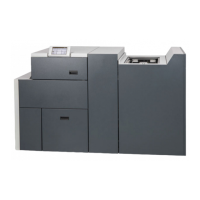
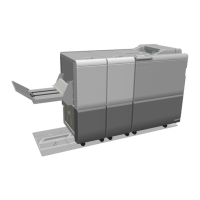
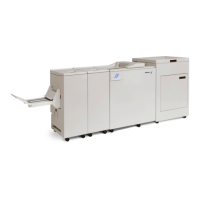
The core function of the Pro50/35 Booklet Making System is to transform printed sheets into finished booklets. This is achieved through a series of integrated modules, each performing a specific task. The system typically starts with a Booklet Maker, which handles the collation, stapling, and folding of sheets. Following this, a Deburster can be integrated to remove any burrs or rough edges from the stapled booklets, ensuring a clean finish. For applications requiring covers, a Cover Feeder is used to automatically add pre-printed covers to the collated sets. To enhance the professional appearance of booklets, a Square Folder module can be added to create a flat, square spine, mimicking the look of perfect-bound books. Further refinement is provided by the Trimmer, which precisely cuts the edges of the booklet for a neat and uniform size. Finally, for more advanced finishing, the RCT Rotator Creaser Trimmer offers capabilities for rotating, creasing, and trimming, allowing for complex booklet designs and improved print quality by preventing toner cracking on folds. Each module is designed to work in conjunction with the others, creating a continuous and efficient production line for booklets.
The Pro50/35 system is designed for ease of use and operational efficiency. The unpacking instructions for each module highlight a straightforward setup process, often involving removing packaging materials, foam supports, and utilizing a wooden ramp to safely move the equipment off its pallet. This indicates a focus on user-friendly installation. Once set up, the modular nature of the system allows users to configure it according to their specific production needs, whether it's a basic staple and fold operation or a more elaborate process involving covers, square folding, and precision trimming. The system's automated functions reduce manual intervention, leading to higher productivity and consistent output quality. For instance, the automatic feeding mechanisms of the Booklet Maker and Cover Feeder ensure a continuous supply of sheets, minimizing downtime. The precise trimming and folding capabilities contribute to a professional finish, which is crucial for high-quality print jobs. The integration of various modules means that a single pass through the system can complete multiple finishing steps, saving time and labor. The system is also designed to handle a variety of paper types and sizes, offering flexibility for different booklet projects.
Maintenance of the Pro50/35 Booklet Making System is facilitated by clear instructions and the design of the modules. The unpacking process itself emphasizes the importance of saving certain items, such as the docking plate, installation package, care pack, foam supports, wooden ramp, and waste box. The "care pack" mentioned in the unpacking instructions for the Booklet Maker and Square Folder suggests that essential maintenance tools or consumables are provided with the device, indicating a proactive approach to user maintenance. The waste box for the RCT Rotator Creaser Trimmer also points to a design that considers waste management, making it easier for users to keep the machine clean and functional. While detailed maintenance procedures are not explicitly outlined in the provided pages, the emphasis on saving specific components and the inclusion of a care pack imply that routine cleaning, part replacement, and general upkeep are expected and supported. The modular design could also simplify maintenance, as individual units might be easier to access and service compared to a single, monolithic machine. Regular maintenance, as suggested by the care pack, would ensure the longevity and optimal performance of each module, contributing to consistent high-quality booklet production.
 General
| Speed | Up to 50 booklets per hour |
|---|---|
| Dimensions | 1422 x 686 x 1041 mm (56" x 27" x 41") |
| Stapling Capacity | 50 sheets |
| Book Thickness | Up to 5 mm |
| Maximum Sheet Capacity | 50 sheets |

 To Next Page