
 Need help?
Do you have a question about the Poly Voyager Focus 2 Office and is the answer not in the manual?
Diagram and description of the headset's controls and functions.
Important safety, charging, battery, and regulatory information.
Details on connecting the headset system to various desk phone types.
Steps to re-pair the headset with the base unit.
Steps to pair the headset with a smartphone or other mobile device.
How to put the headset and base into pairing mode.
Guidance on positioning the microphone boom for comfort and clarity.
How to charge the headset using the base or a USB cable.
How to check the remaining battery level of the headset.
Steps to update the headset firmware for improved performance.
How to turn the headset and base unit on and off.
How to adjust headset, desk phone, and base ringtone volumes.
Instructions for managing calls on the headset and base.
Controlling audio playback and track selection using headset buttons.
Activating Siri, Google Assistant, or Cortana via the headset.
Adjusting Active Noise Cancelling levels for different environments.
Setting default lines and understanding the online indicator LED.
Using the headset via USB cable for improved audio performance.
Troubleshooting specific problems related to the headset itself.
Diagnosing and resolving static, distortion, and echo issues.
Resolving buzzing sounds heard by callers and voice assistant activation problems.
Resolving softphone call initiation, volume, distortion, and echo problems.
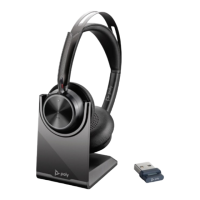
This document describes the Poly Voyager Focus 2 Office, a Bluetooth headset system designed for use with both computers and desk phones. It provides a comprehensive user guide covering setup, basic functions, advanced features, and troubleshooting.
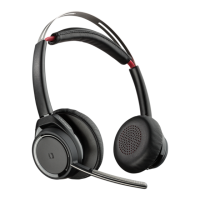
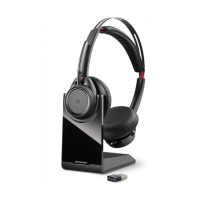
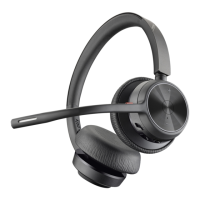
The headset itself is a Bluetooth device with Active Noise Cancelling (ANC) capabilities, allowing users to switch between off, low, and high settings to manage external noise. It features volume up and down controls, a call button that also interacts with Microsoft Teams (for Teams models), and dedicated buttons for play/pause, next track, previous track, and mute/unmute. The headset is powered on/off with a slide switch and includes a Bluetooth pairing function. The microphone boom is rotatable, allowing users to wear the headset on either the right or left side, with the audio automatically syncing to the chosen orientation. The boom should be positioned approximately two finger widths from the corner of the mouth for optimal performance. The headband is flexible for comfort.
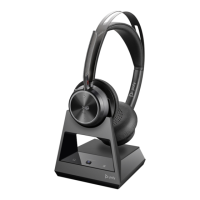
The base serves as the central hub for the system, connecting the headset to both a computer and a desk phone. It includes buttons for computer and Microsoft Teams (Teams model only), a Bluetooth LED, a desk phone button, and a charging LED. On the back, it has a USB port, a power jack, a handset lifter jack, a telephone interface cable jack, and a Bluetooth pairing button. The base also features controls for desk phone listening and speaking volume, along with a desk phone configuration switch (A-G) to ensure compatibility with various phone models. The base is designed to charge the headset when placed in its cradle.
Usage features of the Voyager Focus 2 Office are extensive. For setup, users can choose from several configurations depending on their desk phone type (dedicated headset port, standard, with EHS cable, or with HL10 lifter). The base's configuration switch (A-G) needs to be adjusted for optimal compatibility, with 'A' being the default for most phones and 'D' for Cisco phones. Proper positioning of the base is crucial, with a minimum recommended separation of 6 inches from the desk phone and 12 inches from the computer to prevent noise and interference.
Pairing the headset to the base is typically pre-done, but instructions are provided for re-pairing. The headset can also be paired to a mobile device by putting it into pair mode and searching for "Poly VFOCUS2 Series" on the mobile device's Bluetooth settings. The headset can pair with up to 8 devices but maintain only 2 connections simultaneously, including the base.
Charging the headset is done by placing it in the base's cradle or by connecting it via a micro USB cable to a computer or wall charger. LEDs on the headset indicate charging status, with a full charge taking approximately 2 hours. Battery status can be checked by sliding and releasing the power switch, which triggers a voice alert or illuminates headset LEDs.
Basic call management includes powering the headset on/off, adjusting headset volume, and fine-tuning desk phone listening and speaking volumes on the base. The base also has an adjustable ringtone volume to alert users of incoming calls when not wearing the headset. For softphone calls, microphone volume can be adjusted through a test call. Users can make calls by tapping the computer or desk phone audio button on the base, which provides a dial tone. Answering and ending calls can be done via the headset's call button or the corresponding audio button on the base. Muting is possible by tapping the mute button, rotating the microphone boom up, or taking off the headset (if smart sensors are active).
Advanced call features include holding calls (by pressing the headset call button for 2 seconds or the base's audio button for 2 seconds) and switching between calls. For Teams models, the dedicated Teams button on both the headset and base allows quick access to the Microsoft Teams desktop app, viewing notifications, or joining meetings.
Smart sensors enhance usability by automatically responding to headset wear. For example, putting on the headset can answer a mobile/softphone call or resume music/media, while taking it off can keep a call in the headset or pause music/media. Sensors can be reset if they are not functioning correctly or disabled through the Poly Lens App or by holding specific headset buttons.
More features include controlling audio playback (play/pause, next/previous track, fast forward/rewind) using the call button. A voice assistant (Siri, Google Assistant, Cortana) can be activated by pressing and holding the call button for 2 seconds when paired to a smartphone and out of base range. ANC can be set to low (for office) or high (for loud environments). The default outbound phone line/audio channel can be changed in the Poly Lens App. An online indicator (red LED) informs others when the user is on a call. For environments with Bluetooth density problems, a "corded mode" allows direct connection of the headset to a computer via a USB cable, improving audio performance while also charging the headset.
Maintenance features primarily involve firmware updates and software management. Users are encouraged to load the Poly Lens App (or Plantronics Hub App) to customize device behavior, access advanced settings, and enable call control functionality for softphones. Firmware updates, performed via the Poly Lens App, are crucial for improving performance and adding new features. During updates, it's important not to use the device, disconnect from paired devices, avoid starting a second update, refrain from streaming media, and not answer or place calls.
Troubleshooting guidance is provided for common issues. If no dial tone is heard, users should check headset charge and pairing, adjust the base's configuration switch, verify base-to-desk phone connections, and ensure the HL10 lifter is operating correctly. For static, users should ensure proper separation between the base, computer, and telephone, and move closer to the base if out of range. Distorted sound can be resolved by lowering desk phone speaking/listening volumes, adjusting headset volume, and checking base positioning. Echo in the headset requires lowering desk phone speaking/listening volumes and potentially adjusting headset volume or microphone position. If others hear a buzz, the base should be moved further from the phone or plugged directly into a wall outlet. Issues with Siri/Google Now activation are addressed by ensuring the headset is out of base range and paired to the smartphone. Handset lifter problems require checking its power cord connection. Softphone dialing issues point to checking headset charge and pairing, Poly Lens App installation, and ensuring the headset is the default sound device. Low/high speaking/listening volume in softphones can be adjusted via headset controls, computer sound settings, or the softphone application. Softphone sound distortion/echo can be fixed by reducing volumes, repositioning the microphone, or lowering headset volume. Finally, if PC speakers are not producing audio, users are guided to adjust sound playback settings in their computer's control panel or system preferences. For Teams model users, instructions are provided on how to interact with Microsoft Teams and how the headset works with other softphones, including setting the target softphone in Poly Lens Desktop App. Audio cutting out during softphone calls suggests Bluetooth density problems, recommending the use of corded mode.
 General
| Battery Life (ANC off) | 24 hours |
|---|---|
| Compatibility | PC, Mac, Mobile devices |
| Wearing style | Over-the-ear |
| Connectivity | Bluetooth |
| Battery Life (ANC on) | Up to 16 hours |
| Noise Cancellation | Active Noise Cancelling (ANC) |
| Multi-device Pairing | Yes |
| Charging Time | 2 hours for full charge |
| Ear Cushions | Memory foam with leatherette |
| Warranty | 2-year limited warranty |





 To Next Page