
 Need help?
Do you have a question about the Polycom Poly VVX Series and is the answer not in the manual?
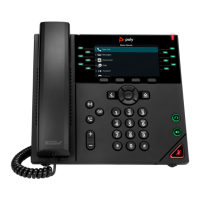
Phone's default display for selecting lines, viewing calls on shared lines, or quickly calling favorites.
Access new calls, messages, directories, Do Not Disturb, Call Forwarding, settings, and applications.
Steps to initiate a call using the handset, speakerphone, or headset.
Methods to answer incoming calls via handset, speakerphone, headset, or softkey.
Procedure to park an active call and retrieve it later using the PARK button.
Instructions for placing an active call on hold and resuming it.
How to mute and unmute a call during an active conversation.
Enabling and disabling the DND feature to send calls directly to voicemail.
Steps to initiate a conference call with two other parties.
Transferring a call to another party without announcing it first.
Announcing a call to the recipient before transferring it.
Transferring a call directly to another user's voicemail.
Guide to adding new contacts, including setting favorites.
Using navigation arrows to view call history like Missed, Received, and Placed Calls.
First-time procedure to set up the voicemail mailbox.
Options for updating voicemail greetings, name, and password.
How to check for new voicemail messages using the Voicemail button and password.
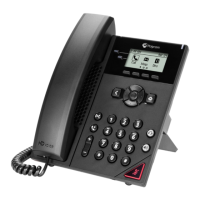
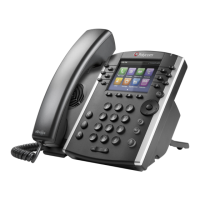
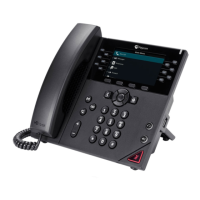
This document describes the features and functions of the Poly VVX Series phone, a device designed for voice communication with various advanced capabilities.
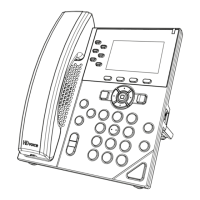
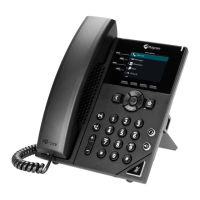
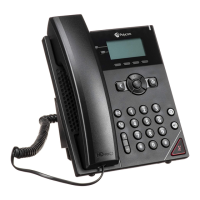
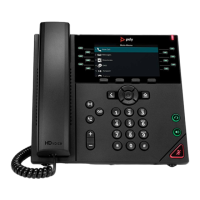
The Poly VVX Series phone is a voice communication device that allows users to place, answer, and manage calls, as well as access voicemail and directory services. It supports standard telephony functions like hold, mute, transfer, and conferencing, alongside features for contact management and call history. The phone's interface is divided into a "Lines View" for active calls and favorites, and a "Home View" for accessing broader features like messages, directories, and settings.
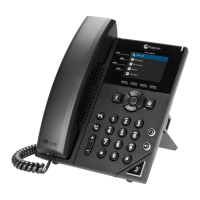
The document does not explicitly list technical specifications such as display type, resolution, processor, memory, or network connectivity standards (e.g., Ethernet, Wi-Fi). However, it implies the presence of a graphical display, a keypad, dedicated function buttons (e.g., Speakerphone, Headset, Voicemail, Hold, Mute), and softkeys that change contextually. The phone supports multiple lines, indicated by "Line Keys," and features a "Message Waiting Indicator" for visual notification of new voicemails. Audio features include a speakerphone and headset support.
*, *, and then the Extension, and press "Transfer" again.5 for settings. Options include recording mailbox greeting, recording name, changing password, recording/using temporary greeting, and deleting temporary greeting.#, and follow audio prompts.The document does not detail specific maintenance features such as firmware updates, troubleshooting guides, or cleaning instructions. However, it implicitly suggests that system administrators play a role in managing certain aspects of the phone's functionality, such as resetting voicemail passwords or configuring DND settings. This indicates that some administrative control and support are available for the device.


 To Next Page
 General