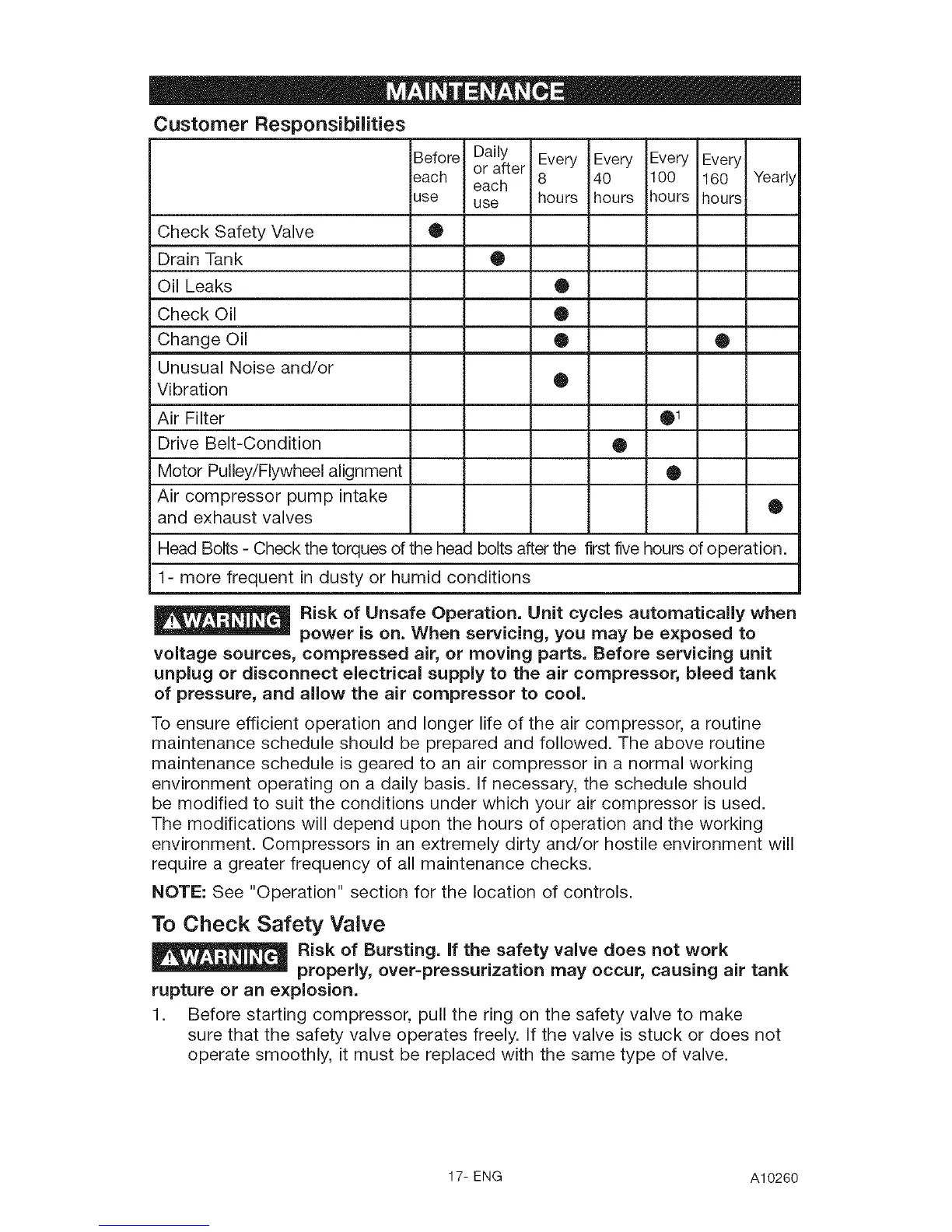
Customer Responsibilities
Before Daily Every Every Every Every
or after
each each 8 40 100 160 Yearly
use use hours hours hours hours
Check Safety Valve •
Drain Tank •
Oil Leaks •
Check Oil •
Change Oil • •
Unusual Noise and/or
IVibration •
' O1A_r Filter
Drive Belt-Condition •
Motor Pulley/Flywheel alignment •
iAir compressor pump intake
and exhaust valves •
Head Bolts - Check the torques of the head bolts afterthe first five hours of operation.
1- more frequent in dusty or humid conditions
_Risk of Unsafe Operation. Unit cycles automatically when
-- power is on. When servicing, you may be exposed to
voltage sources, compressed air, or moving parts. Before servicing unit
unplug or disconnect electrical supply to the air compressor, bleed tank
of pressure, and allow the air compressor to cool.
To ensure efficient operation and longer life of the air compressor, a routine
maintenance schedule should be prepared and followed. The above routine
maintenance schedule is geared to an air compressor in a normal working
environment operating on a daily basis. If necessary, the schedule should
be modified to suit the conditions under which your air compressor is used.
The modifications will depend upon the hours of operation and the working
environment. Compressors in an extremely dirty and/or hostile environment will
require a greater frequency of all maintenance checks.
NOTE: See "Operation" section for the location of controls.
To Check Safety Valve
_Risk of Bursting. If the safety valve does not work
-- properly, over-pressurization may occur, causing air tank
rupture or an explosion.
1. Before starting compressor, pull the ring on the safety valve to make
sure that the safety valve operates freely. If the valve is stuck or does not
operate smoothly, it must be replaced with the same type of valve.
17- ENG A10260



 To Next Page