12
SURFACE GRINDING WITH GRINDING WHEELS
1. Allow the tool to reach full speed before touching the tool to the
work surface.
2. Apply minimum pressure to the work surface, allowing the tool
to operate at high speed. Grinding rate is greatest when the tool
operates at high speed.
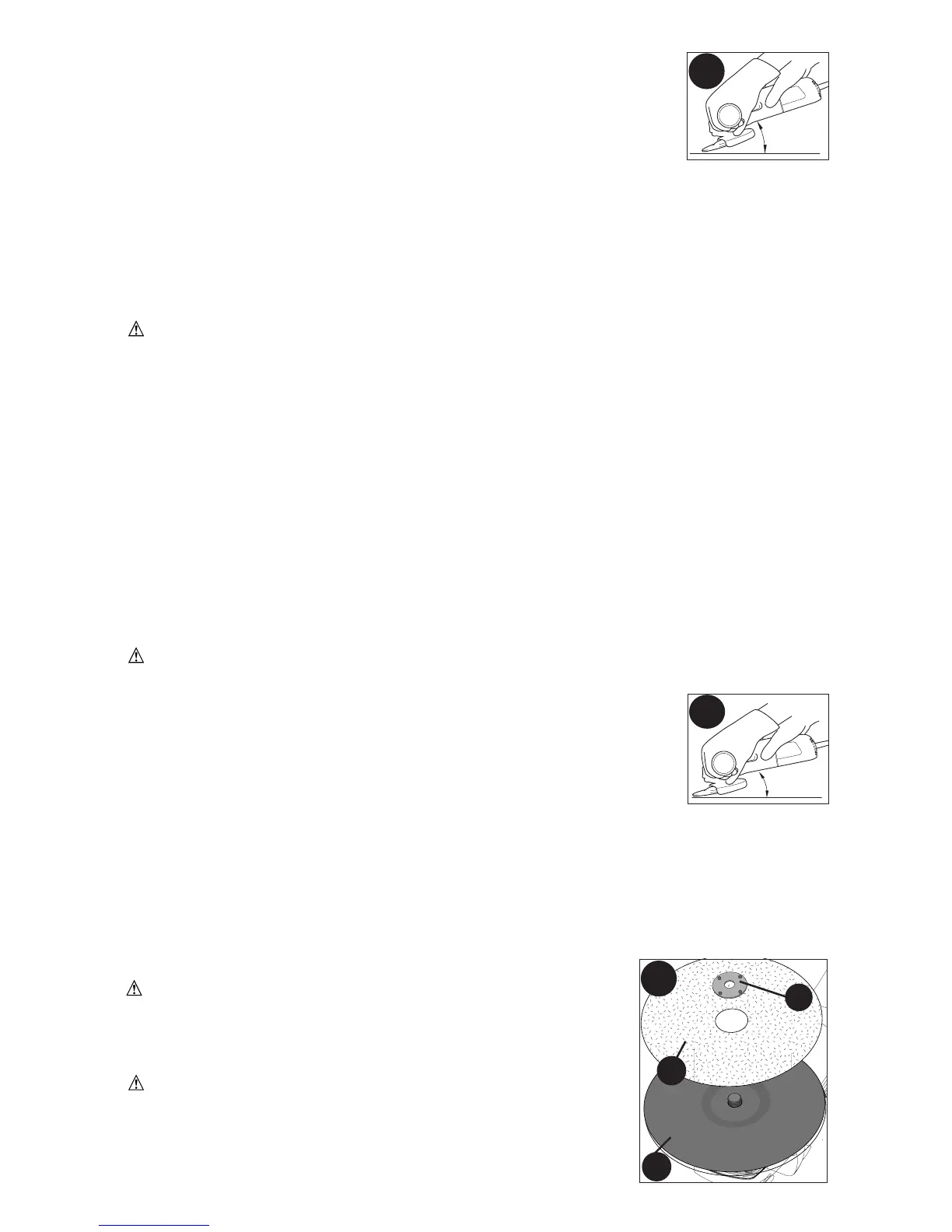
3. Figure J - Maintain a 20˚ to 30˚ angle between the tool and work surface.
4. Continuously move the tool in a forward and back motion to avoid creating gouges in
the work surface.
5. Remove the tool from work surface before turning tool off. Allow the tool to stop
rotating before laying it down.
EDGE GRINDING WITH GRINDING WHEELS
CAUTION: Wheels used for edge grinding may break or kick back if they bend or
twist while the tool is being used to do cut-off work. To reduce the risk of serious
injury, limit the use of these wheels with a standard Type 27 guard to shallow cutting and
notching (less than 1/2 inch (13mm) in depth). The open side of the guard must be
positioned away from the operator. For deeper cutting with a Type 1 cut-off wheel, use a
closed Type 1 guard. See pages 9 and 10 for more information.
1. Allow the tool to reach full speed before touching the tool to the work surface.
2. Apply minimum pressure to the work surface, allowing the tool to operate at high
speed. Grinding rate is greatest when the tool operates at high speed.
3. Position yourself so that the open-underside of the wheel is facing away from you.
4. Once a cut is begun and a notch is established in the workpiece, do not change the
angle of the cut. Changing the angle will cause the wheel to bend and may cause
wheel breakage. Edge grinding wheels are not designed to withstand side pressures
caused by bending.
5. Remove the tool from the work surface before turning the tool off. Allow the tool to
stop rotating before laying it down.
CAUTION: Do not use edge grinding wheels / cutting wheels for surface grinding
applications because these wheels are not designed for side pressures encountered
with surface grinding. Wheel breakage and injury may result.
SURFACE FINISHING WITH SANDING FLAP DISCS
1. Allow the tool to reach full speed before touching the tool to the
work surface.
2. Apply minimum pressure to work surface, allowing the tool to
operate at high speed. Sanding rate is greatest when the tool
operates at high speed.
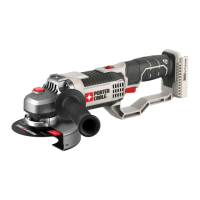
3. Figure K - Maintain a 5˚ to 10˚ angle between the tool and work surface.
4. Continuously move the tool in a forward and back motion to avoid creating gouges
in the work surface.
5. Remove the tool from work surface before turning tool off. Allow the tool to stop
rotating before laying it down.
MOUNTING SANDING BACKING PADS
WARNING: To prevent accidental operation, turn off and
unplug tool before performing the following operations.
Failure to do this could result in serious personal injury.
NOTE: Guard may be removed when using sanding backing pads.
WARNING: Proper guard must be reinstalled for grinding
wheel, sanding flap disc, cutting wheel, wire brush or wire
wheel applications after sanding applications are complete.
1. Figure L - Place or appropriately thread backing pad (14)
on the spindle.
J
20˚-30˚
K
5˚-10˚
13
14
15
L


 To Next Page