13
3.2.2 Sensor types and Input wiring
Run the cable through the glands & tighten. Unplug the green connectors and wire in as required. Ensure
unused glands are replaced with blanking plugs to prevent water from getting inside the unit.
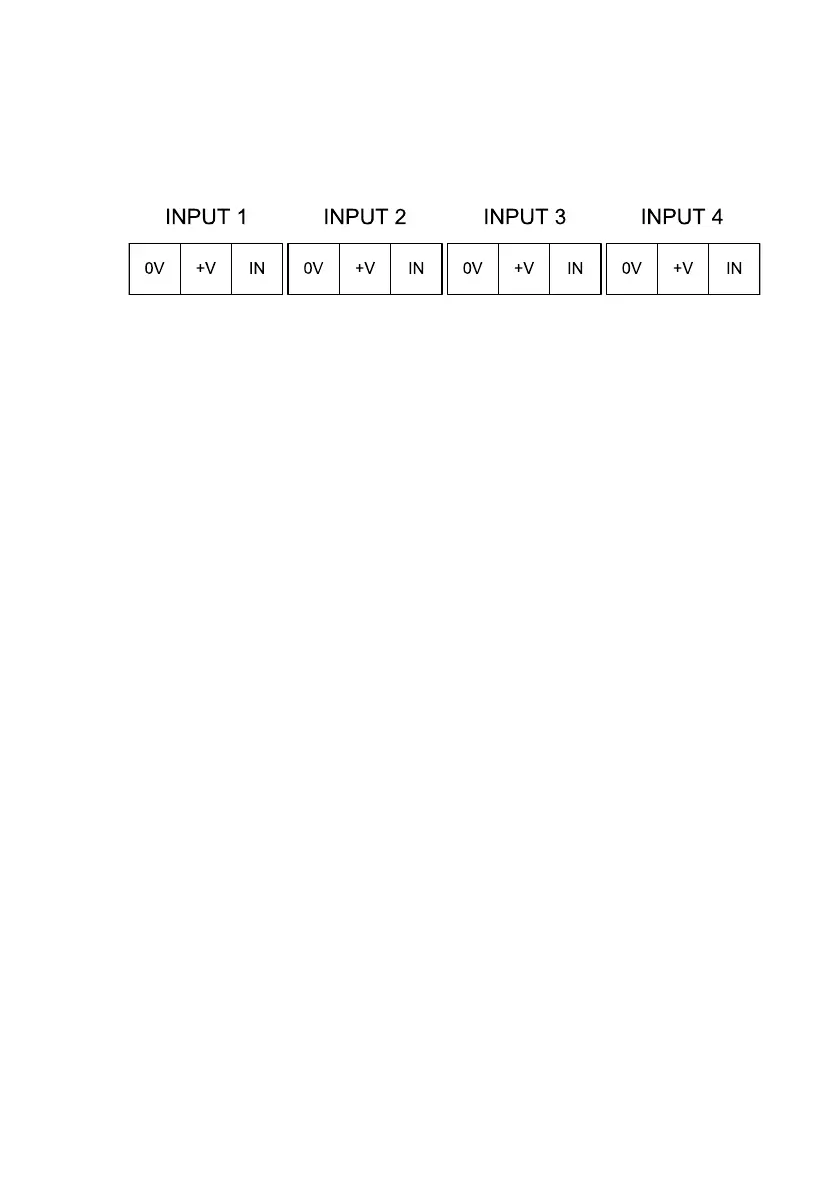
Each input channel has its own plug and corresponding socket. On each socket, three connections are
available.
0V: This is the 0V / -Ve connection for the channel, although they are all common to each other.
+V: This will provide the supply voltage to the channel, also known as the excitation voltage. This is
configurable to either 21.6V, 5V or 3.6V (un-regulated). It is important that the load on this does not exceed
31.25mA.
IN: This is the input for the channel, also known as ‘signal.’ This will accept 0-10V or 4-20mA.
Note: It is important that the channel used for the sensor excitation and the sensor inputs are the same.
0 – 10V output (three wire)
This sensor type will typically have a greater than 14V input, while the output will vary between 0 and 10V
depending on the readings. Generally, but not always, these use less power than the same sensor type with a
4-20mA output.
0 – 5V ratiometric (three wire)
The sensor will be supplied with 5V (+/- 2.5%) – with this the sensor feeds a proportion of the voltage back to
the input. Usually this type requires very little power.
4 – 20mA loop (two wire, +V and IN)
The sensor is measured using a current loop. This means that the total power consumption of the sensor varies
between 4 and 20mA depending on the measurement of the sensor. The benefit of using a current based
output is that it is generally more immune to external interference than a voltage output.
4 – 20mA or 0 – 20mA powered (three wire)
This type is powered from a separate supply and the output varies depending on the measurement of the
sensor. This type of sensor is usually used when the minimum current requirement exceeds 4mA meaning a
two wire system is not possible.
Switched input / Volt free contact (two wire, +V and IN)
This is simply a switch – the contact will be supplied with 3.6V from the +V contact. The input will monitor the
state of the switch using this wetting voltage.
Other – Please contact Powelectrics with any other sensor type
3.2.3 Output wiring


 To Next Page