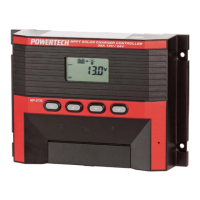
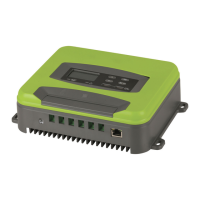
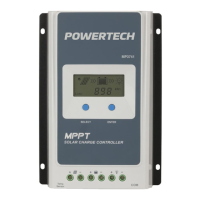
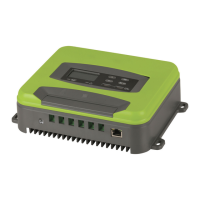
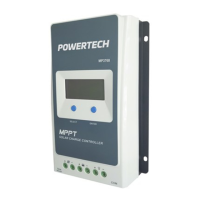
The POWERTECH Dual Battery Solar Controller (MP-3760) is a solar charge controller designed to manage the charging of two separate battery banks from solar panels. It is suitable for use in various applications such as RVs, caravans, boats, and buses.
Function Description:
The primary function of this device is to efficiently charge two independent battery banks simultaneously using solar power. Unlike single-battery charge controllers, this unit addresses the common issue of neglecting the motor start battery when camped in one spot for extended periods, by ensuring both house battery banks or one house bank and the motor start battery are charged. It employs highly efficient Pulse-Width Modulation (PWM) charging technology to optimize battery charging. The controller provides electronic protection against overcharging, short circuits, and accidental reverse battery connections, ensuring the safety and longevity of the batteries and the system.
Important Technical Specifications:
- Output Current: Provides up to 10A charging current across both channels (limited by the size of your solar panels).
- System Voltage: Works with both 12V and 24V DC systems, with automatic detection.
- Max Solar Input Voltage:
- 30V for 12V systems
- 55V for 24V systems
- Battery Input Voltage Range:
- 8-15V for 12V systems
- 8-30V for 24V systems
- Battery Types Supported: Sealed, Gel, and Flooded batteries.
- Charging Voltages (for 12V system, multiply by 2 for 24V):
- Equalize Charging Voltage: 14.6V (Sealed), - (Gel), 14.8V (Flooded)
- Boost Charging Voltage: 14.4V (Sealed), 14.2V (Gel), 14.6V (Flooded)
- Float Charging Voltage: 13.8V (Sealed), 13.8V (Gel), 13.8V (Flooded)
- Boost Time: 2 hours.
- Self-Consumption:
- 4mA at night
- 10mA during charging
- Temperature Compensation: -30mV/12V/°C.
- Terminals: 4mm².
- Operating Temperature: -35°C to +55°C.
- Dimensions: 153 x 76 x 37mm.
- Net Weight: 250g.
Usage Features:
- Dual Battery Charging: Capable of charging two completely separate battery banks simultaneously or even a single battery.
- Automatic Battery Voltage Detection: The regulator automatically detects the battery voltage (12V or 24V).
- Battery Type Selection: Allows users to select the battery type (Sealed, Gel, or Flooded) to ensure optimal charging profiles.
- Charging Priority Setting: Users can set the charging priority as a percentage for Battery #1, and the controller automatically calculates the remaining percentage for Battery #2. If only Battery #1 is detected, all power is automatically sent to Battery #1. When Battery #1 is fully charged, more charge will go to Battery #2. If Battery #1's voltage drops, the system reverts to the priority setting.
- Charging Frequency Selection: Users can select the PWM charging frequency (25Hz pre-set, 50Hz, or 100Hz).
- Remote Temperature Sensor (RTS) Support: Features a connection point for an optional RTS to remotely monitor battery temperature, allowing for more accurate battery regulation. In the absence of an RTS, the controller uses a local temperature sensor.
- Local Temperature Sensor: Measures ambient temperature to adjust battery regulation accordingly.
- Remote Meter Connection: Includes a communication port for an optional remote meter (not included) to display charging status and other information.
- LED Indicators: Provides visual feedback on charging status, battery status, and errors through LEDs.
- Multiple flashes per second: Short circuit.
- One flash per second: Fully charged.
- LED ON: Charging.
- One flash every 3 seconds: Battery connected, no charge current.
- LED OFF: No connection or over voltage.
Maintenance Features:
- Electronic Protection: Built-in safeguards against overcharging, short circuits, and reverse battery connections help protect the system from damage and reduce the need for frequent maintenance due to electrical faults.
- Troubleshooting Guide: The manual provides a clear troubleshooting section based on LED flash patterns, enabling users to quickly diagnose common issues such as short circuits, fully charged batteries, active charging, no charge current, or no connection/over voltage. This simplifies maintenance and problem-solving for the user.

 Need help?
 General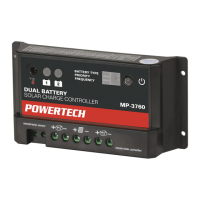

 To Next Page