EasyManua.ls Logo

Precor 515e - Page 19

Precor 515e
23 pages
Print Icon
To Next Page IconTo Next Page
To Previous Page IconTo Previous Page
Loading...
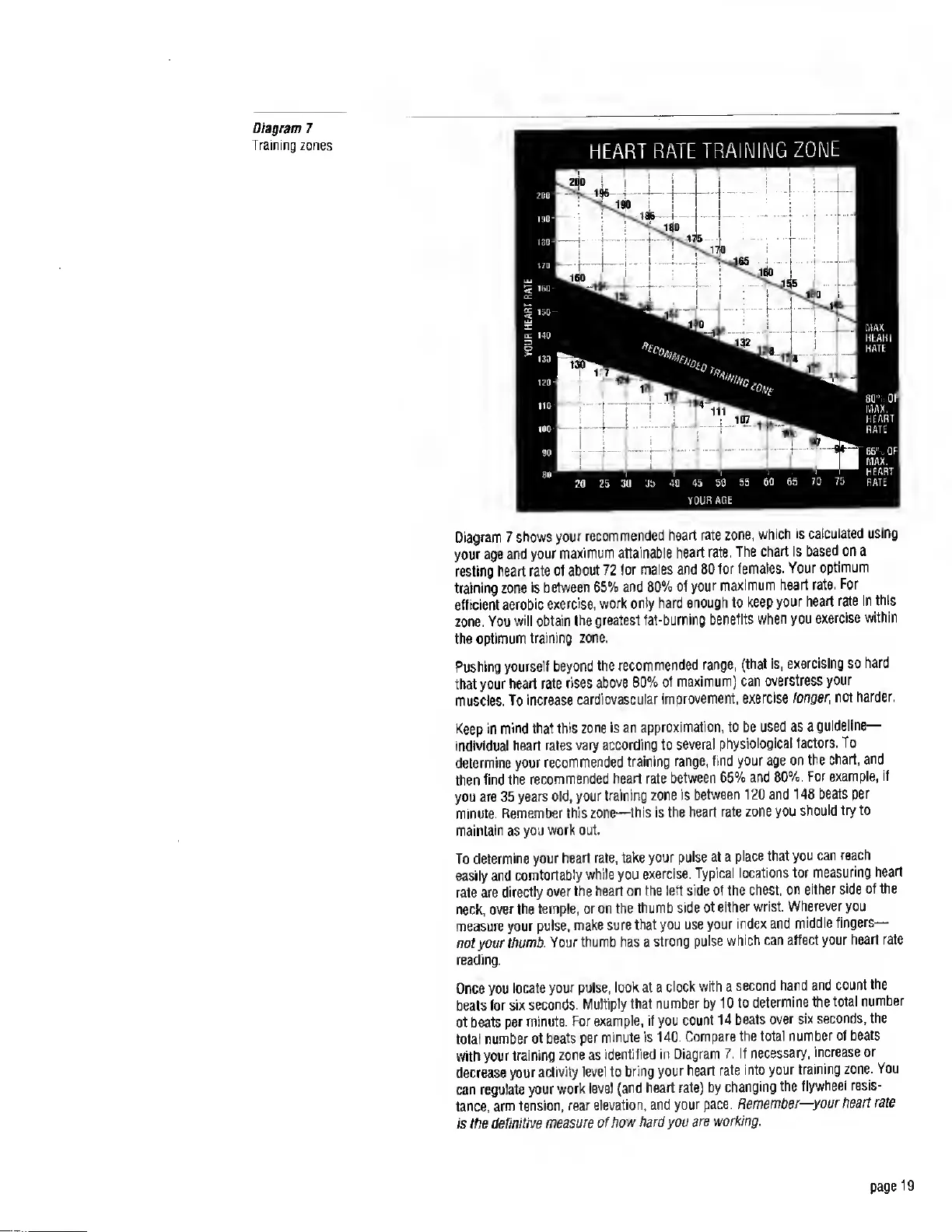
Diagram
7
Training
zones
Diagram
7
shows
your
recommended
heart
rate
zone,
which
is
calculated
using
your
age
and
your
maximum
attainable
heart
rate.
The
chart
is
based
on
a
resting
heart
rate
ot
about
72
tor
males
and
80
for
females.
Your
optimum
training
zone
is
between
65%
and
80%
of
your
maximum
heart
rate.
For
efficient
aerobic
exercise,
work
only
hard
enough
to
keep
your
heart
rate
In
this
zone.
You
will
obtain
the
greatest
fat-burning
benefits
when
you
exercise
within
the
optimum
training
zone.
Pushing
yourself
beyond
the
recommended
range,
(that
is,
exercising
so
hard
that
your
heart
rate
rises
above
80%
of
maximum)
can
overstress
your
muscles.
To
increase
cardiovascular
improvement,
exercise
longer,
not
harder.
Keep
in
mind
that
this
zone
is
an
approximation,
to
be
used
as
a
guideline-
individual
heart
rates
vary
according
to
several
physiological
factors.
To
determine
your
recommended
training
range,
find
your
age
on
the
chart,
and
then
find
the
recommended
heart
rate
between
65%
and
80%.
For
example,
if
you
are
35
years
old,
your
training
zone
is
between
120
and
148
beats
per
minute.
Remember
this
zone—this
is
the
heart
rate
zone
you
should
try
to
maintain
as
you
work
out.
To
determine
your
heart
rate,
take
your
pulse
at
a
place
that
you
can
reach
easily
and
comfortably
while
you
exercise.
Typical
locations
for
measuring
heart
rate
are
directly
over
the
heart
on
the
left
side
of
the
chest,
on
either
side
of
the
neck,
over
the
temple,
or
on
the
thumb
side
of
either
wrist.
Wherever
you
measure
your
pulse,
make
sure
that
you
use
your
index
and
middle
fingers—
not
your
thumb.
Your
thumb
has
a
strong
pulse
which
can
affect
your
heart
rate
reading.
Once
you
locate
your
pulse,
look
at
a
clock
with
a
second
hard
and
count
the
beats
for
six
seconds.
Multiply
that
number
by
10
to
determine
the
total
number
of
beats
per
minute.
For
example,
if
you
count
14
beats
over
six
seconds,
the
total
number
of
beats
per
minute
is
140.
Compare
the
total
number
of
beats
with
your
training
zone
as
identified
in
Diagram
7.
If
necessary,
increase
or
decrease
your
activity
level
to
bring
your
heart
rate
into
your
training
zone.
You
can
regulate
your
work
level
(and
heart
rate)
by
changing
the
flywheel
resis¬
tance,
arm
tension,
rear
elevation,
and
your
pace.
Remember—your
heart
rate
is
the
definitive
measure
of
how
hard
you
are
working.
page
19

Related product manuals