Jazzy 1113 www.pridemobility.com 9
II. SAFETY
Public Streets and Roadways
WARNING! You should not operate your power chair on public streets and roadways. Be
aware that it may be difficult for traffic to see you when you are seated on your power
chair. Obey all local pedestrian traffic rules. Wait until your path is clear of traffic, and
then proceed with extreme caution.
Stairs and Escalators
Power chairs are not designed to travel up or down stairs or escalators. Always use a lift.
WARNING! Never use your power chair to negotiate steps or escalators. You may cause
injury to yourself and to others and/or damage your power chair.
Doors
n Determine if the door opens toward or away from you.
n Drive your power chair gently and slowly forward to push the door open. Or drive your power chair gently and
slowly rearward to pull the door open.
Lifts
Modern liftss have a door edge safety mechanism that, when pushed, reopens the lift door(s).
n If you are in the doorway of a lift when the door(s) begin to close, push on the rubber door edge or allow the
rubber door edge to contact the power chair and the door will reopen.
n Use care that pocketbooks, packages, or power chair accessories do not become caught in lift doors.
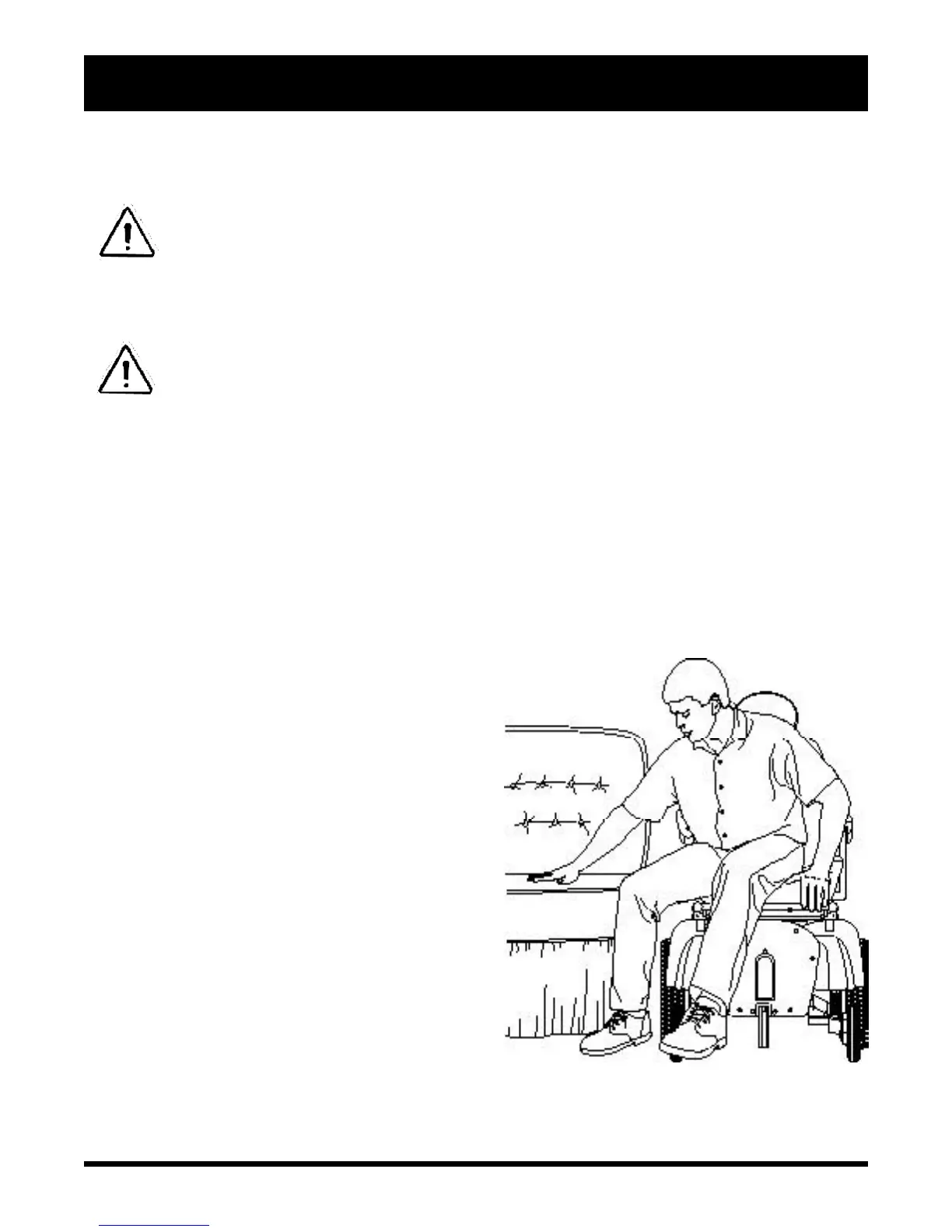
Figure 4. Ideal Transfer Position
Lift/Elevation Products
If you will be traveling with your power chair, you may
find it necessary to use a lift/elevation product to aid in
transportation. Pride recommends that you closely review
the instructions, specifications, and safety information set
forth by the manufacturer of the lift/elevation product be-
fore using that product.
Motor Vehicle Transport
Currently, there are no standards approved for tie-down
systems in a moving vehicle of any type to transport a
person while seated in a power chair.
Transfers
Transferring onto and off of your power chair requires a
good sense of balance. Always have an attendant or
healthcare professional present while learning to properly
transfer yourself.


 To Next Page