-13-
4.
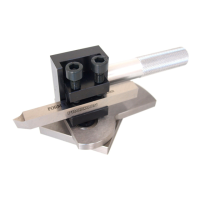
Release all clamp screws (1) and drive the individual retaining
jaws (2) onto the work piece
If the work piece is not round and smooth at the support point, it
must
first be turned round.
Lubricate the jaws and work piece regularly when turning.
5.
Check that the work piece is positioned in the steady free of
play and retighten clamp screws (1).
Careand Maintenance
Cleaning
Caution!
Always disconnect the mains plug for all adjustment and mainten-
ance
work! Risk of serious injuries or damage due to inadvertent
starting up of the device, or hazarddue to electric shock!
1.
After use, thoroughly clean all chips from the machine using a
brush or handbrush. Do not use compressed air for cleaning.
2. Regularly lubricate or oil all moving parts, spindles and guides!
The outside of the housing can be cleaned with asoft, dry or
damp cloth. Do not use compressed air when cleaning.
It is possible to use mild soap or other suitable cleaning agent
here. Solvents or cleaning agents containing alcohol (e.g. petrol,
cleaning alcohol etc.) should be avoided, since these can attack
the plastic housing casings as well as wash offthe lubricants. To
avoid fireortoxic reaction, never use gasoline, naphtha, acetone,
lacquer thinner,orsimilar highly volatile solvents to clean the lathe.
Do not allow brake fluids, gasoline, or penetrating oils to come in
contact with the plastic parts. They contain chemicals that can
damage or destroy plastics.
Please observe:
All electrical or mechanical repairs should be done only by quali-
fied service technicians. When servicing use only PROXXON repla-
cement parts. Use of any other parts may create ahazardorcause
product damage.
Any attempt to repair or replace electrical parts on this lathe may
create ahazardunless repair is done by aqualified service techni-
cian. Repair service is available at your PROXXON service center.
Lubricating:
Lubricate or oil all parts according to lubrication diagram (Fig. 26).
A=oil /lubricate beforeuse
B=oil /lubricate once amonth
Adjusting the play of the guides (Fig. 27)
Turn switch OFF and always remove plug from power source befo-
re making any adjustments or repairs.
Note:
Even if the guides areregularly lubricated or oiled, it is unavoidable
that the guides will exhibit play after some time due to wear.
The proceduredescribed hereusing the example of the upper car-
riage is the same for all guides, thereforeitapplies analogously to
the other guides on your lathe. For that reason they will not be
treated separately here. Adjust the guides according to the motto:
As "tightly" as necessary,aseasy running as possible!
Please consider: If guides areset too closely,this causes higher
operating forces as well as increased wear!
1.
Release and slightly unscrew the counter nuts 1ofthe adju-
sting screws 2for the upper carriage 3using an open-end
spanner
5.
2. Evenly turninthe adjusting screws 2with an Allen key 4until
the
play is eliminated.
3. Retighten the counter nuts 1. In the process, hold the adjusting
scr
ews 2inposition with the fixed spanner 5sothat they do
not misadjust again.
4. Turn over the machine and slightly unscrew the set screw 2
(Fig.
28).
5. Then check if the support can still be moved easily and if it runs
completely without play.
Adjusting the play of the handwheels (Fig. 29):
Just
as for the guides, handwheel wear during operation cannot be
avoided which ensures that the backlash increases slowly but con-
sistently
.Tominimise this again, please proceed as follows:
1. Hold on to the handwheel 1and release the cap nut 2.
2. Turn the handwheel slightly to the right.
3. Retighten the cap nut while still holding the handwheel.
Please consider hereaswell:
The complete elimination of the backlash and atoo "tight" adjust-
ment for the handwheels is unreasonable: If the handwheels are
set too closely,this causes higher operating forces as well as
increased wear hereaswell!


 To Next Page