PAGE 2
GENERAL DESCRIPTION:
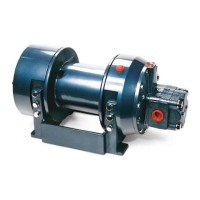
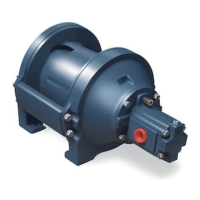
The PULLMASTER Model M50 is a planetary hydraulic winch having equal speed in both directions. The main
components of this unit are:
✛ hydraulic gear motor
✛ multi disc brake with static and dynamic function
✛ primary planet reduction
✛ secondary planet reduction
✛ final planet reduction
✛ brake housing
✛ cable drum
✛ final drive housing
FUNCTION IN FORWARD ROTATION (HOISTING):
In forward rotation, or when the winch is pressurized for hoisting, the output torque and rpm of the hydraulic motor
are transmitted to the sungear of the primary planet reduction. The output torque and rpm of the primary reduction
stage are transmitted to the secondary reduction stage by the secondary sungear, which is splined to the primary
planet hub. The final sungear is splined to the secondary planet hub and transmits the output torque and rpm of
the secondary reduction stage to the final planet reduction stage. The final planet hub is splined onto the cable
drum. In forward rotation, or when a load is raised, an over-running clutch, which connects the motor drive shaft
to the automatic brake assembly, permits free rotation of the sungear, without effecting the brake. When the winch
rotation is stopped, the load on the cable drum causes the over-running clutch to lock and the maximum load is
held safely by the disc brake.
FUNCTION IN REVERSE ROTATION (LOWERING):
In reverse rotation, or when the winch is pressurized for lowering of a load, hydraulic pressure from the reverse
side of the hydraulic motor is channelled to the brake piston, causing the brake piston to release the multi-disc
brake against a number of brake springs. The pressure required to release the brake is 400-800 psi (28-55 bar).
The over-running clutch, connecting the motor drive shaft to the brake assembly, locks, causing the brake disks
to rotate between divider plates, which are engaged into the brake housing. If the load on the cable drum tends
to effect the lowering speed, the resulting pressure drop in the brake piston causes friction between the brake
discs and the divider plates. In this way a completely smooth lowering speed can be achieved in a stepless
operation by modulation of the winch control handle. When the control handle is returned to neutral position,
rotation stops and the disc brake applies automatically.
During lowering operations of the winch, the friction created by the brake discs results in temperature. This
temperature is dissipated by the circulation of hydraulic fluid through the brake housing. For efficient cooling of
the automatic brake, the circulation flow should be adjusted to supply 5 (US) gpm (19 l/min). For models with
external circulation (standard), an oil supply must be provided from an external source. This flow must be returned
DIRECTLY TO THE RESERVOIR with a permissible back pressure of 30 psi (2 bar).
IMPORTANT: Under no circumstances must the pressure in the brake housing be permitted to exceed 30
psi (2 bar). Excessive pressure in the brake housing will damage the oil seal separating the
brake housing from the drum interior. Damage to this seal will cause the drum to fill up with
hydraulic fluid. To prevent damage to the drum seal and end cover of the final drive housing,
if the cable drum fills up with hydraulic fluid, a breather relief ( see PARTS REFERENCE, item
130) is installed on the end cover. The breather relief bleeds to atmosphere and serves as
a warning that the seal between brake housing and drum has been damaged.
253 REV. 040708
DESCRIPTION OF THE MODEL M50



 To Next Page