The IoN 3 MHz is a tabletop plasma chemistry reactor designed for medical, scientific, and educational use. It facilitates surface modification of materials through plasma treatment, which involves exposing a material to a high-energy, excited gas plasma to alter its surface properties. This process occurs at near-ambient temperatures and avoids toxic chemicals. The system is capable of surface activation, cleaning, and etching applications.
Function Description:
The IoN 3 MHz system operates by creating a low-pressure, RF-induced gaseous discharge within a reaction chamber. A material or specimen is loaded into the chamber, which is then evacuated to a mild vacuum (0.25 – 1 Torr) by a mechanical vacuum pump. A process gas is drawn through the chamber over the specimen, increasing the chamber pressure to between 0.25 and 1 Torr, depending on the application. RF power is applied to the chamber at a frequency of 13.56 MHz, exciting the process gas atoms or molecules and dissociating them into chemically active species. These species are short-lived and recombine as they are carried out of the reaction chamber. The system includes a sample holder that must make secure contact with both RF and Ground feedthrough rails for proper plasma processing. The chamber door is hinged and seals vacuum-tight with a gasket. A VACUUM PORT, VENT VALVE, and EXHAUST MANIFOLD are part of the vacuum system. The VENT VALVE is normally open, allowing the chamber to vent to atmosphere when the VACUUM PORT is not activated, serving as a safety feature. An electronically controlled gas solenoid valve opens to allow gas into the chamber when the RF comes on and closes if the process is stopped, timed out, or aborted, or in case of electrical power loss.
Important Technical Specifications:
- Dimensions (door closed): 13.75" W x 13.5" H x 21.5" L (349.25 x 342.9 x 546.1 mm)
- Chamber Interior Dimensions: 5" x 5" x 6" Deep (127 x 127 x 152.4 mm)
- Chamber Material: 6061-T6 high-grade aerospace aluminum
- Weight: 75 lbs.
- Electrical: 110-220VAC, 1 phase, 10 amp, 50-60 Hz, 18 AWG, 3 wire.
- Process Gas Regulation: Regulated to 10 PSIG before entering the system.
- Gas Connections: 0.25" O.D. corrosion-resistant materials (stainless steel or Teflon tubing).
- Gas Fittings: 1/4" FPT fittings (requiring 1/4” Swagelok ferrule style compression fittings).
- Vacuum Pump Connection: KF25 flange.
- Internal RF Power Generator: 150 Watts +/-5% @ full load output into 50 Ohm impedance.
- Operating Frequency: 13.56 MHz.
- Circuitry: Solid state with automatic impedance matching.
- Operating Temperature Range: 55-85 degrees Fahrenheit.
- Relative Humidity: 10-90% non-condensing.
- IP Rating: IP20.
- Timer Range: 6 seconds to 999.9 minutes.
- Pressure Sensor Range: 0.01 Torr (10 mTorr) to 2 Torr.
- Normal Operating Pressure: 0.5 Torr (500mT) to 1.2 Torr.
- Crossover Pressure for Plasma Strike: 0.35 Torr (350 mT).
Usage Features:
- Front Panel Controls:
- TIMER: Starts once the RF ON switch is released, displaying elapsed time.
- AC ON: Push-button lamp switch, illuminated when main power is on.
- VACUUM: Push-button lamp switch, illuminated when chamber is under vacuum. Activates vacuum port and closes vent valve.
- PROCESS START: Initiates the process by delivering RF power and gas, activating the TIMER when RF comes on, and striking plasma at 0.35 Torr.
- PROCESS ABORT: Stops the process, turns off RF and gas supply, clears the timer, and performs a system reset.
- Switch-selected Display: Shows chamber PRESSURE (Torr), POWER INPUT (watts), REFLECTED POWER (watts), and FORWARD POWER (watts).
- Chamber Door: Hinged door for access to the vacuum chamber, designed for even sealing.
- Viewport Window: Proprietary polymer window for UV protection, allowing observation of samples and plasma.
- Gas Flow: Flowmeters provide a relative measure of process gas flow.
- LED Diagnostic Lights (10-14): Provide visual confirmation of system functions.
- Interlocks LED: Illuminates when all three interlocks (Chamber Door, Left Panel, Back-Left Panel) are engaged, allowing RF activation.
- Vacuum LED: Illuminates when the vacuum valve opens after AC ON is activated, indicating pump-down.
- Pressure LED: Illuminates for 25 seconds after PROCESS START is pressed, indicating system readiness for crossover pressure.
- Gas Flow LED: Illuminates when conditions for gas flow are met (AC ON, VACUUM, PROCESS START, vacuum pressure at least 1 Torr).
- RF On LED: Illuminates when the RF generator applies power to the chamber, provided all preconditions are met.
- Safety Interlocks: Two double interlock switches on the system case (top of left side cover, top of back-right pump cover) and one single interlock switch for the chamber door. These prevent RF power activation if not engaged. An electronic interlock also prevents RF activation unless the chamber is under vacuum.
- Process Parameter Control: Operators can alter process gas(es), flow rate/pressure, RF energy applied, and treatment time to optimize plasma processes.
- Vacuum Integrity Check: The system allows monitoring of chamber pressure via an internal Pirani pressure gauge on the front display. Users can check for leaks by observing pressure readings during pump-down.
Maintenance Features:
- Long Term Storage: Recommendations include protective packaging, desiccant to minimize moisture, and running the vacuum pump for five minutes every three months to lubricate seals.
- Chamber Cleaning: The chamber should be cleaned periodically with isopropyl alcohol or other suitable cleaning agent.
- Vacuum Pump Maintenance: Regular pump oil checks and changes are recommended. The vacuum pump exhaust can be routed through an oil mist eliminator (OME) or vented outside, especially for high production use or with hazardous gases.
- Safety Interlock Checks: Interlocks should be periodically tested by pushing them in and out.
- Troubleshooting Guide: Provides steps for common issues such as panel lights not illuminating, chamber not evacuating, failure to reach minimum base pressure, and contamination.
- O-ring and Gasket Inspection: Regular checks of the chamber door O-ring and viewport window gasket for good condition and proper sealing are advised.
- External Fitting Tightening: All external fittings should be tightened if added.
- Leak Detection: Small leaks can be located by squirting IPA (alcohol) on external fittings and sealing ports, observing a slight rise in chamber pressure. Leaks can be repaired by replacing O-rings, seals, hoses, or fittings.
- Pump Foreline Loop: Designed to prevent back-streaming of pump oil into the chamber during prolonged pump-down.

 Need help?
 General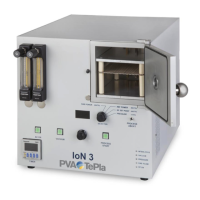

 To Next Page