Document No.: 1P0446-1 Rev. B, April 7, 2014
Section 6 - Theory of Operation
This chapter gives an overview of plasma and plasma processes. It outlines the basic requirements to
create a plasma and what variables are under operator control.
A gas plasma consists of a collection of ions, free radicals, and electrons produced when a gas is
transformed to a high energy, excited state by exposure to an energy source under the right physical
conditions. Natural plasma examples include lightning, fire, and the Aurora.
Plasma treatment is a process by which the surface of a material is modified in some way through the
actions of the dissociated molecular components of a gas. Because these components are in such a
high energy state, they are very chemically reactive and can easily affect changes to the surface of
materials. The changes that occur are complex and dependent on many variables including gas
chemistry, process pressure, and the surface chemistry of the material being processed. The process
occurs near ambient temperatures without employing toxic chemicals.
Surface activation processes work by altering the first several molecular layers of the bulk material
through incorporation of chemical functional groups that increase the surface energy of the material.
This leads to improvements in the adhesion and wetability of the treated material.
TYPICAL PLASMA PROCESS
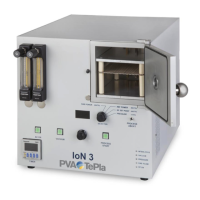
Plasma processing in the IoN 3 MHz is accomplished through the use of a low pressure, RF induced
gaseous discharge. The material or specimen is loaded into the reaction chamber. The chamber is
evacuated to a mild vacuum (.25 – 1 Torr) by a mechanical vacuum pump. A process gas is drawn
through the chamber over the specimen increasing the chamber pressure to between .25 -1 Torr,
depending on the application. RF power is applied to the chamber at a frequency of 13.56 MHz. This
excites the process gas atoms or molecules and dissociates them into chemically active species.
These species are very short lived and recombine to form the original gas molecules as soon as they
are carried out of the reaction chamber.
BASIC ELEMENTS OF PLASMA TREATMENT
These steps are flowcharted on the next page.
In order to develop and optimize a plasma process for a given material, the operator has the ability to
alter the following parameters:
x Process gas(es) selected for use.
x Flow rate/pressure of selected gas(es).
x Amount of RF energy applied to the vacuum chamber.
x Amount of time material is exposed to the plasma.
Process pressure, RF power, and treatment time are the primary factors that affect the intensity of
the treatment. For example, a high energy treatment would be run under conditions of relatively low
pressure, high power, and long treatment time. Conversely, a low energy treatment would be run
under conditions of relatively high pressure, low power, and a short treatment time. Since every
material has different treatment requirements and many factors need to be taken into account, it is
difficult to say what type of treatment will give the desired results.
A general rule would be that energetic processes are better for cleaning and etching applications;
more moderate processes are better for surface activation applications.


 To Next Page