- 3-
SAFETY INSTRUCTIONS FOR TILE SAW
READ THIS OWNER’S MANUAL COMPLETELY AND MAKE
SURE YOU UNDERSTAND ALL OF IT’S SAFETY GUIDELINES.
1. KEEP GUARDS IN PLACE and in working order.
2. REMOVE ADJUSTING KEYS AND WRENCHES. Form habit of checking to see that keys and adjusting
wrenches are removed from tool before turning it on.
3. KEEP WORK AREA CLEAN. Cluttered areas and benches invite accidents.
4. DON’T USE IN A DANGEROUS ENVIRONMENT. Don’t use power tools in damp or wet locations or expose
them to rain. Keep work area well lighted.
5. KEEP CHILDREN AWAY. All visitors should remain at a safe distance from work area.
6. MAKE WORKSHOP CHILD-PROOF with padlocks, master switches or by removing starter keys.
7.
USE RIGHT TOOL. Don’t force tool or attachment to do a job for which it was not designed.
8.
DON’T FOR
CE TOOL.
It has been designed to operate at maximum safety and per
formance levels.
9. WEAR PR
OPER APPAREL.
Do not wear loose clothing, neckties, rings, bracelets or other jewelr
y which may
get caught in moving par
ts. Non-slip foot wear is recommended. Wear protective hair covering if you have
long hair.
10. ALWAYS USE SAFETY GLASSES. Also use face or dust mask for commercial cutting operations. Everyday
eyeglasses only have impact-resistant lenses, they are NOT safety glasses.
11. SECURE WORK. Use clamps or a vise instead of your hand to hold work when practical. This safety
precaution allows for proper tool operation using both hands.
12. DON’T OVERREACH. Keep proper footing and balance at all times.
13. MAINTAIN TOOLS WITH CARE. Keep tools clean and in good working condition for maximum safety
performance. Follow instructions for lubricating and changing accessories.
14. DISCONNECT TOOLS BEFORE SERVICING – when changing
accessories, such as blades, bits, cutters, etc.
15. REDUCE THE RISK OF UNINTENTIONAL STARTING. Make sure switch is in OFF position before plugging in.
16.
USE RECOMMENDED ACCESSORIES. Consult the owner’s manual for recommended accessories. The use of
improper accessories may increase risk of injury.
17. NEVER STAND ON TOOL. Serious injury could occur if the tile saw is tipped or if the cutting tool is
unintentionally contacted.
18. CHECK DAMAGED PARTS. Before further use of the tool, damaged part(s), (i.e. guard) should be carefully
checked to determine that it will operate properly and perform its intended function. Check for alignment of
moving par
ts, binding of moving parts, breakage of parts, mounting and any other conditions that may
affect the saw’s operation. A guard or other part that is damaged should be pr
operly repaired
or replaced.
19.
DIRECTION OF FEED. Feed work into the blade against
the dir
ection of rotation of the blade only.
20. NEVER LEA
VE TOOL RUNNING UNATTENDED.
TURN POWER OFF
. Don’
t leave tool until it comes
to a complete stop.
21.
POSITIONING OF
TILE SA
W
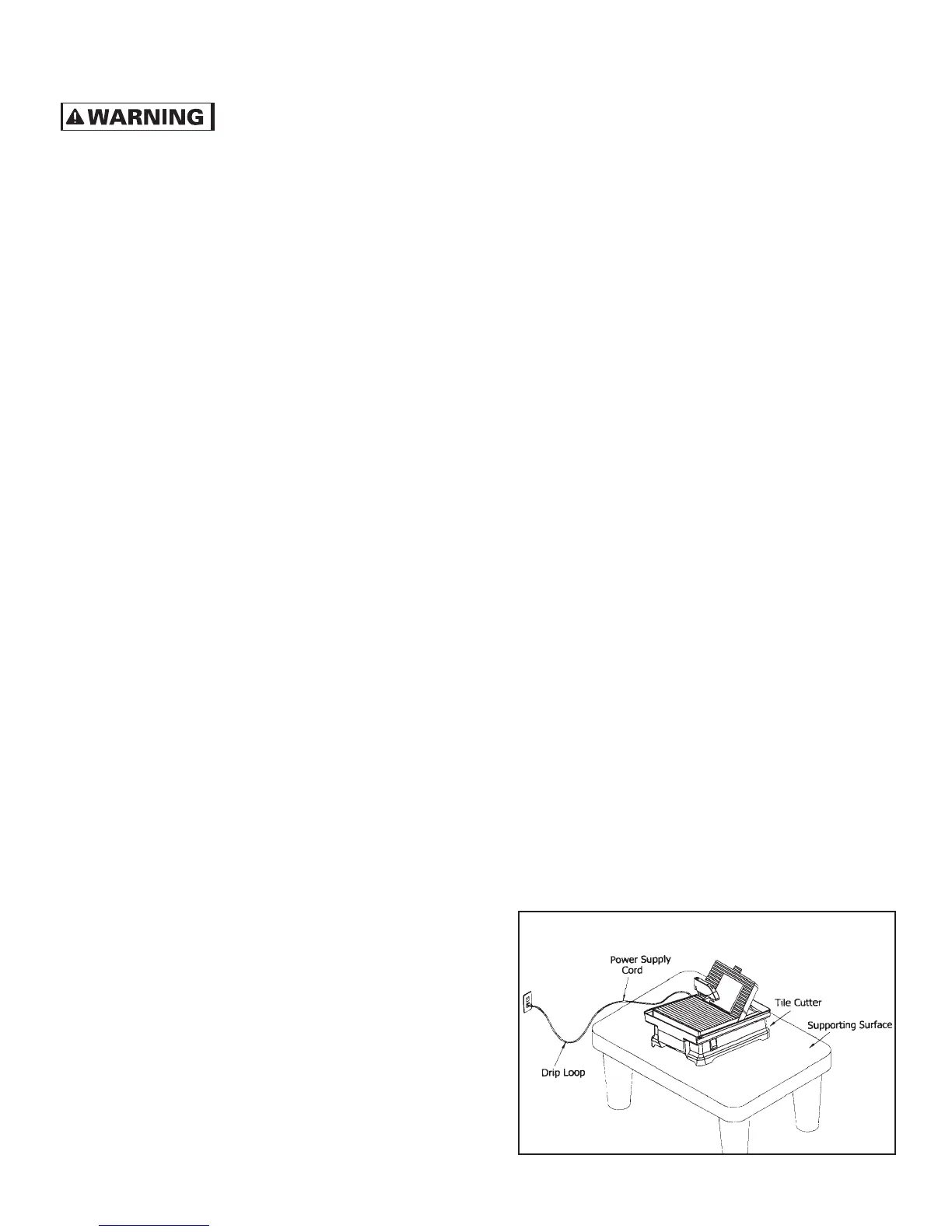
(See Illustration 1)
A.To avoid the possibility of the appliance plug or
r
eceptacle getting wet position the tile saw to one
side of a wall-mounted r
eceptacle to pr
event water
from dripping onto the receptacle or plug. The user
should ar
range a “drip loop” in the cor
d connecting
the saw to a r
eceptacle. The “drip loop” is that par
t
ILLUSTRATION 1


 To Next Page