Need help?
Do you have a question about the Quantum Data 701A and is the answer not in the manual?
The Quantum Data 700A Series Portable Video Test Generators are versatile devices designed for testing video displays and interfaces. These generators are capable of producing a variety of video formats and test patterns, making them suitable for a range of applications from manufacturing to field service.
The primary function of the 700A Series generators is to output video test signals to a display or device under test. They support a wide array of signal types including VESA (RGB component video), NTSC/PAL (composite color baseband video, separate luminance and chrominance, or RGB component video), HDTV/SDTV-RGB (luminance plus color difference signals or RGB component video), and HD/SDI (digital video signals, active on 701A only). This broad compatibility allows the generator to test various display technologies and standards.
The device features a comprehensive set of pre-defined video formats and test images (patterns). Users can select from these standard options to generate specific video outputs. For more specialized testing, the generator also supports user-defined formats, which can be created and stored in non-volatile memory.
Beyond video, the 700A Series can also generate stereo audio signals through a 3.5 mm phone jack, with the left channel producing a 1 KHz tone and the right channel a 2 KHz tone. The 701A model extends this by using the left channel as the monophonic audio source for modulated RF output.
Specialized tests include HDCP (High-bandwidth Digital Content Protection) interface testing, which allows the generator to output HDCP-encrypted video content to verify the functionality of DVI receivers that support HDCP. It also features a Pseudo Random Noise (PR Noise) pattern for testing cable and device integrity in systems that support the Quantum Data pseudo random noise standard.
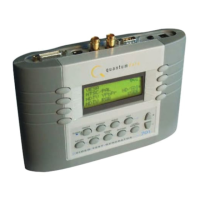
The generator is designed for portability and ease of use, featuring a clear LCD display and a set of function buttons for intuitive navigation.
User Interface: The LCD displays messages and menu options, with an asterisk indicating the active menu item. Function buttons are clearly labeled for common tasks:
Power Management: The generator can operate on AC power using the supplied adapter or on six AA rechargeable NiMH batteries. A "low battery" message indicates when batteries need recharging or replacement. A "Power Save" preference can be enabled to automatically turn off the generator after 30 minutes of inactivity when running on battery power, though this is ignored during burn-in test sequences.
Format and Image Selection: Users can easily select desired video formats and test images from dedicated menus. The "Signal Type" button filters formats based on their type, simplifying selection.
Test Sequences: The generator supports running pre-defined test sequences, which are series of format and image combinations. These sequences can be run manually, stepping through each combination, or in "Burn-In" mode for automatic, continuous cycling. The "DDC Step" mode allows for testing each format supported by a DDC-compliant display.
Horizontal Scanning Frequency Adjustment: The "Freq Shift" option under the "Test" menu allows for increasing or decreasing the horizontal scanning frequency of the current video format by +/- 10% in 2% increments, useful for fine-tuning display synchronization.
Video Generator Manager (VGM): This Windows-based application enhances the generator's capabilities by allowing users to create and edit custom video formats and test sequences on a computer. VGM connects to the generator via a null modem serial cable. It provides a graphical interface to manage the 132 format locations and one test sequence that can be stored in the generator.
The 700A Series includes features for calibration and firmware updates to ensure continued accuracy and functionality.
Calibration: The generators use programmable hardware for setting amplitude calibration factors for analog video outputs, stored in Flash EPROM. While Quantum Data calibrates new generators to published specifications, users can recalibrate these amplitudes to meet specific testing conditions. The calibration process involves using a DC voltmeter, oscilloscope, and vector scope to adjust RGB analog video and sync amplitudes, as well as NTSC peak white signal and chrominance. A hardware jumper (J10) inside the generator allows for enabling or disabling user recalibration, preventing accidental changes to calibration settings.
Firmware Updates: The generator's operating system firmware can be updated via the serial port using a computer and HyperTerminal. Firmware updates, available from Quantum Data's support website, can introduce new features, improve performance, or revise existing video formats. The update process involves connecting the generator to a PC, entering a specific mode, and transferring the firmware file. After an update, users may need to clear and reload formats if the update includes new or revised video formats.
 Horizontal Timing
| horizontal frequency | 1 KHz to 250 KHz |
|---|---|
| total pixels | 144 to 4096 |
| active range | 16 to 4096 pixels |
Vertical Timing| vertical frequency | 1 Hz to 650 Hz |
|---|---|
| active lines | 1 to 4096 |
| scan types | Progressive, 2:1 Interlace |
Video Outputs| timing accuracy | 2% |
|---|---|
| SDI/HD-SDI bit stream | 1.485 Gb/s and 1.485/1.001 Gb/s |
| signal swing | 800 mV |
Audio Outputs| connector | 3.5 mm stereo phone jack |
|---|---|
| left signal tone | 1 KHz |
| right signal tone | 2 KHz |
 Power
Power| battery type | Six AA 1500 mA-H rated rechargeable NiMH batteries |
|---|---|
| battery use time | 8 hours |
| AC input | 100-240 VAC @ 47-63 Hz |
Size and Weight| size | H 5.5 x W 8.25 x D 2 inches |
|---|---|
| metric size | H 140 x W 210 x D 51 mm |
| ship weight | 4 lbs |

 To Next Page