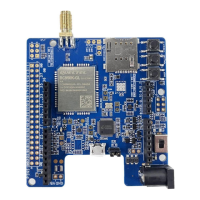
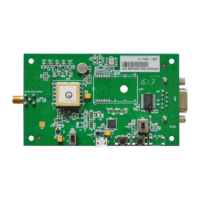
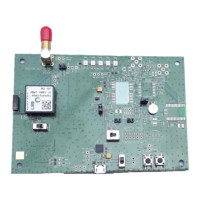
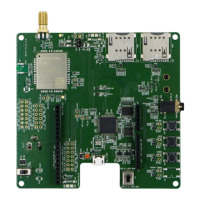
The Quectel BG95xA-GL & BG950S-GL TE-B is a Low-Power Wide-Area (LPWA) development board designed to assist engineers in developing applications and testing the basic functionalities of Quectel BG950A-GL, BG951A-GL, BG952A-GL, BG953A-GL, BG955A-GL, and BG950S-GL modules. This user guide specifically uses the BG950A-GL TE-B as a representative to introduce the BG95xA-GL and BG950S-GL TE-B series. The board facilitates communication with mobile network operator infrastructures through LPWA radio protocols in 3GPP Rel-13 and 3GPP Rel-14.
Function Description
The TE-B serves as a comprehensive tool for various development and testing scenarios. Its core function is to provide a platform for firmware upgrades, power consumption tests, and debugging applications built around the BG95xA-GL and BG950S-GL modules.
The board features multiple interfaces to support these functions:
- Power Supply Interfaces: It includes a DC Jack (J0201) for power adapter input and a USB (J0401) for USB power supply. An external power supply interface (J0202) is also available.
- USB-to-UART Interface (J0301): This interface is crucial for communication with a PC, enabling AT command communication, data transmission, firmware upgrades, software debugging, and log output. It is managed by a USB-to-UART bridge controller (U0301) and supports various UART channels depending on the module variant.
- For BG95xA-GL, it typically provides:
- Main UART for AT command communication and data transmission (default baud rate 115200 bps, 8N1 frame format, supports RTS/CTS flow control).
- Debug UART for RF calibration and SFP log output (default baud rate 921600 bps, 8N1 frame format, supports RTS/CTS flow control).
- DM UARTs for firmware upgrade, software debugging, DM log output, GNSS data, and NMEA sentence output (default baud rate 115200 bps, 8N1 frame format, supports RTS/CTS flow control).
- GNSS UART (only for BG951A-GL) for GNSS data, NMEA sentence output, and GNSS firmware upgrade (default baud rate 115200 bps).
- For BG950S-GL, it typically provides:
- Main UART for AT command communication and data transmission (default baud rate 115200 bps, 8N1 frame format, supports RTS/CTS flow control).
- DM UARTs for firmware upgrade, software debugging, RF calibration, log output, GNSS data, and NMEA sentence output (default baud rate 115200 bps, 8N1 frame format, supports RTS/CTS flow control).
- Antenna Interfaces: The board includes a Main Antenna Interface (J0501) for RF SMA connection and a GNSS Antenna Interface (J0502) for GNSS SMA connection.
- USIM/eSIM Support: A Micro SIM card connector (J0604) and an eSIM (U0601) are provided, supporting 1.8 V external USIM/eSIM cards.
- Control Buttons and Switches:
- PWRKEY Button (S0401): Used to turn the module on/off.
- RESET_N Button (S0402): Resets the module.
- PON_TRIG Switch (S0403): Allows entering/exiting e-l-DRX, sleep mode, PSM, or turning off the module, and enabling/disabling the main UART.
- GNSS_BOOT Button (S0404): Forces the module into download mode for BG951A-GL GNSS chip only.
- AUTO_POWER_ON Switch (S0405): Enables automatic power-on.
- Power Switch (S0201): Controls the power to the module.
- GNSS_EN Switch (S0101): Power switch specifically for the BG951A-GL module.
- Recovery Button (S0102): Forces the BB chip into download mode.
- Indicators:
- Power Indicator (D0403): Indicates the power up/down status.
- STATUS (D0404): Indicates the operation status.
- NETLIGHT (D0405): Indicates the network connection status.
- GPS_1PPS (D0406): Indicates GNSS pulses per second status.
- Voltage Regulators: The board incorporates a DC-DC converter (U0201) and LDOs (U0202, U0203) for 3.3 V and 1.8 V low dropout voltage linear regulation, respectively. Voltage-level translators (U0302-U0306) ensure proper signal levels.
Usage Features
The TE-B is designed for ease of use in a development environment.
- Standalone Operation: The board can be used independently for firmware upgrades, power consumption tests, and application debugging.
- Simple Setup: To begin, users need to install the USB-to-UART driver, insert a Micro-SIM card (NB-IoT or Cat M USIM depending on needs), connect the rod antenna to the main antenna connector (J0501), and switch the PON_TRIG Switch (S0403) to "HIGH."
- PC Connectivity: Connecting the J0301 (USB-to-UART interface) to a PC via a Micro-USB cable allows the PC's Device Manager to display serial port information, identifying the various UART channels for different functions (e.g., AT commands, debugging, firmware upgrade, GNSS data).
- Module Control: Physical buttons and switches provide direct control over the module's power, reset, and operational modes (e.g., e-l-DRX, sleep, PSM).
- Visual Status Feedback: LED indicators (Power, STATUS, NETLIGHT, GPS_1PPS) offer immediate visual feedback on the module's power, operational state, network connectivity, and GNSS activity.
- Comprehensive Documentation: The user guide provides detailed instructions and diagrams for component placement, functional diagrams, and wiring, ensuring developers can effectively utilize the board.
Maintenance Features
While the document primarily focuses on development and testing, some aspects touch upon maintenance and best practices:
- Thermal Dissipation: For normal and extended operating temperature ranges, the document emphasizes the importance of ensuring effective thermal dissipation. This may involve adding passive or active heat sinks, heat pipes, or vapor chambers to maintain the module's performance and comply with 3GPP specifications. This is a critical consideration for long-term reliability and performance, especially in demanding environments.
- Firmware Upgrades: The board supports firmware upgrades via the DM UART interface, allowing developers to keep the module's software up-to-date with the latest features and bug fixes. This is a key aspect of maintaining the module's functionality and security over its lifecycle.
- Power Consumption Testing: The guide includes a dedicated section on power consumption testing, outlining the necessary tools and procedures. This allows developers to optimize their applications for energy efficiency, which is crucial for LPWA devices. The modification of the TE-B by soldering wires to VBAT and GND pins of J0202 and using an external DC power analyzer (like Keysight's N6705C) enables precise measurement of the module's current consumption in different operation modes. This proactive testing helps in identifying and resolving power-related issues early in the development cycle.
- Troubleshooting: The availability of debug UARTs for RF calibration and SFP log output, along with DM UARTs for software debugging and log output, provides essential tools for diagnosing and resolving issues during development and post-deployment.
- Driver Updates: The recommendation to install the latest USB-to-UART driver from the provided link ensures stable and correct communication between the TE-B and the PC, which is a fundamental maintenance step for the development environment.
- Component Information: The detailed table of components and interfaces, including their RefDes and descriptions, aids in understanding the board's layout and facilitates any necessary hardware-level inspection or modification. For instance, the mention of Tantalum Capacitors (C0223, C0227, C0231) being used for front-end module energy storage provides insight into critical power path components.

 Need help?
 General


 To Next Page