16
engineeringengineering
JDV Mk3 Owner’s Manual
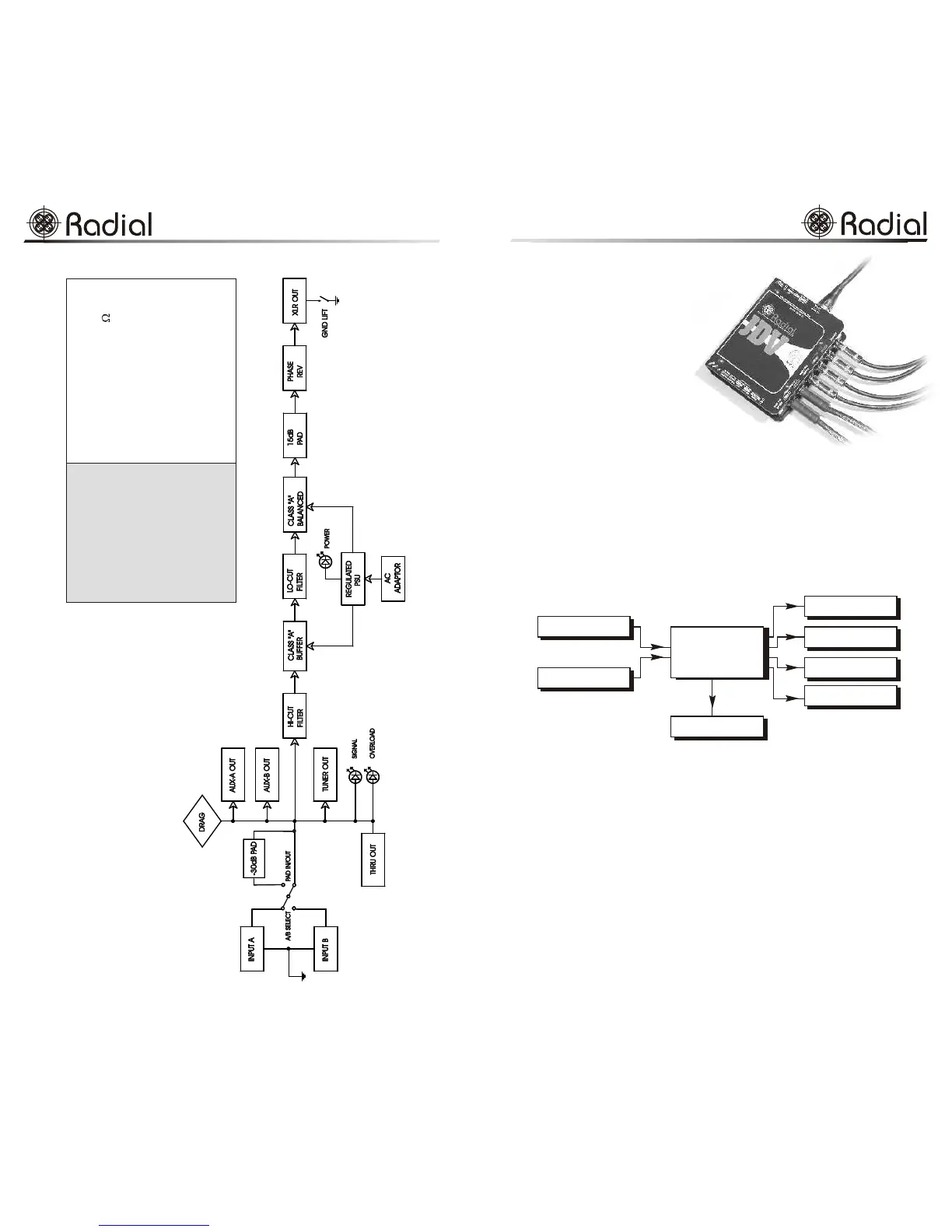
JDV Mk3 Block Diagram
JDV Mk3 Owner’s Manual
engineeringengineering
1
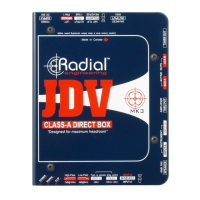
The Radial JDV Mk3 takes this concept to a completely new level by providing
the musician and engineer with greater flexibility than ever before and does so
without any signal degradation whatsoever. The concept is simple: We have
broken down the signal path into three zones:
(1) Instruments, (2) Musician’s setup, (3) Engineer’s setup.
Each ‘zone’ features expanded functionality: Dual inputs allow two instruments
to be selected without having to reconnect. By offering several instrument thru-
puts, the musician can now work inside his own 'creative world' giving him
greater freedom to create new sounds and inspired results. These include a
standard thru-put for a traditional amplifier, two unity-gain auxiliary outputs to
drive a stereo rig, an effect device or simply more amps. A designated tuner
output allows constant frequency monitoring while being outside the primary
audio signal chain. For the engineer, a standard balanced XLR output provides
the dry instrument signal to track.
One may ask: “This seems so easy and natural, I wonder why no one has ever
done this before?” Truth is that although it may look easy on paper, the challenge
is retaining the signal integrity without degradation. The JDV does this with
virtually zero harmonic distortion, phase distortion or inter-modulation distortion.
To make matters even more interesting, matching the buffered outputs to the
thru-put presents yet another challenge. But what is life without challenges?
INSTRUMENT 1
MIXER
TUNER
AUX OUT 2
AUX OUT 1
AMPLIFIER
RADIAL
JDV
INSTRUMENT 2
Radial JDV Mk3 Zoned Concept
Input zone
Engineer’s zone
Musician’s zone
Design Concept
If you think about it, a direct box is
actually a central distribution hub from
which the instrument signal is managed. Most
DI's simply offer an instrument input, a thru-put to
the musician's amplifier and then an output for the mixing
console.
JDV Mk3 DirectBox
JDV Mk3Specificatons
Frequency Response: 10Hz ~ 30kHz (+/-1dB)
Residual Noise: -93dB @ 1V-RMS
Distortion (20Hz ~ 20kHz): < 0.015% @ 1V-RMS (1.2k load)
< 0.5% @ 5V-RMS (without load)
Phase Deviation: < 5º @ 100Hz
Intermodulation Distortion: 0.07% (DIN standard)
Input Impedance: 10kOhms ~ 3.9mOhms
Output Impedance: 600 Ohms
Input Pad (speaker): -30dB
Output Pad: -15dB
Power requirement: Custom 30Volt supply


 To Next Page