The Magic Behind Great Sound
With the advent of 24bit/96kHz digital recording, expanding dynamic headroom
while lowering the noise floor has become the 'holy grail' of analogue circuit design.
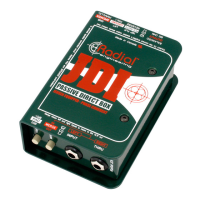
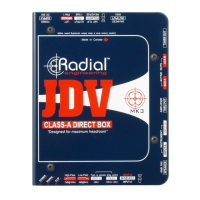
The Radial JDV begins with a true Class-A design for audiophile quality. Class-A
circuits are preferred over more common push-pull designs (Class A-B) as they
do not introduce harsh zero-cross distortion. Open the JDV and you will see big,
high-voltage discrete components. These are used because they simply sound
better! For example, larger capacitors are able to store more energy than smaller
ones. This means that the audio signal does not starve when pushed to the limits.
But that is not all. The Radial JDV Mk3 is actually a feed-forward design. This
means that unlike traditional circuits that use a feedback loop to stabilize the
signal path, the JDV circuit looks more like a tube design which by all accounts is
nuts! The result however is stunning! Run a square wave through the JDV and
you get perfectly sharp edges without overshoot or ringing.
To further enhance headroom, the JDV employs an unprecedented 30-volt internal
rail voltage for exceptional dynamic signal handling. High output signals are
handled with ease and since it is virtually impossible to overload the JDV, phase,
harmonic and inter-modulation distortions are virtually eliminated. One should
note that the Radial JDV is a unity gain device. This means that whatever you
put in you get out. In fact, the JDV has so much headroom the PAD is located at
the output so that it will not overload your mixer.
To elevate sound quality yet another notch, we have added Drag™ control; an
innovation that we developed while creating the popular Radial JD7 Injector that
essentially recreates the natural tone that is lost when driving buffered outputs to
several amplifiers (more on this later).
At the end of the day, what sets Radial products apart from all others is our
unyielding commitment to quality and our never ending quest to make our
products innovative, and musical.
Ultimately, the magic to great sound comes from the added care during the design
process, better quality parts and a full understanding of how musicians and
engineers work so that the most can be derived. We do everything we can to
make sure that what you put in, you get out.
Nothing added, nothing lost.
What Is a Direct Box Anyway?
Whether in live or studio conditions, connecting an instrument to a mixer requires
matching the high-impedance (high-Z ¼” guitar jack) of the instrument to a
balanced low-impedance (low-Z XLR jack) system. This is the primary task of
the direct box. Proper impedance matching will provide a wider frequency
response, improved dynamics and in most cases significantly less noise.
It is important to note that the output of the direct box is designed to work along-
side microphones. Once the instrument signal has been converted to a balanced
low-Z signal (think low resistance), it must drive long cables without appreciable
noise. Concert snake systems employ splitting transformers to bridge the signal to
several destinations such as the front of house (FOH) mixing console, the monitor
mixing console, and sometimes a broadcast or recording truck. These 'bridging'
transformers are designed to work at mic level. Since DI's need to work within
this same environment, the output signal is akin to a 600-Ohm mic level.
Thus the output of a direct box should be connected to a mic input such as found
on mixing consoles or mic preamps. The better the pre-amp, the better the results.
2
engineeringengineering
JDV Mk3 Owner’s Manual
Why is the speaker pad switch recessed and difficult to get to?
This is a think before action precaution. This is the most dangerous feature on
the JDV. If one connects a speaker output directly to the JDV without a load,
there is a good chance that they will blow the input. By making sure that getting
into this function is difficult, we figure that the user will be aware of what he is
doing and be less prone to make a mistake.
I am not getting much level. What could be wrong?
Check the recessed -30dB speaker pad switch. If this is pushed in, the input
level will be way down. This is usually the offender because it is hard to see.
Also, check the -15dB output pad to make sure it is not depressed.
I am getting too much level, can I use the line level input on my mixer?
Yes. The JDV, being a unity gain device, is able to produce line level output
signals if driven hard.
The sound seems a little muffled in the high-end?
If the Vary-Z is engaged and the Drag control is completely counter-clockwise,
the sound can be muffled as you are dropping the input impedance well below
normal. Also check to make sure the lo-pass filter is not on.
Can I use the Tuner out to drive another amp or effect device?
Yes but the quality of this output will be more along the lines of regular direct
boxes. The TUNER OUT signal is guitar level and is perfectly fine for effects and
having fun. Of course its primary function is to keep you tuned without
allowing the tuner circuit to get in the way of the sound.
15
JDV Mk3 Owner’s Manual
engineeringengineering


 To Next Page
 Loading...