scope of this manual, we recommend that users take the time to access the
wealth of information available on this subject on the web, at the library or by
consulting with recording engineers or collegues. The following are some
pointers to get you started.
Ground Loops
When connecting several pieces of equipment together, a common problem is
ground hum and noise caused by what is commonly known as ground loops.
These are usually caused by electrical phase inversions, by common-mode noise
or voltage differential between equipment.
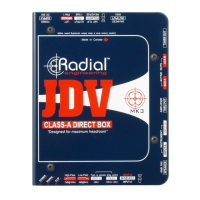
The JDV is equipped with a ground lift switch that lifts the ground connection
from the JDV to the mixer at the balanced XLR output. The JDV employs a
floating ground scheme and as such must be grounded at either the input or the
output.
For instance, if you are using the JDV with an acoustic guitar and connecting
directly to the mixer without using any of the ¼” output connectors, the ground
lift should be in the out position so that a safety ground to the mixer is
galvanized. If on the other hand you are using the ¼” outputs, the ground lift can
be 'lifted' (depress the switch) as the JDV will now be grounded in two places.
A common solution to reduce ground noise is to connect all of the audio
equipment to the same electrical phase. This is easiest accomplished by using a
power bar and a single power outlet. On large stages, touring professionals have
their own 'distros' or power distribution systems that are pre-configured to this
end. We suggest consulting an electrician and a trained audio technician should
you be in a position to rewire your studio.
Induced Noise
Electro-magnetic induction (EMI) is caused by the magnetic field from one
electrical circuit polluting the field of another. Every copper wire, be it low-level
signal or high power voltage, will emit a magnetic field. These wires are also
subject to induced noise from adjacent magnetic fields. The more power going
through the wire, the larger the electro-magnetic field. For instance, power cables
emit a large magnetic field while signal levels do not. In fact, signal level
conductors are either shielded or split into balanced twisted pair configurations as
a means to keep unwanted noise out. Good quality cable is important.
By keeping audio cables away from power cables, you will immediately reduce
the noise floor. If you must cross these, cross them at 90º if at all possible so that
the interaction of their magnetic fields is kept to a minimum.
The Radial JDV comes equipped with a separate DC supply. As commonly
known, power supplies emit magnetic fields, which in turn can cause noise in
audio systems. The advantage of an external supply is less noise inside the JDV's
metal shell. To further reduce magnetic induction, the JDV power supply should
be kept away from any signal carrying cables and equipment.
A Note About Safety and Shock Hazards
When connecting several pieces of equipment together, it is very important to
ensure that proper electrical wiring be maintained. This is most important when
using older equipment in older homes or venues where electrical safety standards
may not have been upgraded to today's standards. Before connecting equipment
together, always ensure all amplifiers or equipment being used are connected to a
proper electrical system and ensure that all equipment is grounded via the A/C
rd
cord’s 3 prong (U-ground). Failing to do so could cause severe damage to your
equipment and/or increased possibility of electric shock.
8
engineeringengineering
JDV Mk3 Owner’s Manual
Typical Setups
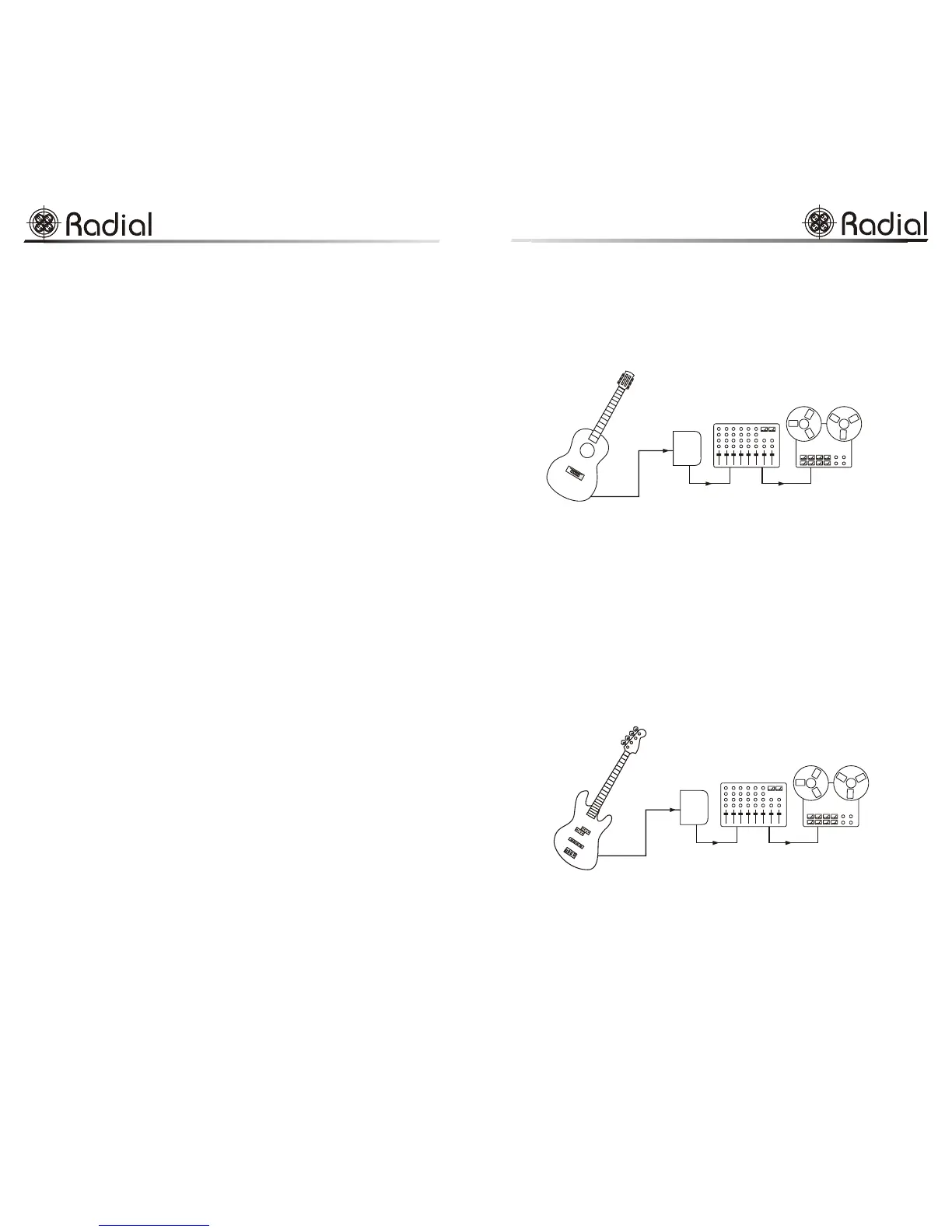
Acoustic guitar without amplifier
The direct connection is the most basic set-up, most often employed in live stage
or studio situations where the musician does not have his own amplifier, and
relies on monitors to hear their instrument.
In this set-up, the VARY-Z switch is normally in the OUT position, as active
instruments will not be affected. For acoustic guitars, we suggest depressing the
LO-CUT (High-Pass) filter switch. This gentle roll off will reduce acoustic
resonance and opportunity for low-frequency run-away feedback without
affecting the tone. The HI-CUT (Low-Pass) filter would only be engaged if the
instrument is generating exceptional high-frequency noise or hiss. The ground
switch should be in the OUT position to ensure proper safety grounding to the
mixer.
Electric guitar in the studio without amplifier
This same connection as shown above is used in the studio for direct recording
of basses and clean guitar tracks. The difference here being that the instrument
may be passive like a traditional Fender Precision Bass. As such, you may want
to engage the DRAG control to recreate the natural loading of the instrument.
Start by turning the DRAG fully clockwise and depress the VARY-Z switch to drop
the input impedance to 1 meg-Ohm. Now turn the control counter-clockwise
until the sound 'feels' right. This subtle effect will depend on the output level of
the pick-ups and creative decision making of the engineer. 12 o'clock is an
average single coil puck-up to a regular amplifier.
9
JDV Mk3 Owner’s Manual
engineeringengineering
JDV
Mk3
JDV
Mk3


 To Next Page
 Loading...