RD4000 Locating System User Manual
Page 38
FAULTFINDING
Using the A-frame to locate cable sheath faults (FaultFinding)
The A-frame is used to locate cable sheath faults on power and telecom cables. To use FaultFind you will need
the following equipment:
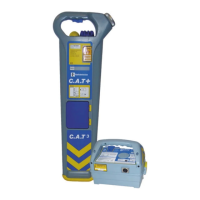
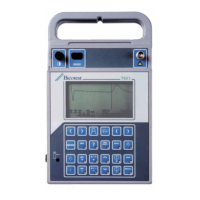
• RD4000Rx or RD4000MRx with FaultFind (FF) option
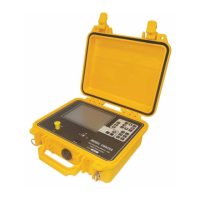
• RD4000T10 transmitter with FF option or RD4000T3F transmitter
• Accessory A-frame connection leads.
Green Red
Preparation
Using RD4000 standard locating techniques, locate the cable for a short distance and trace and mark its route.
Remove all earth bonds from the line to be traced during FaultFinding.
Connecting the transmitter
• Ensure the transmitter is switched off
• Push the connector plug into the transmitter accessory socket
• Clip the red connection lead to the cable or cable sheath ensuring that the area around the connection is clean
• Extend the black connection lead as far away as possible and at 90
0
to the probable route of the target cable
and clip the connector to the ground stake.
Note: Always connect the black connection lead to a ground stake and not a water pipe or buried cable, as
these may carry the signal.
Using the VΩ function to confirm a fault (RD4000T10 transmitter only)
If using the RD4000T10 transmitter, use the VΩ function to confirm the presence of a fault.
Before performing this procedure, REMOVE ALL EARTH BONDS from the cable.
• Connect the transmitter
• Switch the transmitter on and using the up and down arrows, scroll through the menu until ‘MEASURE’ is
displayed on the screen
• Press and hold the VΩ key to select ohms and take the resistance reading. A low resistance (typically less
than two Megohms) indicates a fault.






 To Next Page
