Reach PoE4N Tester Manual 1.4 08/09/2017 Page 5
2. General
2.1. Overview
Manufacturers of Ethernet Power Sourcing Equipment (PSE) such as Ethernet Switches
need to test PoE power functionality during manufacturing. Once a unit is in
manufacturing, it can be assumed that it has already been tested for full Compliance with
the applicable IEEE 802.3 PoE standard. It is not cost-effective, nor necessary, to
perform full compliance testing at the manufacturing stage. What is needed is a
functional test that verifies the software’s ability to detect and control power, and the
basic connectors’ and magnetics’ ability to provide power and pass data.
The Reach RT-PoE tester family has been designed for cost-effective functional
production test. It assumes that the PSE can be operated in a “diagnostic” mode whereby
the power control and detection functions of the PSE can be individually tested. The
LLDP protocol specified by the 802.3at standard is not supported so as to keep the cost of
the tester low. Most switches provide a way of bypassing LLDP to provide full power to
a particular port. LLDP is implemented in firmware: if the unit can pass data under power
it can pass LLDP packets, and so testing LLDP functionality is not necessary for a
production test.
The Reach Power-over-Ethernet Tester Model RT-PoE4N provides diagnostic functional
testing of 24 PSE ports compatible with IEEE Standards 802.3af and 802.3at. In addition
it can test high power ports such as UPoE that use all four pairs to provide power. It can
draw up to 660mA per power pair while passing gigabit traffic. It provides high density
with 24 Powered Device (PD) loads in a 1U high chassis.
Each RT-PoE4N port passes up to GbE speed traffic to the next port to facilitate data
traffic testing. That is, Port 1 data connects to Port 2, 3 to 4, and so on. This is useful
when the PSE has diagnostics to do port-to-port traffic testing, or when the PSE is set up
for port pair VLANs to force traffic through all ports. This contrasts with the RT-PoE3N
that has the data broken out to a separate REF port.
2.2. Front panel
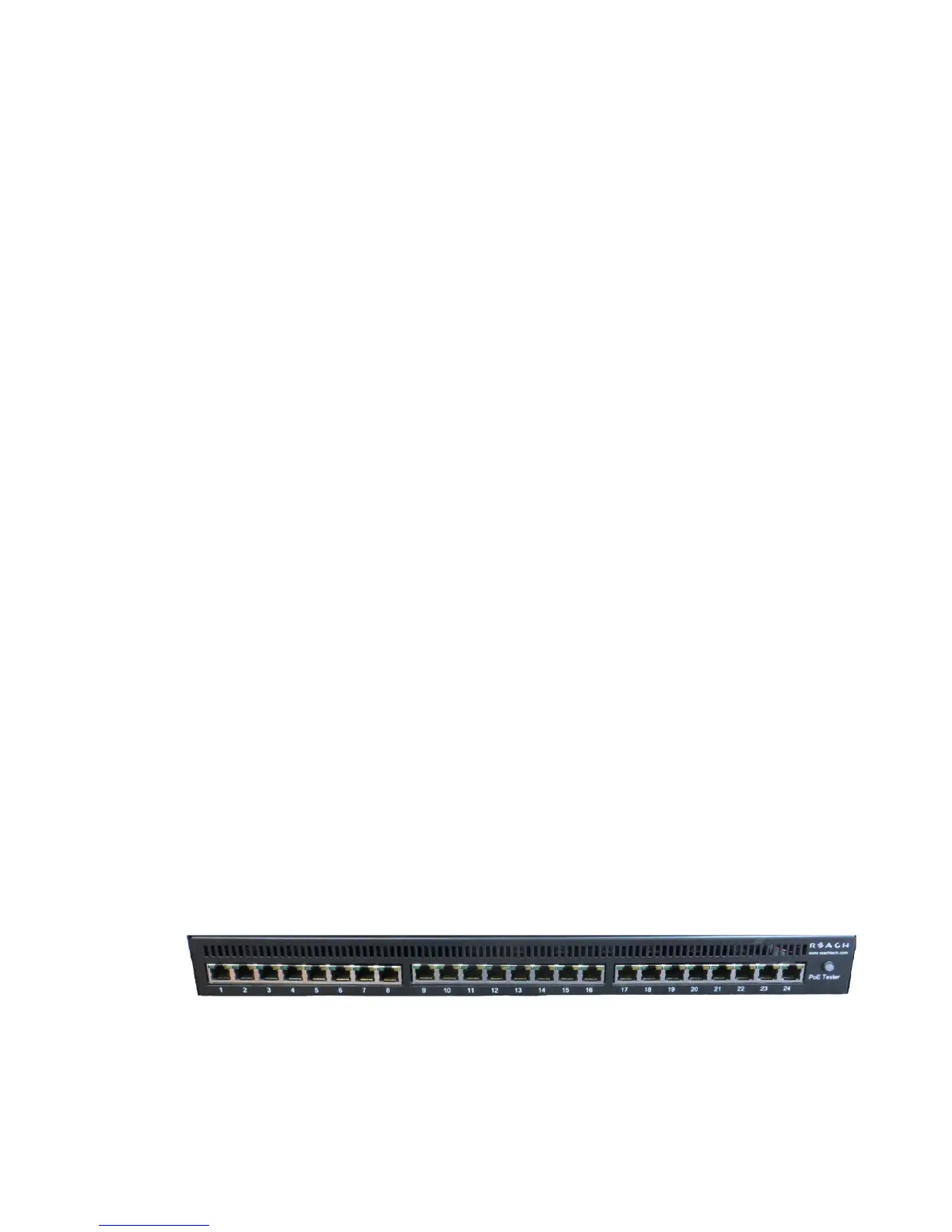
Picture 1: Front of RT-PoE4N


 To Next Page