8
Chapter 3
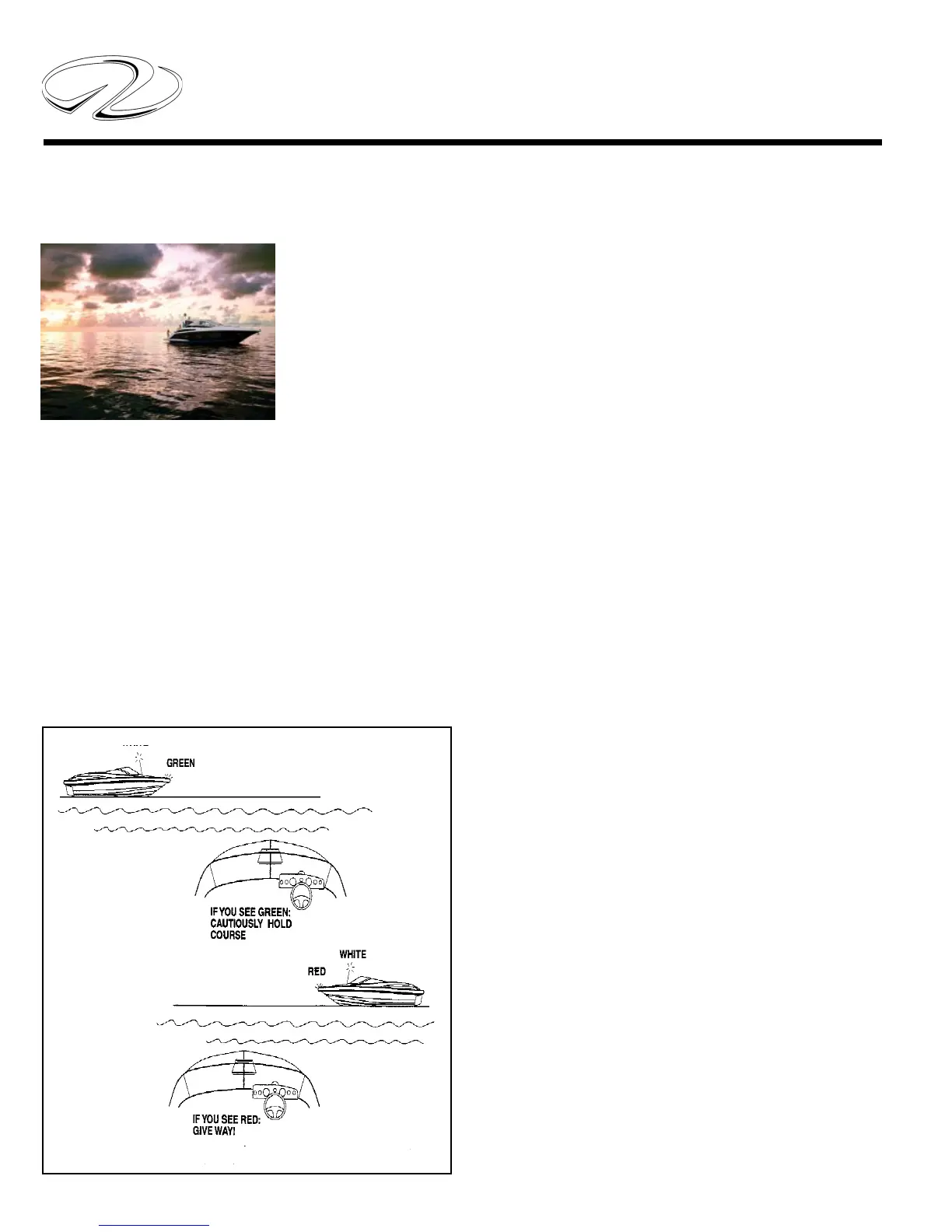
NIGHT RUNNING
Boats operating
between sunset and
sunrise ( hours vary by
state), or in conditions
of reduced visibility,
must use navigation
lights. Nighttime
operation, especially
during bad weather
and fog, can be dangerous. All Rules of the Road apply
at night, but it is best to slow down and stay clear of all
boats regardless of who has the right-of-way.
To see more easily at night, avoid bright lights when
possible. Also, it is helpful to have a passenger keep watch
for other boats, water hazards and navigational aids.
To determine the size, speed and direction of other vessels
at night, you should use the running lights. A green light
indicates starboard side, and a red light indicates port side.
Generally, if you see a green light, you have the right-of-
way. If you see a red light, give way to the other vessel.
BRIDGE CLEARANCE
Be aware that your vessel requires a specifi ed bridge
clearance height. This height is a measured estimate from
the waterline to the top of the highest equipment height.
The estimated height can change because of variances
in the loaded condition of the vessel. Consult the bridge
clearance specifi cations located in Chapter 12 (Technical
Information section).
Some bridges are tendered. Know and use the proper
bridge signals when approaching these bridges (see
bridge signals in this chapter). You can also monitor and
communicate on channel 13 of a VHF radio for bridge
information in most domestic locals. Other bridges are
marked with a clearance measurement and you are on your
own. It is recommended that you have a look out posted for
additional visual assistance when entering a bridge zone.
After determining your vessel will clear the bridge proceed
with caution at a safe idle speed. Keep your eye on vessel
traffi c at all times in order to react quickly. Keep both hands
on the helm since you may need to change course because
of current and wind conditions. Resume a safe speed once
clear of the bridge structure and acknowledgment of clear
visibility.
Just use common sense around any type of bridge
structure!
BRIDGE LIGHTING
Bridge lighting is maintained by the Department of
Homeland Security. On the following pages are 2 typical
examples of night-time bridge lighting. As the skipper
approaches bascule and fi xed bridges light position (arc of
visibility) and color will indicate the safe channel through
the bridge. Notice green denotes the “safe” entry location
on single-span bridges and green or white on multiple-
span bridges designates the main channel. In addition,
green denotes the “up” position for single and double lift
bridges.



 To Next Page