DRIVING ADVICE, ECO-DRIVING
3
Fuel consumption is accredited in
accordance with a standard regula-
tory method. Identical for all manu-
facturers, this enables vehicles to be
compared with one another.
Consumption in real time depends
on vehicle usage conditions, the
equipment fitted and the user’s dri-
ving style. To optimise fuel con-
sumption, please refer to the follow-
ing advice.
Depending on the vehicle, you have
different functions to help you re-
duce your fuel consumption:
– the rev counter;
– the gear change indicator.
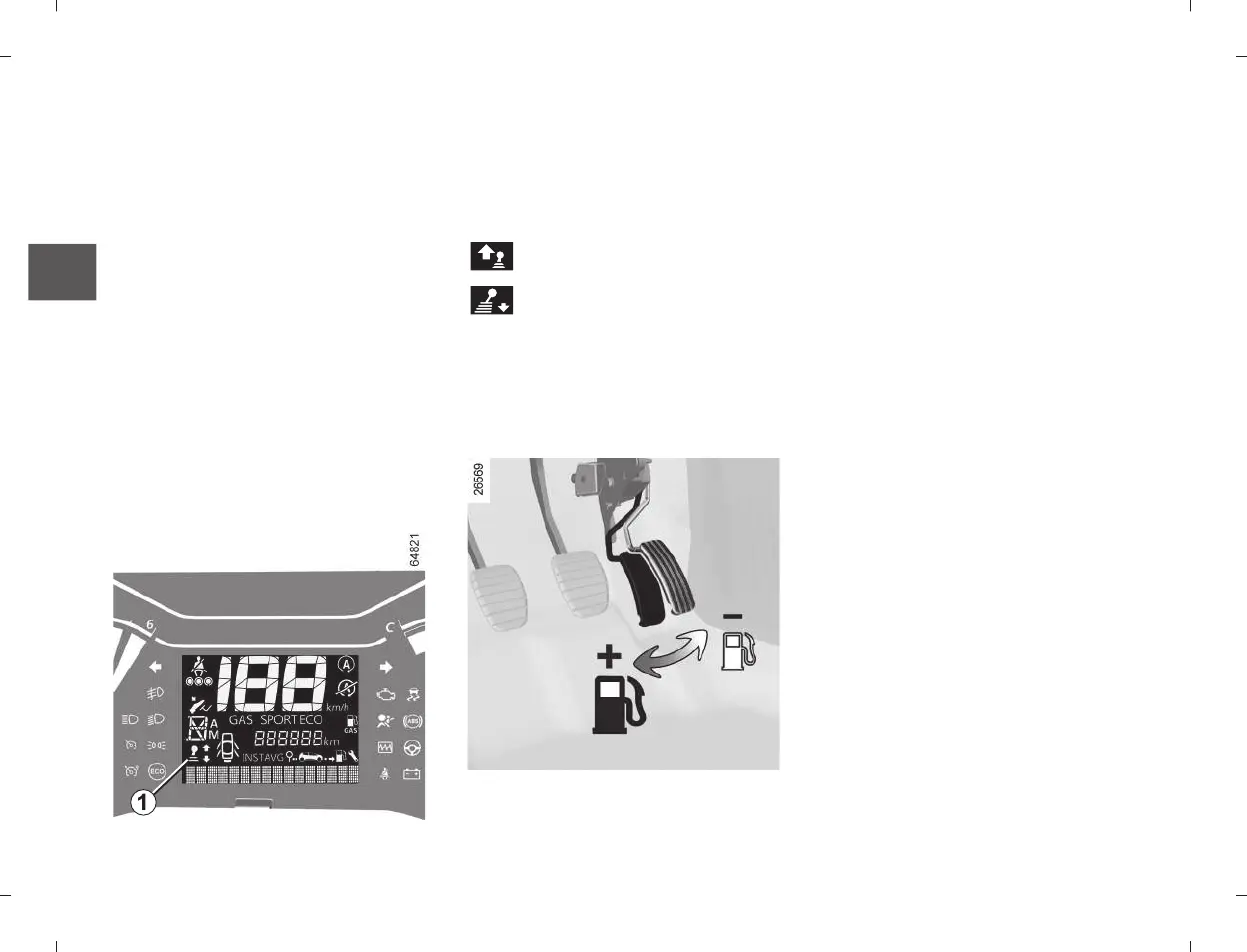
Gear change indicator 1
Depending on the vehicle, to obtain
optimum consumption levels, a
warning light on the instrument pan-
el lets you know the best time to
move up or down a gear:
shift up a gear;
downshift a gear.
If you regularly follow this indicator,
you will reduce your vehicle’s fuel
consumption.
Driving advice and ECO dri-
ving
Behaviour
Drive carefully for the first few
kilometres until the engine reach-
es its normal operating tempera-
ture, rather than let it warm up
while the vehicle is stationary;
–
High speeds significantly affect
the vehicle's fuel consumption;
Examples (at a steady speed):
–
reducing the speed from 130
km/h (80 mph) to 110 km/h (68
mph) approximately saves
up to 20% of fuel approxi-
mately;
–
reducing the speed from 90
km/h (56 mph) to 80 km/h (50
mph) approximately saves
up to 10% of fuel approxi-
mately.
–
Dynamic driving involving heavy
and frequent acceleration and
braking is expensive on fuel in
comparison to the time saved;
–
Do not overrev the engine in the
intermediate gears. You should
always use the highest gear pos-
sible;
–
Avoid sudden acceleration;
–
Brake as little as possible. If you
anticipate an obstacle or bend in
advance, you may then simply re-
lease the accelerator pedal;
–
Do not try to maintain the same
speed up a hill, accelerate no
more than you would on the level.
–
|
62 - Driving





 To Next Page