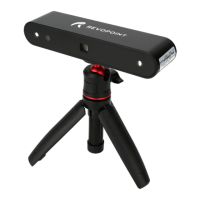
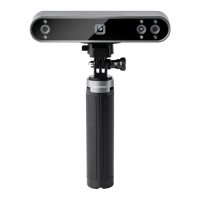
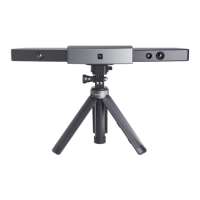
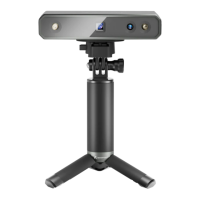
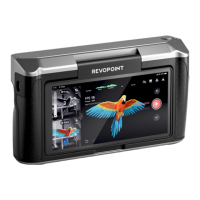
The Revopoint POP 2 3D Scanner is a versatile device designed for capturing three-dimensional models of objects. It integrates the functionalities of both handheld and desktop 3D scanners, leveraging advanced 3D camera hardware and a high-speed intelligent chip to deliver accurate depth information. The core technology relies on binocular vision and micro-structured light, combined with a proprietary micro projecting chip, to achieve high-accuracy 3D point cloud data, with precision up to 0.05mm.
Function Description
The primary function of the POP 2 3D Scanner is to create detailed 3D models of physical objects. It supports texture scanning, enabling the direct generation of vivid 3D models suitable for color 3D printing. The scanner is equipped with a high-performance 3D calculation chip, which, along with intelligent algorithms, ensures smooth scanning without performance degradation, even when used with standard computers.
The device offers various scanning modes to accommodate different object types and scanning environments:
- Feature Mode: Ideal for scanning objects with distinct shapes, such as sculptures or items with easily identifiable features. This mode relies on the unique geometric characteristics of the object for tracking.
- Marker Mode: Designed for objects with large, smooth, or regularly repeating features that might otherwise confuse the scanner's internal pattern recognition. In this mode, tracking markers are placed irregularly on or around the object. The scanner identifies the unique patterns formed by these markers to determine the relative location of each frame of point cloud data. For optimal results, at least six markers should be visible in each frame during scanning.
- Face Mode: Specifically configured for scanning human faces, with exposure and gain settings optimized for typical skin reflectivity.
- Head Mode: Extends face scanning to include hair (even dark hair) along with the face, adjusting exposure and gain accordingly.
- Body Mode: Suitable for scanning human bodies or larger objects from a greater distance than other modes, with appropriate exposure and gain settings.
- Dark Mode: Intended for scanning objects with darker surfaces, such as black or dark gray clothes or boxes. However, it's important to note that not all dark objects can be successfully scanned, especially those that absorb or reflect too much light (e.g., black leather shoes). Exposure and gain are set manually in this mode.
The scanner also supports different texture options:
- No Color: Captures only the shape information of the object, without color data.
- Colorful: Captures both color and shape information, allowing for the generation of full-color 3D models. These models can be exported in .PLY and .OBJ formats.
Usage Features
The POP 2 3D Scanner is designed for ease of use, with a straightforward workflow guided by the Revo Scan software.
Hardware Connection:
- Laptop Connection: The scanner connects to a PC via a USB 3.0+ port. It's crucial to use a USB 3.0 or higher port, as USB 2.0 may not provide sufficient operating current, leading to power resets and connection losses.
- Wireless Connection to a Smartphone: The scanner can connect wirelessly to smartphones (Android and iOS) via Wi-Fi in Host mode. The scanner provides its own Wi-Fi network (SSID: POP2-REVO-XXXXXXXX) with a default password (Revopoint3d). Users can customize the SSID and password through the Revo Scan software when connected to a PC.
Software Interface (Revo Scan):
The Revo Scan software provides a user-friendly interface with several key panels:
- Main Menu Panel: Offers access to Preview, New Scan, and Model List functions.
- Preview: Displays the scanner's current configuration.
- New Scan: Initiates a new scan project, allowing users to configure accuracy, scan mode, and texture settings.
- Model List: Manages stored scans, enabling operations on individual files or batch processing.
- System Settings: Allows users to specify language, data storage location, and enable hardware-accelerated rendering.
- About: Displays device and software version information, and provides options to configure Wi-Fi and report bugs.
- Status Bar: Shows the scanner's connection status, connection mode, and readiness.
Scanning Workflow:
- Device Connection Confirmation: Upon opening Revo Scan, the software confirms the device connection. A blue LED on the scanner's rear panel indicates a successful connection.
- New Scan Configuration: Users select the desired accuracy (Fast Scan or High Accuracy Scan), scan mode (Feature, Marker, Face, Head, Body, Dark), and texture option (No Color or Colorful).
- Distance Confirmation: The software provides real-time feedback on the scanning distance, guiding users to maintain an "Excellent" distance for optimal resolution and tracking. While "Too near" allows for higher resolution, it increases the risk of losing track.
- Brightness Adjustment: Users can adjust the brightness and gain for both the RGB camera and Depth camera. An "Auto" setting is available, but switching to "Manual" before data capture is recommended to prevent exposure variations and potential lockups.
- Start/Pause Scanning: The scan can be started or paused using a dedicated button. A countdown precedes the start of scanning.
- Tracking and Point Cloud Capture: During scanning, users are advised to move the scanner slowly and steadily, maintaining a relatively fixed distance. Scanned areas are displayed in blue. Scanning already blue areas is generally unnecessary and can consume memory/processing time.
- Complete/Restart Scanning: Users can stop the current project, choosing to complete the scan (fusing the point cloud) or delete the project to start over.
- Point Cloud Fusing: After scanning, the point cloud data is fused. Users can adjust the "Point Pitch" setting, which influences resolution and processing time. A smaller pitch results in higher resolution but longer processing.
- Meshing: The fused point cloud data is converted into a mesh model. Users can adjust "Mesh Quality" (higher quality means more detail but longer processing) and "Denoise" (smoother results, but may lose detail). The "Fill Hole" option can be used, though it may produce undesirable results for large holes.
- Texturing: For scans made with the "Colorful" option, texture can be applied to the mesh model, enhancing color and visual detail.
- Export: The completed 3D model can be exported in various formats, including .PLY, .OBJ, and .STL.
Operation Tips:
- Lose Track: If the scanner loses track (indicated by a "Lose Track" warning), users should re-target the cameras to a previously scanned (blue) area and hold still until tracking is re-acquired (red changes to green).
- Too Few Points: This warning suggests an incorrect distance between the scanner and the object. Users should adjust the distance until the "Excellent" indicator is highlighted.
- Detect Plane/Need More Feature: This prompt appears when scanning a plane or object with insufficient features for proper alignment. Solutions include:
- Stopping the scan, restarting, and selecting Marker mode with physical markers.
- Pausing the scan, using "Undo" to remove chaff, then stopping, completing, and exporting existing data before switching to Marker mode.
- Undo/Redo Scan: Allows users to revert or reapply scanned frames, useful for correcting alignment errors.
- Continue Scan:
- After Point Cloud Fusing: Users can continue scanning an object even after the initial point cloud data has been fused, useful for adding more frames or filling holes.
- Import a Model File: Existing 3D models with defects can be imported into Revo Scan, allowing users to continue scanning over them to fix imperfections.
- Batch Processing: Streamlines the workflow by applying the same processing settings (fusing, meshing, texturing) to multiple scanned models simultaneously. Users can choose between "Fast Speed," "High Accuracy," or "Custom" settings for processing.
- Keyboard Shortcuts: Pressing the "Space Bar" on a computer keyboard toggles between Start and Pause during scanning.
Maintenance Features
While the manual doesn't explicitly detail maintenance features, it provides crucial information for optimal device performance and longevity:
- Operating Temperature: The product's operating temperature range is 0°C to 40°C (32°F to 104°F). Operating outside this range is not recommended and can affect performance.
- Software Updates: Users are encouraged to visit the official website (www.revopoint3d.com) for the latest software and documents, including updates for Revo Scan, Revo Studio (post-processing), and Revo Calibration (parameter adjustment). Keeping the software updated ensures access to the latest features and bug fixes.
- Calibration: The mention of "Revo Calibration" software indicates that the device may require calibration to maintain accuracy. This software helps adjust POP 2's parameters for consistent, good results.
- Special Object Scanning: For transparent and highly reflective objects, the use of scanning spray powder is recommended. This is a practical tip for preparing objects to ensure successful data capture.
- Outdoor Scanning: When scanning outdoors, a cover is needed to avoid interference from intense light, which can impact the scanner's performance.
- Warranty: The manual includes a warning about a "Warranty Void If Seal Is Broken" label, emphasizing the importance of not damaging or removing it to maintain warranty coverage.
The Revopoint POP 2 3D Scanner is a comprehensive tool for 3D model creation, designed with flexibility and user-friendliness in mind, catering to both novice and experienced users through its intuitive software and diverse scanning capabilities.

 Need help?
 General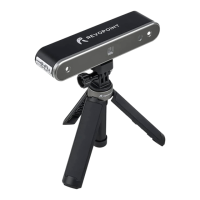

 To Next Page