REYMSA COOLING TOWERS, INC.
www.reymsa.com
The
All-Fiberglass
Cooling Towers
63
Operation
C.3.2 SCALE FORMATION
Scale is the most widely-known water-caused trouble. Indeed the term is so familiar that it is often
applied incorrectly to all solid accumulations in water systems. Scale is but a single type of fouling; others
being sedimentation, corrosion, slime, etc. A true scale forms by crystallization of a dissolved salt when its
concentration exceeds its solubility.
The most common formed scale consists of:
▪ Calcium Carbonate (lime scale)
▪ Calcium Sulfate and silica
▪ Algae growth, slime, and other micro-organisms
C.3.3 BIOLOGICAL GROWTH
Slime and algae in cooling systems are frequently spoken of and handled as though they were a single
word and single problem. Algae require sunlight for their growth, which can be prevented by reducing
the sunlight exposure. Minimizing the development of algae and bacterial slimes is important because
they reduce the heat transfer, decrease cooling water flow, localize corrosion, and serve as a mortar for
permitting rapid build-up of deposits consisting of an agglomeration of sediments, corrosion products, and
scale.
The aim in cooling water treatment is microbiological control to avoid significant slime or algae growth, not
the almost impossible goal of maintaining circulating water completely sterile. The many treatment chemicals
available for microbiological control in Cooling Towers include chlorine and other compounds which yield
available chlorine, some of these compounds have broad spectrum effectiveness and others are specific for
a more limited range of organisms
Periodic measurement of the overall bacterial population of the water is recommended to maintain a
biological control.
Finally, whenever flagrant microbiological growths develop, chemical or mechanical cleaning must be included
along with micro biocide treatment in any effective program for promptly re-establishing microbiological
control.
Cooling Tower must be cleaned periodically to prevent the growth of bacteria
including legionella pneumophica, to avoid the risk of sickness or death.
CAUTION
C.3.1 SUSPENDED SOLIDS
Sedimentation of solid materials occurs in the Tower basin, pipes and equipment as a product of corrosion,
mill scale particles, silt or fly ash scrubbed from air by the Cooling Tower. It is recommended that every
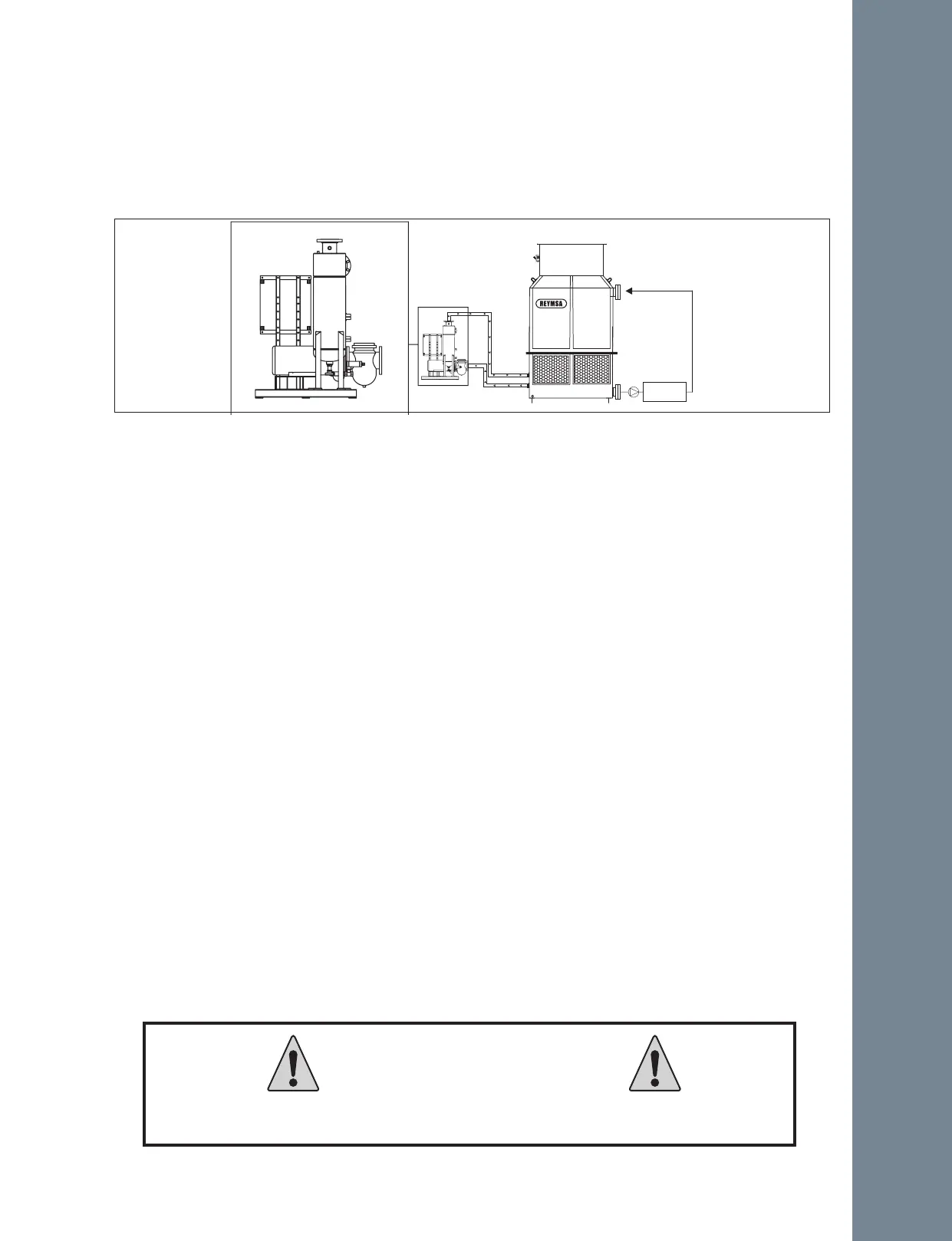
Cooling Tower is fitted with a solid separator. REYMSA offers a centrifugal separator as a design option for
suspended solids control (see Figure C-8).
Figure C-7: Filtration system
Pump
Pump
Centrifugal
Separator
Filter
Control Panel
From the System
To the
System
Process



 To Next Page