EasyManua.ls Logo

Rheem RA1460AJ1NA - User Manual

Rheem RA1460AJ1NA
48 pages
Print Icon
To Next Page IconTo Next Page
Loading...
AIR COOLED
CONDENSING UNITS
92-104921-09-07 (5/16)
Printed in USA
[ ] indicates metric conversions.
Do not destroy this manual.
Please read carefully
and keep in a safe place
for future reference by a
serviceman.
WARNING
THESE INSTRUCTIONS
ARE INTENDED AS AN AID
TO QUALIFIED, LICENSED
SERVICE PERSONNEL FOR
PROPER INSTALLATION,
ADJUSTMENT, AND
OPERATION OF THIS
UNIT. READ THESE
INSTRUCTIONS
THOROUGHLY
BEFORE ATTEMPTING
INSTALLATION OR
OPERATION. FAILURE
TO FOLLOW THESE
INSTRUCTIONS MAY
RESULT IN IMPROPER
INSTALLATION,
ADJUSTMENT, SERVICE,
OR MAINTENANCE
POSSIBLY RESULTING IN
FIRE, ELECTRICAL SHOCK,
PROPERTY DAMAGE,
PERSONAL INJURY, OR
DEATH.
INSTALLATION INSTRUCTIONS
(-)A13, (-)A14 & (-)A16 MODEL SERIES –
13, 14 & 16 SEER
WARNING:
RECOGNIZE THIS SYMBOL
AS AN INDICATION OF
IMPORTANT SAFETY
INFORMATION
ST-A1226-01-00
FEATURING INDUSTRY STANDARD
R-410A REFRIGERANT
earth friendly refrigerant
e
ar
t
h
r
y r
dly
dl
e
n
i
fr
h
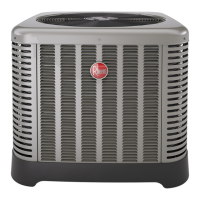
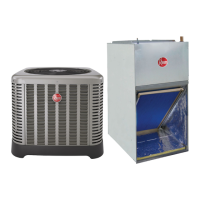
NOTE: Actual unit appearance
may vary.

Table of Contents

Questions and Answers

  • J
    Jennifer PetersenSep 23, 2025
    What causes a gurgling noise in my Rheem RA1460AJ1NA Air Conditioner's liquid line?
    • S
      Stephanie WilliamsSep 23, 2025
      If you hear a gurgling or pulsing noise at the expansion device or liquid line of your Rheem Air Conditioner, it's likely due to air or noncondensibles in the system. To resolve this, recover the refrigerant, evacuate the system, and then recharge it.
  • P
    Paul HarrisAug 23, 2025
    Why are the registers sweating in my Rheem RA1460AJ1NA Air Conditioner system?
    • D
      danielkellerAug 25, 2025
      If the registers in your Rheem Air Conditioner system are sweating, it's likely due to low indoor airflow. Try increasing the blower speed or reducing any restrictions in the airflow. Replacing the air filter can also help.
  • B
    beardjenniferAug 25, 2025
    How to troubleshoot a Rheem RA1460AJ1NA that will not run?
    • K
      kristinmosesAug 26, 2025
      If your Rheem Air Conditioner unit won't run, several factors could be the cause. It could be due to a power outage or loose electrical connection, so check the voltage at the line voltage connections. The thermostat might be out of calibration, so try resetting it. A blown fuse or tripped breaker can also prevent the unit from running, so replace the fuses or reset the breaker. Other potential issues include a defective transformer (check the wiring and replace if necessary), an open high-pressure control (reset it), an open low-pressure control, a defective control board (check diagnostic codes), or miswiring of communications (check communication wiring).
  • D
    deanna15Aug 27, 2025
    What to do if Rheem RA1460AJ1NA Air Conditioner compressor short cycles?
    • L
      Linda PayneAug 27, 2025
      If your Rheem Air Conditioner's compressor is short cycling, several factors could be responsible. First, check the voltage at the compressor terminals; it must be within ± 10% of the nameplate marking when the unit is operating. A defective overload protector could also be the cause, requiring replacement. Lastly, a refrigerant undercharge might be the issue, in which case you should add refrigerant.
  • M
    michellebennettAug 27, 2025
    What causes Rheem RA1460AJ1NA outdoor fan to run but compressor not?
    • F
      Frank CobbAug 27, 2025
      If the outdoor fan of your Rheem Air Conditioner is running but the compressor isn't, it could be due to several reasons. A defective run or start capacitor may be the cause, requiring replacement. The contactor could also be defective and need replacement. Check for correct voltage at the compressor and ensure all connections are tight, as a loose connection could be the problem. The compressor might be stuck, grounded, have an open motor winding, or an open internal overload; wait at least 3 hours for the overload to reset, and if it remains open, replace the compressor. A low-voltage condition could also be the cause, in which case you should add start kit components.
  • W
    webbcoreySep 16, 2025
    What does it mean when my Rheem RA1460AJ1NA has high head and low vapor pressures?
    • R
      ritataylorSep 16, 2025
      If your Rheem Air Conditioner has high head pressure but low vapor pressures, there might be a restriction in the liquid line, expansion device, or filter drier. Remove or replace the defective component. Another cause could be a bad TXV, which would need to be replaced.
  • S
    Sean MartinSep 13, 2025
    Why is the indoor coil of my Rheem Air Conditioner iced, with low vapor pressure?
    • N
      Natasha DelgadoSep 13, 2025
      If you notice low vapor pressure, a cool compressor, and an iced indoor coil in your Rheem Air Conditioner, it could be due to low indoor airflow. Try increasing the blower speed or reducing restrictions, and replace the air filter. If you're operating the unit below 65°F outdoors, consider adding a Low Ambient Kit. Moisture in the system can also cause this issue, so recover the refrigerant, evacuate, recharge, and add a filter drier. Finally, a closed ID circuit could be the problem, requiring repair or replacement of the ID coil.
  • K
    Karen RaymondSep 15, 2025
    What causes fluctuating head and vapor pressures in a Rheem RA1460AJ1NA Air Conditioner?
    • T
      Tara MckinneySep 15, 2025
      If your Rheem Air Conditioner is experiencing fluctuating head and vapor pressures, it could be due to TXV hunting. Check the TXV bulb clamp and air distribution on the coil; consider replacing the TXV. Another potential cause is air or noncondensibles in the system, which requires recovering the refrigerant, evacuating, and recharging.
  • K
    Kathryn NelsonSep 5, 2025
    Why do my Rheem RA1460AJ1NA registers sweat?
    • O
      Olivia SnyderSep 5, 2025
      Sweating registers in your Rheem Air Conditioner system are typically caused by low indoor airflow. To resolve this, increase the speed of the blower or reduce any restrictions. Also, replace the air filter.
  • T
    thunterSep 3, 2025
    What does low head and high vapor pressures mean for Rheem RA1460AJ1NA?
    • C
      Cody WilliamsSep 3, 2025
      Low head pressure coupled with high vapor pressures in your Rheem Air Conditioner can point to a bad TXV, which requires replacement. Another potential cause is a bad compressor, which would also need replacing.

Summary

IMPORTANT SAFETY INFORMATION

AWARNINGS

Key safety warnings for installation and operation.

ACAUTIONS

Important cautions regarding R-410A systems and installation practices.

Efficiency Testing Notice

Procedure for verifying energy efficiency ratings.

GENERAL INFORMATION

Application

Guidelines for selecting and surveying air conditioning equipment.

Checking Product Received

Steps for inspecting units for shipping damage and verifying components.

Electrical and Physical Data

Technical specifications including electrical and physical attributes.

UNIT MODEL NUMBER EXPLANATION

Breakdown of model number coding for unit identification.

DIMENSIONAL DATA

Table detailing unit dimensions for various models.

Specifications

Detailed technical specifications for unit performance and sizing.

Proper Installation

Critical steps for optimal performance and energy efficiency.

INSTALLATION

Choosing a Location

Guidance on selecting optimal outdoor unit placement for longevity and service.

Operational Issues

Considerations for unit placement affecting performance and maintenance.

Corrosive Environment

Protecting the unit from corrosive elements and environmental factors.

For Units With Space Limitations

Clearance requirements for units with space constraints.

Factory-Preferred Tie-Down Method for High Wind or Seismic Loads

Recommended methods for securing units against seismic or wind loads.

Customer Satisfaction Issues

Placement considerations to ensure homeowner comfort and noise reduction.

Unit Mounting

Instructions for securely mounting the outdoor unit.

Tools and Refrigerant

Required tools, refrigerant specifications, and safety precautions for R-410A.

Specifications of R-410 A

Properties and compatibility information for R-410A refrigerant.

Quick-Reference Guide For R-410 A

Key points for servicing R-410A systems.

Replacement Units

Guidelines for replacing existing line sets and filter driers.

Indoor Coil

Requirements for matching indoor coils with R-410A outdoor units.

Interconnecting Tubing

Practices for installing tubing between indoor and outdoor units.

Refrigerant Level Adjustment

Adjusting refrigerant charge based on line set length and configuration.

Interconnecting Tubing and Fitting Losses

Calculating equivalent length of tubing and fittings.

Liquid Line Selection

Determining the correct liquid line size for optimal performance.

Long Line Set Applications

Special considerations for long line set installations.

Oil Level Adjustments for Long Line Set Applications

Calculating and adding oil for long line set configurations.

Suction Line Selection

Importance of suction line sizing for oil return and system performance.

Refrigerant Migration During Off Cycle

Managing refrigerant migration to prevent issues during system off cycles.

Interconnecting Tubing (cont.)

Scenarios for long line sets with units on the same level or outdoor unit below.

Interconnecting Tubing (cont.)

Scenarios for long line sets with outdoor unit above indoor unit.

Interconnecting Tubing

Table for liquid line size and equivalent length calculations.

Interconnecting Tubing

Continuation of liquid line size and equivalent length tables.

Interconnecting Tubing

Continuation of liquid line size and equivalent length tables.

Interconnecting Tubing (cont.)

Table for vapor line selection and capacity multipliers.

Interconnecting Tubing (cont.)

Continuation of vapor line selection and capacity multiplier tables.

Interconnecting Tubing

Table for liquid line size and equivalent length calculations for (-)A14XXW.

Interconnecting Tubing (cont.)

Table for vapor line selection and capacity multipliers for (-)A14XXW.

Interconnecting Tubing (cont.)

Table for vapor line selection and capacity multipliers for (-)A16.

Tubing Installation

Guidelines for installing refrigerant tubing correctly.

Interconnecting Tubing (cont.)

Routing, support, and connection of refrigerant tubing.

Tubing Connections

Proper brazing techniques and materials for tubing connections.

Interconnecting Tubing (cont.)

Leak testing procedures using nitrogen and checking for leaks.

WIRING

Control Wiring

Instructions for low-voltage control wiring and thermostat connections.

FIELD WIRE SIZE FOR 24-VOLT THERMOSTAT CIRCUITS

Table for selecting appropriate wire gauge for thermostat circuits.

Typical Noncommunicating Thermostat Wiring Diagrams

Illustrative diagrams for common thermostat wiring configurations.

Power Wiring

Guidelines for connecting high-voltage power supply to the unit.

Grounding

Critical steps for properly grounding the unit for electrical safety.

START-UP

Start-Up

Procedures for initial start-up and post-shutdown periods.

Checking Airflow

Importance of verifying and balancing airflow for system performance.

Evacuation and Leak Testing

Procedures for system evacuation and final leak detection.

Evacuation Procedure

Detailed steps for evacuating air and moisture from the system.

Final Leak Testing

Methods for detecting leaks after evacuation using a halogen detector.

Checking Refrigerant Charge

Methods for verifying and adjusting refrigerant charge.

Confirm ID Airflow and Coils Are Clean

Ensuring proper indoor airflow and clean coils before charging.

Charging by Weight

Calculating and adding refrigerant charge by weight.

Gross Charging by Pressures

Procedure for initial system charge based on pressure readings.

Final Charge by Subcooling

Method for fine-tuning charge using subcooling measurements.

Finishing Up Installation

Final steps after charge adjustment, including sealing ports and thermostat setup.

COMPONENTS AND CONTROLS

Compressor Crankcase Heat (CCH)

When and how to install crankcase heaters for compressor protection.

High- and Low-Pressure Controls (HPC and LPC)

Function and operation of high and low-pressure safety controls.

ACCESSORIES

Time Delay Control

Function of time delay controls for compressor start-up protection.

Low Ambient Control (LAC)

How LAC maintains performance in low ambient temperatures.

Hard Start Components

Use of start components for difficult starting conditions.

DIAGNOSTICS

Electrical Checks Flowchart

Troubleshooting flowchart for electrical system issues.

Cooling Mechanical Checks Flowchart

Troubleshooting flowchart for cooling system mechanical issues.

General Troubleshooting Chart

Table of common symptoms, causes, and remedies for system problems.

Service Analyzer Charts

Charts for diagnosing compressor overheating issues.

Service Analyzer Charts

Charts for electrical issues, flooded starts, and compressor problems.

Service Analyzer Charts

Charts for contamination, loss of lubrication, and slugging issues.

Service Analyzer Charts

Charts for flooding and thermostatic expansion valve (TEV) issues.

Service Analyzer Charts

Continuation of TEV troubleshooting and valve regulation issues.

COOLING MODE TROUBLESHOOTING TIPS

Indicators for diagnosing cooling mode system problems.

WIRING DIAGRAMS

For Single-Phase Models

Wiring diagram for single-phase remote air conditioner units.

For Three-Phase Models

Wiring diagram for three-phase remote air conditioner units.

Rheem RA1460AJ1NA Specifications

General IconGeneral
RefrigerantR-410A
Compressor TypeScroll
Phase1
TypeAir Conditioner
Voltage208-230V
Energy Efficiency Ratio (EER)11.5

Related product manuals