Owner’s Manual
13
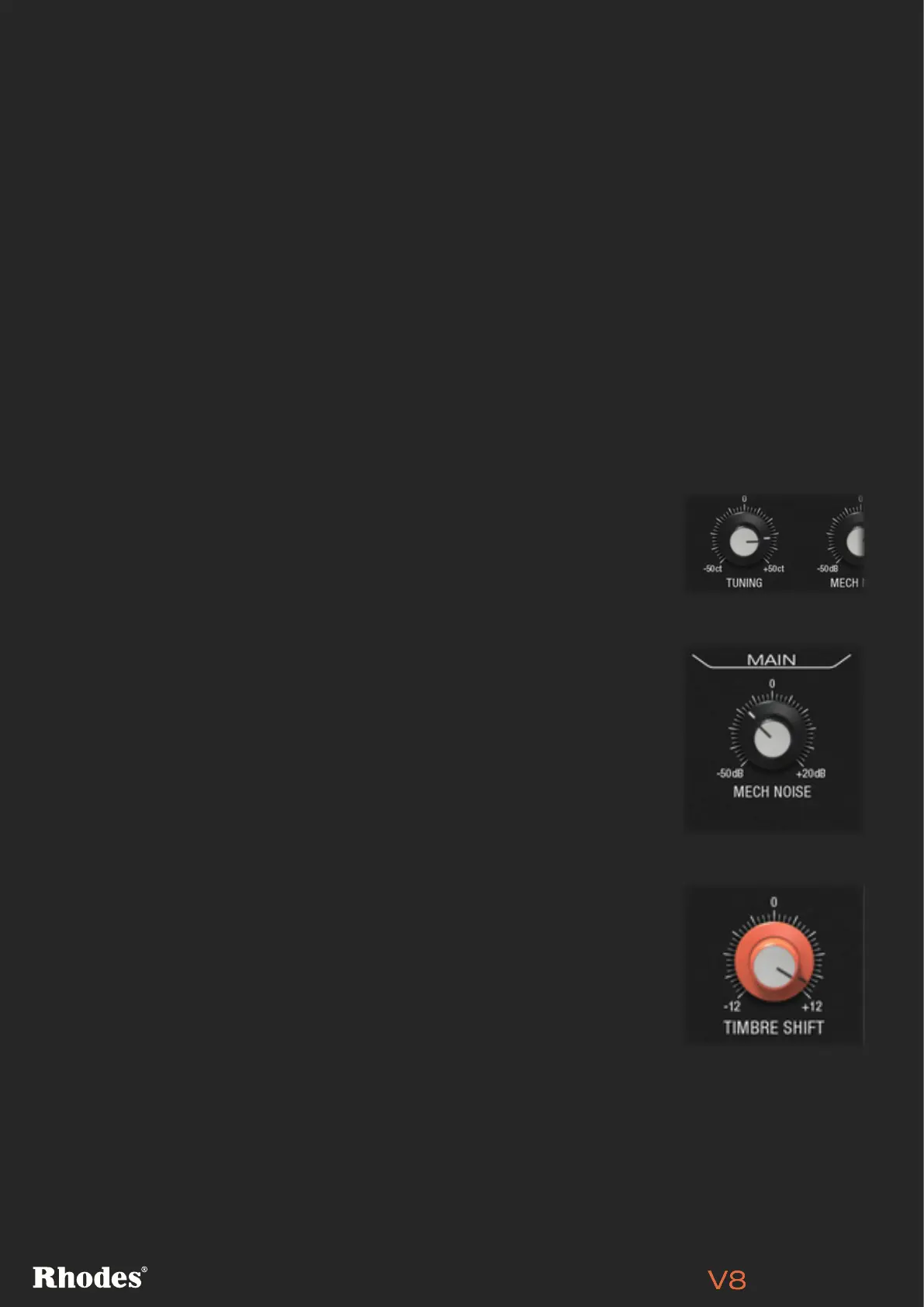
TUNING
The Tuning dial is the master tuning control for the V8. Turn it to the right and
every note goes up in pitch. Turn it to the left, and everything goes down in
pitch. This controls the tuning of the entire instrument, allowing it to be set up
to 50 cents sharp or flat.
DETAIL Page
More ways to customise the V8 sound lie in the DETAIL page, with global mechanical and electronic
controls, as well as further more detailed parameters for the front-panel effects, plus amp and cab
models to enhance the sound. Changes on the DETAIL page are saved as part of a Profile and
therefore as part of a Preset.
If we zoom in closer, the following parameters on the DETAIL page are saved as parts of a Profile:
Everything on the top row of parameters (except Tuning): Mech Noise, Timbre Shift, Profile EQ,
Velocity Curve/Depth and Pedal Level/Init Velocity. Everything on the bottom row of the DETAIL page
is saved as part of a Preset, including Pan Slew/Smooth, Compressor Threshold, Chorus Delay, Phase
and Spread, Phaser Resonance, Phase and Spread, Delay Ping-Pong, Jitter and Spread and finally, the
amp and mic models.
TIMBRE SHIFT
Acting in the same way as the SETUP page’s per-note Timbre sliders (but
globally instead of per-note), the orange Timbre Shift dial controls the angle
of the tine relative to the pickup AND the distance of the tine relative to the
pickup pole, increasing or reducing its harmonic content and perceived level.
At higher levels of Timbre Shift, the tine position is lower relative to the
pickup pole’s centre, bringing out more harmonics and animating the tone
more overall. At lower levels, the tine is raised higher above the pickup pole
centre and fewer harmonics are present in the resulting, ‘rounder’ sound.
The Timbre Shift control works closely in conjunction with the per-note
Timbre sliders on the SETUP page, so be sure to experiment with different
levels with both together to get a feel for the wide range of extended sonic
opportunities available.
MECHANICAL NOISE
The Rhodes MK8 is an electro-mechanical instrument, which generates
sound with keys and hammers that strike thin metal tines. Turning up the
mechanical noise dial introduces more of the sound of these actions, for a
more organic, textured feel.
Examples of these non-tonal sounds including cabinet resonance, hammers
hitting tines, damper release noise, pedal noise, and all other sounds from
inside the cabinet.


 To Next Page