EasyManua.ls Logo

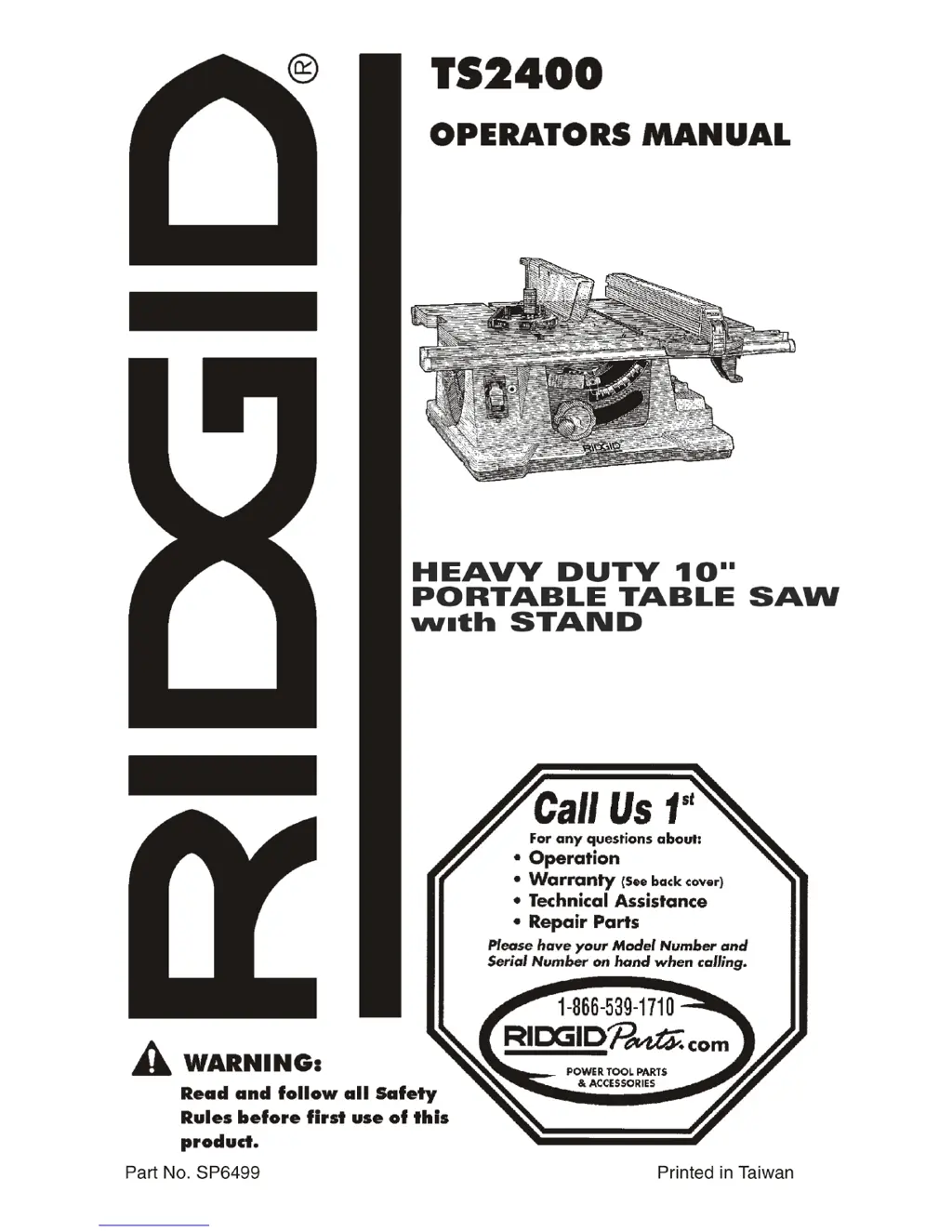
RIDGID Table Saw - User Manual

RIDGID Table Saw
68 pages
Print Icon
To Next Page IconTo Next Page
Loading...

Table of Contents

Questions and Answers

  • V
    victor41Aug 12, 2025
    Why does my RIDGID Table Saw keep tripping the circuit breaker?
    • K
      Kelly WoodAug 12, 2025
      If your RIDGID Saw experiences frequent opening of fuses or circuit breakers, it could be due to an overloaded motor. Try feeding the workpiece into the blade more slowly. Another cause might be that the fuses or circuit breakers do not have sufficient capacity. In this case, install proper size fuses or circuit breakers.
  • K
    Kimberly MejiaAug 16, 2025
    What to do if my RIDGID Table Saw motor stalls and blows fuses?
    • C
      Cynthia RobinsonAug 16, 2025
      If your RIDGID Saw motor stalls, resulting in blown fuses or tripped circuit breakers, it could be that the voltage is too low for the motor to reach operating speed. Request a voltage check from the power company. Another potential cause is that the fuses or circuit breakers do not have sufficient capacity; install proper size fuses or circuit breakers.
  • J
    Jamie MejiaAug 20, 2025
    Why is my RIDGID Table motor not developing full power?
    • K
      Kristina LopezAug 20, 2025
      If your RIDGID Saw motor fails to develop full power, ensure that the circuit isn't overloaded with lights, appliances, and other motors. Avoid using other appliances or motors on the same circuit while operating the saw. Also, check if the wiring circuit (extension cord) is too long or undersized. Increase wire sizes or reduce the circuit length. General overloading of power company facilities could also be the reason; request a voltage check from the power company. Finally, incorrect fuses or circuit breakers in the power line can cause this. Install correct fuses or circuit breakers.
  • O
    Oscar LopezAug 25, 2025
    What causes my RIDGID Saw motor to overheat?
    • B
      Bonnie ClarkAug 25, 2025
      If your RIDGID Saw motor overheats, it could be due to the motor being overloaded. Try feeding the workpiece into the blade more slowly. Another possible cause is improper cooling. Clean out sawdust to provide normal air circulation through the motor.
  • K
    Kenneth FryAug 27, 2025
    How to reduce vibration on my RIDGID Table Saw?
    • J
      Jacqueline GoodmanAug 27, 2025
      If your RIDGID Saw experiences excessive vibration, the blade may be out of balance or damaged. Replace the blade.
  • L
    laura69Aug 31, 2025
    Why does my RIDGID Table motor start slowly?
    • M
      Mary JonesAug 31, 2025
      If your RIDGID Saw motor starts slowly or fails to come up to full speed, low voltage could be the cause. Request a voltage check from the power company. Another cause could be windings burned out or open. Have the motor repaired or replaced.
  • K
    Kerri MirandaSep 3, 2025
    What to do if my RIDGID Table Saw cut binds when ripping?
    • D
      Donald BarnesSep 4, 2025
      If your RIDGID Saw cut binds, burns, or stalls the motor when ripping, the blade may be dull or have an improper tooth set. Sharpen or replace the blade. The blade could also be heeling. A warped board can also cause this issue; make sure the concave or hollow side is facing “down” and feed slowly. Another possibility is that the rip fence is not parallel to the blade. Finally, the spreader could be out of alignment.
  • C
    cesarcalderonSep 8, 2025
    Why does my RIDGID Table Saw motor spark and not start?
    • C
      Chelsea ShawSep 8, 2025
      If your RIDGID Saw motor runs intermittently, sparks excessively, or fails to start, the brushes may be worn or damaged. Replace the brushes.

Summary

Safety Instructions For Table Saw

Safety Signal Words and Pre-Use Checks

Defines safety terms (DANGER, WARNING) and essential pre-operation checks.

Preventing Kickbacks and Thrown Pieces

Critical safety measures to prevent injuries from jams, slips, or thrown workpieces.

Sawblade Spinning and Accidental Starting Safety

Precautions during operation and steps to prevent unintentional power-up.

Motor Specifications and Electrical Requirements

Getting to Know Your Table Saw

Alignment Procedures

Checking Table Insert and Sawblade Parallelism

Ensuring the table insert is flush and the sawblade is parallel to the miter groove.

Adjusting Blade Tilt Squareness (90° & 45°)

Verifying the accuracy of blade angles relative to the table.

Aligning Rip Fence and Sliding Table Extension

Ensuring the rip fence is parallel and the sliding table extension locks correctly.

Guard, Spreader, and Miter Gauge Alignment

Adjusting the blade guard, spreader, and miter gauge for optimal performance and safety.

Safety Instructions for Basic Saw Operations

Safe Cutting Techniques and Practices

Proper methods to avoid injury during cuts, including hand placement and feed rate.

Work Feed Devices

Basic Saw Operations

Maintaining Your Table Saw

Troubleshooting Guide

Saw Operation and Motor Issues

Solutions for common problems like vibration, binding, and motor malfunctions.

RIDGID Table Saw Specifications

General IconGeneral
Motor15 Amp
Voltage120 V
Max. RPM5000 RPM
Blade Diameter10 inches
Arbor Size5/8 inches
Dust Port Size2-1/2 inches
Table Size20 inches x 26 inches

Related product manuals