EasyManua.ls Logo

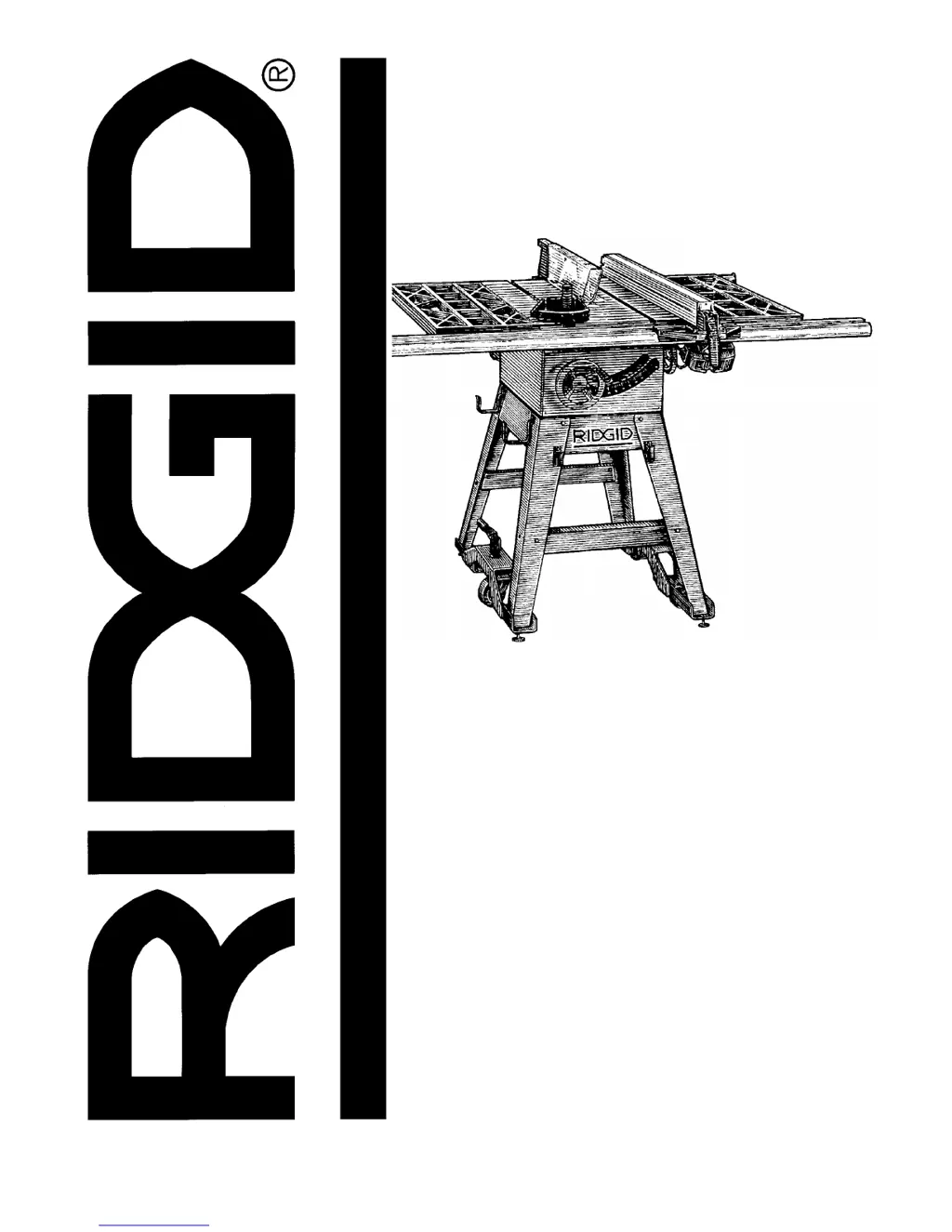
RIDGID TS2424 - User Manual

RIDGID TS2424
68 pages
Print Icon
To Next Page IconTo Next Page
Loading...
2:1(5·60$18$/
$VVHPEO\
2SHUDWLRQ
5HSDLU3DUWV
)RU<RXU6DIHW\
5HDGDOOLQVWUXFWLRQVFDUHIXOO\
48(67,21625&200(176"
&$//5,'*,'
Part No. SP6127 Printed in U.S.A.
,1&+&2175$&725
6(5,(6%(/7'5,9(6$ :
76 

Table of Contents

Questions and Answers

  • J
    Janet ReeseAug 16, 2025
    How to adjust my RIDGID TS2424 for accurate 90° and 45° cuts?
    • O
      Olivia WillisAug 16, 2025
      If your RIDGID Saw cut is not true at 90° or 45° positions, the stop collars may not be properly adjusted. See the “Adjustment” section, “Blade Tilt, or squareness of blade to table”.
  • O
    osmithAug 19, 2025
    Why does my RIDGID TS2424 Saw motor overheat?
    • F
      fernando19Aug 19, 2025
      If the RIDGID Saw motor overheats, it could be due to overloading. Try feeding the material into the blade more slowly. Another reason could be improper cooling. Clean out any sawdust to allow for normal air circulation through the motor. See “Maintenance” and “Lubrication” section.
  • A
    Andrew OrtizAug 22, 2025
    What to do if my RIDGID TS2424 motor stalls and trips the circuit breaker?
    • C
      clarktammyAug 22, 2025
      If your RIDGID Saw motor stalls, resulting in blown fuses or tripped circuit breakers, the starting switch may not be operating. Have the switch replaced. Also, the voltage may be too low for the motor to reach operating speed, so request a voltage check from the power company. Insufficient capacity of fuses or circuit breakers can also cause this issue; install the proper size fuses or circuit breakers.
  • C
    Carolyn MillerAug 25, 2025
    Why does my RIDGID TS2424 keep tripping the circuit breaker?
    • A
      Amy FitzgeraldAug 26, 2025
      If the RIDGID Saw experiences frequent opening of fuses or circuit breakers, the motor may be overloaded. Try feeding the material into the blade more slowly. Also, check if the fuses or circuit breakers have sufficient capacity and install the proper size if needed. A faulty starting switch can also cause this; have it replaced.
  • S
    Stacey CantrellAug 28, 2025
    Why RIDGID Saw motor fails to develop full power?
    • J
      Joshua ShepardAug 28, 2025
      If the RIDGID Saw motor fails to develop full power, it might be due to an overloaded circuit. Avoid using other appliances or motors on the same circuit while using the saw. Undersized wires or a circuit that is too long can also cause this; increase wire sizes or reduce the wiring length. General overloading of power company facilities can also be a factor; request a voltage check from the power company. Finally, incorrect fuses or circuit breakers in the power line can be the cause; install the correct ones.
  • T
    Timothy MurphyAug 31, 2025
    What to do if the starting switch in my RIDGID TS2424 motor won't operate?
    • C
      Charles GarciaAug 31, 2025
      If the starting switch in your RIDGID Saw motor will not operate, burned switch contacts (due to extended hold-in periods caused by low line voltage, etc.) may be the cause. Have the switch replaced and request a voltage check from the power company. If equipped, a shorted capacitor could be the problem; have it tested and replaced if defective. Loose or broken connections can also prevent operation; have the wiring checked and repaired.
  • K
    kimberly21Sep 3, 2025
    Why does my RIDGID TS2424 Saw motor start slowly?
    • D
      Dr. Erica Evans MDSep 3, 2025
      If your RIDGID Saw motor starts slowly or fails to come up to full speed, low voltage may be the cause. Request a voltage check from the power company. Another possibility is burned out or open windings, in which case you should have the motor repaired or replaced. A faulty starting switch could also be the issue; have the switch replaced.
  • P
    Pamela BrownSep 6, 2025
    How to reduce excessive vibration on my RIDGID Saw?
    • E
      Ethan DunnSep 6, 2025
      If you experience excessive vibration with your RIDGID Saw, the blade may be out of balance. Discard the blade and use a different one.
  • J
    Joseph HansenSep 9, 2025
    What to do if my RIDGID TS2424 Saw cut binds when ripping?
    • A
      Ashley GuzmanSep 9, 2025
      If the cut binds, burns, or stalls the motor when ripping with your RIDGID Saw, the blade may be dull or have an improper tooth set. Sharpen or replace the blade. Blade heeling could also be the issue; see the “Adjustments” section, “Heeling Adjustment”. A warped, cupped, or twisted board can also cause this; consider cutting from the other side or using a jig or fixture to make it stable. If the rip fence is not parallel to the blade, see the “Assembly” section, “Aligning Rip Fence.” Finally, the spreader may be out of alignment; see the “Assembly” section, “Installing Blade Guard.”
  • R
    Ryan McclainSep 12, 2025
    Why is the tilt and elevating hand-wheel on my RIDGID TS2424 Saw hard to turn?
    • R
      Rachel GreenSep 12, 2025
      If the tilt and elevating hand-wheel on your RIDGID Saw turn hard, it could be due to sawdust on the threads of the tilt screw or elevating screw. See the “Maintenance” and “Lubrication” sections. Another cause could be bearing retainers that are too tight. See the “Assembly” section, “Checking Tilt Mechanism.”

Summary

Safety Instructions For Table Saw

Safety Signal Words

Defines DANGER, WARNING, CAUTION signal words for safety.

Before Using The Saw

Steps to take before operating the saw for safety.

Kickback and Throwback Prevention

Instructions to prevent kickbacks and material ejection.

Personal Protection (Eyes, Hands, Ears)

Precautions for personal protection, including eye and ear protection.

Sawblade Spinning Precautions

Safety advice when the saw blade is in motion.

Before Each Use Inspection

Inspecting the saw before each operation for safety.

Work Area and Cut Planning

Steps for planning cuts and workpieces to ensure safety.

Safe Dress and Operation Practices

Guidelines for appropriate clothing and personal safety equipment.

Preventing Accidental Starts and Jams

Precautions to prevent accidental starts and clear jams.

Safe Workpiece Feeding

Safe methods for feeding workpieces through the saw.

Post-Operation Safety

Actions to take when finishing operation and leaving the saw.

Rip Type Cut Safety

Specific safety advice for rip cuts.

Crosscut Type Cut Safety

Specific safety advice for crosscut cuts.

Motor Specifications and Electrical Requirements

Power Supply and Motor Details

Details on voltage, amperage, and H.P. for the saw's motor.

Electrical Connection Safety

Safety precautions for electrical connections and grounding.

Unpacking and Checking Contents

Critical Initial Safety Warnings

Critical safety advice before assembly and powering on.

Assembling Leg Stand

Assembling Universal Caster System

Assembling Universal Caster System (continued)

Assembling Universal Caster System To Saw

Leveling Feet Adjustment

Assembling Table Extensions

Table Extension Installation Safety

Safety importance of installing table extensions for fence support.

Checking Heeling Adjustment or Parallelism of Sawblade to Miter Gauge Groove

Blade Parallelism Warnings

Warnings about consequences of misaligned blades (binding, kickback).

Checking Blade Parallelism Procedure

Step-by-step guide to check blade parallelism to the miter gauge groove.

Reaching Under Table Safety

Safety warning about contacting sawblade teeth while reaching under the table.

Checking Blade Tilt, or Squareness of Blade to Table

Blade Tilt Safety Warning

Safety warning before checking blade tilt.

Checking 90° Squareness

Procedure to check if the blade is square to the table at 90 degrees.

Checking Blade Tilt, or Squareness of Blade to Table (continued)

Adjusting 90° Blade Squareness

How to adjust the 90° stop screw for blade squareness.

Checking 45° Blade Alignment

Procedure to check blade alignment at a 45° angle.

Assembly (continued)

Assembly (continued)

Adjusting Rip Fence Guide Bars

Procedure for adjusting rip fence guide bars using shims and alignment.

Assembly (continued)

Getting to Know Your Table Saw

Control Operation Safety Warnings

Crucial safety advice for operating saw controls.

Safety Instructions for Basic Saw Operations

Kickback and Ejection Prevention

Guidance on preventing kickbacks and material ejection.

Safety Instructions for Basic Saw Operations (continued)

Personal Safety and Operation

Covers dress, blade operation, preventing accidental starts, and post-operation.

Basic Saw Operations (continued)

Carbide Tipped Blades Safety

Warnings and instructions for using carbide tipped blades.

Adjustments

Maintaining Your Table Saw

Maintenance Precautions

General safety and maintenance advice for the saw.

Troubleshooting

General Troubleshooting Guide

Common problems, probable causes, and remedies for the table saw.

Troubleshooting (continued)

Motor Troubleshooting

Troubleshooting motor issues like noise, power, speed, and overheating.

RIDGID TS2424 Specifications

General IconGeneral
Motor15 Amp
Voltage120 V
Bevel Capacity0 - 45 degrees
Blade Diameter10 inches
Arbor Size5/8 inches
Maximum Cut Depth at 45 Degrees2-1/2 inches
Dust Collection2-1/2 in Dust Port

Related product manuals